

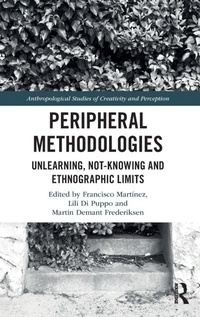
Peripheral Methodologies
Unlearning, Not-knowing and Ethnographic Limits
1st Edition
Published on 28. April 2021
Book
Hardback
184 pages
978-1-350-17307-1 (ISBN)
Description
How does peripherality challenge methodology and theory-making? This book examines how the peripheral can be incorporated into ethnographic research, and reflects on what it means to be on the periphery - ontologically and epistemologically. Starting from the premise that clarity and fixity as ideals of modernity prevent us from approaching that which cannot be easily captured and framed into scientific boundaries, the book argues for remaining on the boundary between the known and the unknown in order to surpass this ethnographic limit. Peripheral Methodologies shows that peripherality is not only to be seen as a marginal condition, but rather as a form of theory-making and practice that incorporates reflexivity and experimentation. Instead of domesticating the peripheral, the authors engage in (and insist on) practicing expertise in reverse, unlearning their tools in order to integrate the empirical and analytical otherwise.
Reviews / Votes
'In a time when positivist pretensions seek to present qualitative work as predictable and controllable, the great asset of this stimulating volume is how it embraces the unknown. Ethnographers almost naturally enter their field peripherally. Always coming from elsewhere, strangers in language and everyday habits, their strengths reside in their potential to keenly observe and, in painstakingly learning, to lay open what is but tacitly present: the multitude of practices that are at the heart of the human condition.'- Regina F. Bendix, University of Goettingen, Germany
'Through sometimes tricky and often tense ethnographic chapters, the book helps to deepen and enliven debate on how to decenter customary epistemological, methodological and institutional practices, habits that have run their course, yet continue to resist unlearning. In these messy times, such efforts to cultivate attention are more necessary than ever, and I applaud the book's ambition to pursue just that.'
- Eeva Berglund, Aalto University, Finland
More details
Series
Language
English
Place of publication
London
United Kingdom
Publishing group
Taylor & Francis Ltd
Target group
College/higher education
Illustrations
10 s/w Abbildungen, 10 s/w Photographien bzw. Rasterbilder
10 Halftones, black and white; 10 Illustrations, black and white
Dimensions
Height: 240 mm
Width: 161 mm
Thickness: 15 mm
Weight
470 gr
ISBN-13
978-1-350-17307-1 (9781350173071)
Copyright in bibliographic data and cover images is held by Nielsen Book Services Limited or by the publishers or by their respective licensors: all rights reserved.
Schweitzer Classification
Other editions
Additional editions
Francisco Martinez | Lili Di Puppo | Martin Demant Frederiksen
Peripheral Methodologies
Unlearning, Not-knowing and Ethnographic Limits
Book
01/2023
1st Edition
Routledge
€63.00
Shipment within 15-20 days
Francisco Martinez | Lili Di Puppo | Martin Demant Frederiksen
Peripheral Methodologies
Unlearning, Not-knowing and Ethnographic Limits
E-Book
04/2021
1st Edition
Routledge
€55.49
Available for download
Francisco Martinez | Lili Di Puppo | Martin Demant Frederiksen
Peripheral Methodologies
Unlearning, Not-knowing and Ethnographic Limits
E-Book
04/2021
1st Edition
Routledge
€55.49
Available for download
Persons
Francisco Martinez is Associate Professor at the School of Humanities of Tallinn University, Estonia.
Lili Di Puppo is Assistant Professor of Sociology at the National Research University Higher School of Economics, Moscow, Russia.
Martin Demant Frederiksen is Associate Professor at the Department of Anthropology, Aarhus University, Denmark.
Lili Di Puppo is Assistant Professor of Sociology at the National Research University Higher School of Economics, Moscow, Russia.
Martin Demant Frederiksen is Associate Professor at the Department of Anthropology, Aarhus University, Denmark.
Content
Foreword, Paul Stoller (West Chester University, USA)IntroductionPart One: Suspension of Clarity1. Bad Analysis: Peripherality, Leaps of Faith, and Experiments in Anthropological Writing, Martin Demant Frederiksen (University of Oslo, Norway)2. Chemaera, Jason Pine (SUNY Purchase, USA)3. Being In The Periphery, Thinking From The Periphery, Kirsten Marie Raahauge (The Royal Danish Academy of Architecture, Design and Conservation, Denmark) Part Two: Staying and Attention 4. Words Flying Away: Sufism and Fieldwork in Russia, Lili di Puppo (HSE Moscow, Russia)5. Imagining Unknowing Knitting: On the Desired Absence of Knowledge, Lydia Arantes (UCL, UK)6. Peripheral Knowledge: Metis in Ceramic Production, Ewa Klekot (Warsaw, Poland)7. Wounded Margins: Vulnerability, the Conditions of Life, and the Ontology of the Body, Jan Hinrichsen (Tuebingen University, Germany)Part Three: Unlearning 8. Objects of Attention. Experiments with Knowledge in the State Museum, Francisco Martinez (University of Helsinki, Finland)9. 'Good Enough' Fieldwork, 'Good Enough' Parenting: Recognising Idioms in the Field, Melissa Nolas and Christos Varvantakis (Goldsmiths, University of London, UK)10. Isomorphic Articulations: 'The Barely' in Collaborative Film-work with Afghan-Danish Women, Karen Waltorp (Aarhus University, Denmark)Conclusion, Mikkel Rytter (Aarhus University, Denmark)BibliographyIndex