

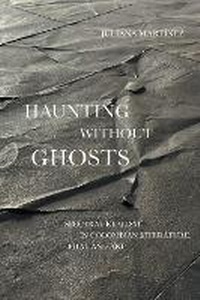
Haunting Without Ghosts
Spectral Realism in Colombian Literature, Film, and Art
Published on 1. December 2020
Book
Hardback
232 pages
978-1-4773-2171-3 (ISBN)
Description
Winner, William M. LeoGrande Prize, Center for Latin American and Latino Studies at American University, 2022
For half a century, cultural production in Colombia has labored under the weight of magical realism-above all, the works of Gabriel GarcIa MArquez-where ghosts told stories about the country's violent past and warned against a similarly gruesome future.
Decades later, the story of violence in Colombia is no less horrific, but the critical resources of magical realism are depleted. In their wake comes "spectral realism." Juliana MartInez argues that recent Colombian novelists, filmmakers, and artists-from Evelio Rosero and William Vega to Beatriz GonzAlez and Erika Diettes-share a formal and thematic concern with the spectral but shift the focus from what the ghost is toward what the specter does. These works do not speak of ghosts. Instead, they use the specter to destabilize reality by challenging the authority of human vision and historical chronology.
By introducing the spectral into their work, these artists decommodify well-worn modes of representing violence and create a critical space from which to seek justice for the dead and disappeared. A Colombia-based study, Haunting without Ghosts brings powerful insight to the politics and ethics of spectral aesthetics, relevant for a variety of sociohistorical contexts.
For half a century, cultural production in Colombia has labored under the weight of magical realism-above all, the works of Gabriel GarcIa MArquez-where ghosts told stories about the country's violent past and warned against a similarly gruesome future.
Decades later, the story of violence in Colombia is no less horrific, but the critical resources of magical realism are depleted. In their wake comes "spectral realism." Juliana MartInez argues that recent Colombian novelists, filmmakers, and artists-from Evelio Rosero and William Vega to Beatriz GonzAlez and Erika Diettes-share a formal and thematic concern with the spectral but shift the focus from what the ghost is toward what the specter does. These works do not speak of ghosts. Instead, they use the specter to destabilize reality by challenging the authority of human vision and historical chronology.
By introducing the spectral into their work, these artists decommodify well-worn modes of representing violence and create a critical space from which to seek justice for the dead and disappeared. A Colombia-based study, Haunting without Ghosts brings powerful insight to the politics and ethics of spectral aesthetics, relevant for a variety of sociohistorical contexts.
Reviews / Votes
[Haunting without Ghosts] is a book written with critical patience to regard the disturbing presence of the specters of enforced disappearance, the violently and intentionally silenced or erased from Colombian history...Haunting without Ghosts not only can teach scholars, but also cultural practitioners who wish to deal with the ethical issues of the representation of historical and structural violence...It is a book to take to heart the harrowing muted cries of the voiceless. (KULT Journal)More details
Series
Language
English
Place of publication
Austin, TX
United States
Target group
Professional and scholarly
Illustrations
18 b&w photos
Dimensions
Height: 229 mm
Width: 152 mm
Thickness: 25 mm
Weight
513 gr
ISBN-13
978-1-4773-2171-3 (9781477321713)
Copyright in bibliographic data and cover images is held by Nielsen Book Services Limited or by the publishers or by their respective licensors: all rights reserved.
Schweitzer Classification
Person
Juliana MartInez is an assistant professor in the Department of World Languages and Cultures at American University, in Washington, DC. Her research, focused on the intersection of violence and body politics in Latin America, has appeared in numerous journals, and she is a coeditor of the 2019 special issue "Violent Tales: Cultural Representation in Colombia and Mexico" for Revista de Estudios HispAnicos. She regularly teaches courses on Latin American literature, film, and history; narratives of violence (particularly in Colombia and Mexico); gender and sexuality; and women writers in Latin America. MartInez has also written for popular venues, including the Guardian and the Huffington Post.
Content
Acknowledgments
Introduction
Chapter 1. Evelio Rosero's Spectral Landscapes of Disappearance
Chapter 2. Beyond Vision: Haptic Perception and Contested Spaces in the Films of William Vega, Jorge Forero, and Felipe Guerrero
Chapter 3. The Revenants: Deferred Burials and Suspended Mourning in the Works of Juan Manuel EchavarrIa, Beatriz GonzAlez, and Erika Diettes
Epilogue
Notes
Works Cited
Index
Introduction
Chapter 1. Evelio Rosero's Spectral Landscapes of Disappearance
Chapter 2. Beyond Vision: Haptic Perception and Contested Spaces in the Films of William Vega, Jorge Forero, and Felipe Guerrero
Chapter 3. The Revenants: Deferred Burials and Suspended Mourning in the Works of Juan Manuel EchavarrIa, Beatriz GonzAlez, and Erika Diettes
Epilogue
Notes
Works Cited
Index