

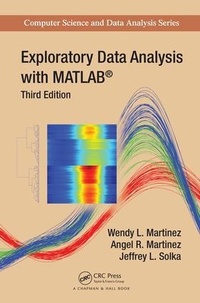
Exploratory Data Analysis with MATLAB
3rd Edition
Published on 27. July 2017
Book
Hardback
590 pages
978-1-4987-7606-6 (ISBN)
Description
Praise for the Second Edition:
"The authors present an intuitive and easy-to-read book. ... accompanied by many examples, proposed exercises, good references, and comprehensive appendices that initiate the reader unfamiliar with MATLAB."-Adolfo Alvarez Pinto, International Statistical Review
"Practitioners of EDA who use MATLAB will want a copy of this book. ... The authors have done a great service by bringing together so many EDA routines, but their main accomplishment in this dynamic text is providing the understanding and tools to do EDA.
-David A Huckaby, MAA Reviews
Exploratory Data Analysis (EDA) is an important part of the data analysis process. The methods presented in this text are ones that should be in the toolkit of every data scientist. As computational sophistication has increased and data sets have grown in size and complexity, EDA has become an even more important process for visualizing and summarizing data before making assumptions to generate hypotheses and models.
Exploratory Data Analysis with MATLAB, Third Edition presents EDA methods from a computational perspective and uses numerous examples and applications to show how the methods are used in practice. The authors use MATLAB code, pseudo-code, and algorithm descriptions to illustrate the concepts. The MATLAB code for examples, data sets, and the EDA Toolbox are available for download on the book's website.
New to the Third Edition
Random projections and estimating local intrinsic dimensionality
Deep learning autoencoders and stochastic neighbor embedding
Minimum spanning tree and additional cluster validity indices
Kernel density estimation
Plots for visualizing data distributions, such as beanplots and violin plots
A chapter on visualizing categorical data
"The authors present an intuitive and easy-to-read book. ... accompanied by many examples, proposed exercises, good references, and comprehensive appendices that initiate the reader unfamiliar with MATLAB."-Adolfo Alvarez Pinto, International Statistical Review
"Practitioners of EDA who use MATLAB will want a copy of this book. ... The authors have done a great service by bringing together so many EDA routines, but their main accomplishment in this dynamic text is providing the understanding and tools to do EDA.
-David A Huckaby, MAA Reviews
Exploratory Data Analysis (EDA) is an important part of the data analysis process. The methods presented in this text are ones that should be in the toolkit of every data scientist. As computational sophistication has increased and data sets have grown in size and complexity, EDA has become an even more important process for visualizing and summarizing data before making assumptions to generate hypotheses and models.
Exploratory Data Analysis with MATLAB, Third Edition presents EDA methods from a computational perspective and uses numerous examples and applications to show how the methods are used in practice. The authors use MATLAB code, pseudo-code, and algorithm descriptions to illustrate the concepts. The MATLAB code for examples, data sets, and the EDA Toolbox are available for download on the book's website.
New to the Third Edition
Random projections and estimating local intrinsic dimensionality
Deep learning autoencoders and stochastic neighbor embedding
Minimum spanning tree and additional cluster validity indices
Kernel density estimation
Plots for visualizing data distributions, such as beanplots and violin plots
A chapter on visualizing categorical data
More details
Series
Edition
3rd edition
Language
English
Place of publication
Oxford
United States
Publishing group
Taylor & Francis Inc
Target group
College/higher education
Edition type
New edition
Product notice
sewn/stitched
Cloth over boards
Illustrations
84 s/w Abbildungen, 16 farbige Abbildungen
16 Illustrations, color; 84 Illustrations, black and white
Dimensions
Height: 236 mm
Width: 157 mm
Thickness: 41 mm
Weight
998 gr
ISBN-13
978-1-4987-7606-6 (9781498776066)
Copyright in bibliographic data and cover images is held by Nielsen Book Services Limited or by the publishers or by their respective licensors: all rights reserved.
Schweitzer Classification
Other editions
Additional editions
Wendy L. Martinez | Angel R. Martinez | Jeffrey Solka
Exploratory Data Analysis with MATLAB
Book
07/2022
3rd Edition
Chapman & Hall/CRC
€70.00
Shipment within 10-20 days
Wendy L. Martinez | Angel R. Martinez | Jeffrey Solka
Exploratory Data Analysis with MATLAB
E-Book
08/2017
3rd Edition
Chapman & Hall/CRC
€68.49
Available for download
Wendy L. Martinez | Angel R. Martinez | Jeffrey Solka
Exploratory Data Analysis with MATLAB
E-Book
08/2017
3rd Edition
Chapman & Hall/CRC
€68.49
Available for download
Previous edition
Wendy L. Martinez | Angel R. Martinez | Jeffrey Solka
Exploratory Data Analysis with MATLAB, Second Edition
Book
12/2010
2nd Edition
CRC Press
€94.08
Article exhausted; check for reprint
Persons
Wendy L. Martinez is a mathematical statistician with the U.S. Bureau of Labor Statistics. She is a fellow of the American Statistical Association, a co-author of several popular Chapman & Hall/CRC books, and a MATLAB (R) user for more than 20 years. Her research interests include text data mining, probability density estimation, signal processing, scientific visualization, and statistical pattern recognition. She earned an M.S. in aerospace engineering from George Washington University and a Ph.D. in computational sciences and informatics from George Mason University.
Angel R. Martinez is fully retired after a long career with the U.S. federal government and as an adjunct professor at Strayer University, where he taught undergraduate and graduate courses in statistics and mathematics. Before retiring from government service, he worked for the U.S. Navy as an operations research analyst and a computer scientist. He earned an M.S. in systems engineering from the Virginia Polytechnic Institute and State University and a Ph.D. in computational sciences and informatics from George Mason University.
Since 1984, Jeffrey L. Solka has been working in statistical pattern recognition for the Department of the Navy. He has published over 120 journal, conference, and technical papers; has won numerous awards; and holds 4 patents. He earned an M.S. in mathematics from James Madison University, an M.S. in physics from Virginia Polytechnic Institute and State University, and a Ph.D. in computational sciences and informatics from George Mason University.
Angel R. Martinez is fully retired after a long career with the U.S. federal government and as an adjunct professor at Strayer University, where he taught undergraduate and graduate courses in statistics and mathematics. Before retiring from government service, he worked for the U.S. Navy as an operations research analyst and a computer scientist. He earned an M.S. in systems engineering from the Virginia Polytechnic Institute and State University and a Ph.D. in computational sciences and informatics from George Mason University.
Since 1984, Jeffrey L. Solka has been working in statistical pattern recognition for the Department of the Navy. He has published over 120 journal, conference, and technical papers; has won numerous awards; and holds 4 patents. He earned an M.S. in mathematics from James Madison University, an M.S. in physics from Virginia Polytechnic Institute and State University, and a Ph.D. in computational sciences and informatics from George Mason University.
Content
Introduction to Exploratory Data Analysis. Dimensionality Reduction - Linear Methods. Dimensionality Reduction - Nonlinear Methods. Data Tours. Finding Clusters. Model-Based Clustering. Smoothing Scatterplots. Visualizing Clusters. Distribution Shapes. Multivariate Visualization. Appendices.