

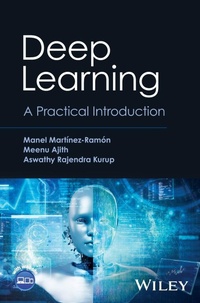
Deep Learning
A Practical Introduction
1st Edition
Published on 8. August 2024
Book
Hardback
416 pages
978-1-119-86186-7 (ISBN)
Description
An engaging and accessible introduction to deep learning perfect for students and professionals
In Deep Learning: A Practical Introduction, a team of distinguished researchers delivers a start-to-finish instruction book with complete coverage of the theoretical and practical elements of deep learning. The book includes extensive examples, end-of-chapter exercises, homework, exam material and a GitHub repository containing code and data for all provided examples.
Combining contemporary deep learning theory with state-of-the-art tools, the chapters are structured to maximize accessibility for both beginning and intermediate students. The authors have included coverage of TensorFlow, Keras, and Pytorch. Readers will also find:
Thorough introductions to deep learning and deep learning tools
Comprehensive explorations of convolutional neural networks, including discussions of their elements, operation, training, and architectures
Practical discussions of recurrent neural networks and non-supervised approaches to deep learning
Fulsome treatments of generative adversarial networks as well as deep Bayesian Neural networks.
Perfect for undergraduate and graduate students studying computer vision, computer science, artificial intelligence, and neural networks, Deep Learning: A Practical Introduction will also benefit practitioners and researchers in the fields of deep learning and machine learning in general.
In Deep Learning: A Practical Introduction, a team of distinguished researchers delivers a start-to-finish instruction book with complete coverage of the theoretical and practical elements of deep learning. The book includes extensive examples, end-of-chapter exercises, homework, exam material and a GitHub repository containing code and data for all provided examples.
Combining contemporary deep learning theory with state-of-the-art tools, the chapters are structured to maximize accessibility for both beginning and intermediate students. The authors have included coverage of TensorFlow, Keras, and Pytorch. Readers will also find:
Thorough introductions to deep learning and deep learning tools
Comprehensive explorations of convolutional neural networks, including discussions of their elements, operation, training, and architectures
Practical discussions of recurrent neural networks and non-supervised approaches to deep learning
Fulsome treatments of generative adversarial networks as well as deep Bayesian Neural networks.
Perfect for undergraduate and graduate students studying computer vision, computer science, artificial intelligence, and neural networks, Deep Learning: A Practical Introduction will also benefit practitioners and researchers in the fields of deep learning and machine learning in general.
More details
Language
English
Place of publication
New York
United States
Target group
Professional and scholarly
Dimensions
Height: 245 mm
Width: 173 mm
Thickness: 28 mm
Weight
872 gr
ISBN-13
978-1-119-86186-7 (9781119861867)
Copyright in bibliographic data and cover images is held by Nielsen Book Services Limited or by the publishers or by their respective licensors: all rights reserved.
Schweitzer Classification
Other editions
Additional editions
E-Book
07/2024
1st Edition
Wiley
€73.99
Available for download
E-Book
07/2024
1st Edition
Wiley
€73.99
Available for download
Persons
Manel Martinez-Ramon, PhD, is King Felipe VI Endowed Chair and Professor in the Department of Electrical and Computer Engineering at the University of New Mexico in the United States. He earned his doctorate in Telecommunication Technologies at the Universidad Carlos III de Madrid in 1999.
Meenu Ajith, PhD, is a Postdoctoral Research Associate in Tri-Institutional Center for Translational Research in Neuroimaging and Data Science (TReNDS) at Georgia State University, Georgia Institute of Technology, and Emory University. She earned her doctorate degree in Electrical Engineering from the University of New Mexico in 2022. Her research interests include machine learning, computer vision, medical imaging, and image processing.
Aswathy Rajendra Kurup, PhD is a Data Scientist at Intel Corporation. She earned her doctorate degree in Electrical Engineering from the University of Mexico in 2022. Her research interests include image processing, signal processing, deep learning, computer vision, data analysis and data processing.
Meenu Ajith, PhD, is a Postdoctoral Research Associate in Tri-Institutional Center for Translational Research in Neuroimaging and Data Science (TReNDS) at Georgia State University, Georgia Institute of Technology, and Emory University. She earned her doctorate degree in Electrical Engineering from the University of New Mexico in 2022. Her research interests include machine learning, computer vision, medical imaging, and image processing.
Aswathy Rajendra Kurup, PhD is a Data Scientist at Intel Corporation. She earned her doctorate degree in Electrical Engineering from the University of Mexico in 2022. Her research interests include image processing, signal processing, deep learning, computer vision, data analysis and data processing.