

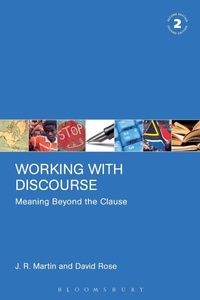
Working with Discourse
Meaning Beyond the Clause
2nd Edition
Published on 31. May 2007
Book
Paperback/Softback
375 pages
978-0-8264-8850-3 (ISBN)
Description
This second edition of the best-selling textbook "Working with Discourse" has been revised and updated throughout. The book builds an accessible set of analytic tools that can be used to explore how speakers and writers construe meaning through discourse. These techniques are introduced in clear steps, through analyses of spoken, written and visual texts that focus on truth and reconciliation in post-apartheid South Africa. The new edition includes a chapter on Negotiation, clear definitions of key terms, chapter summaries and revised suggestions for further reading. Accessibly written and presupposing no prior knowledge of discourse or functional linguistics, this is the ideal textbook for students encountering discourse analysis for the first time at advanced undergraduate or postgraduate level.
More details
Edition
2nd edition
Language
English
Place of publication
London
United Kingdom
Publishing group
Bloomsbury Publishing PLC
Target group
College/higher education
Professional and scholarly
Postgraduate, Upper Level Undergraduate
Edition type
New edition
Dimensions
Height: 234 mm
Width: 156 mm
Thickness: 20 mm
Weight
570 gr
ISBN-13
978-0-8264-8850-3 (9780826488503)
Copyright in bibliographic data and cover images is held by Nielsen Book Services Limited or by the publishers or by their respective licensors: all rights reserved.
Schweitzer Classification
Other editions
Previous edition

Book
03/2003
Continuum International Publishing Group Ltd.
€57.13
Article exhausted; check for reprint
Persons
J. R. Martin is Professor of Linguistics at the University of Sydney, Australia. David Rose is a Research Fellow in Education at the University of Sydney, Australia.
Content
List of Figures; List of Tables; Preface; 1. Interpreting Social Discourse; 2. Appraisal; 3. Ideation: Representing Experience; 4. Conjunction: Connecting Events; 5. Negotiation; 6. Identification: Tracking Participants; 7. Periodicity: Information Flow; 8. Tackling a Text; 9. Connections.