

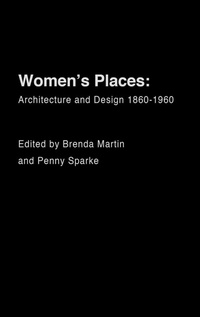
Women's Places
Architecture and Design 1860-1960
Published on 26. June 2003
Book
Hardback
208 pages
978-0-415-28448-6 (ISBN)
Description
What was different about the environments that women created as architects, designers and clients at a time when they were gaining increasing political and social status in a male world? Through a series of case studies, Women's Places: Architecture and Design 1860-1960, examines in detail the professional and domestic spaces created by women who had money and the opportunity to achieve their ideal. Set against a background of accepted notions of modernity relating to design and architecture of the late 19th and early 20th centuries, this book provides a fascinating insight into women's social aspirations and identities. It offers new information and new interpretations in the study of gender, material culture and the built environment in the period 1860-1960.
Reviews / Votes
'An interesting book.' -Kosta Mathey, Trialog, 2004More details
Language
English
Place of publication
London
United Kingdom
Publishing group
Taylor & Francis Ltd
Target group
Professional and scholarly
College/higher education
Dimensions
Height: 240 mm
Width: 161 mm
Thickness: 15 mm
Weight
470 gr
ISBN-13
978-0-415-28448-6 (9780415284486)
Copyright in bibliographic data and cover images is held by Nielsen Book Services Limited or by the publishers or by their respective licensors: all rights reserved.
Schweitzer Classification
Other editions
Additional editions
E-Book
09/2003
Routledge
€78.99
Available for download
E-Book
09/2003
Routledge
€78.99
Available for download
Book
07/2003
Routledge
€85.30
Shipment within 15-20 days
Persons
Content
Introduction 1. Questions of Identity: Women, Architecture and the Aesthetic Movement 2. Creating 'The New Room'. The Hall sisters of West Wickham and Richard Norman Shaw 3. Elsie de Wolfe and her Female Clients, 1905-1915: Gender, Class and the Professional Interior Decorator 4. Your Place or Mine? The Client's Contribution to Domestic Architecture 5. Architecture and Reputation: Eileen Grey, Gender, And Modernism 6. Marie Dormoy and the Architectural Conversation 7. A House of her Own. Dora Gordine and Dorich House (1936) 8. Elizabeth Denby or Maxwell Fry? A Matter of Attribution?