

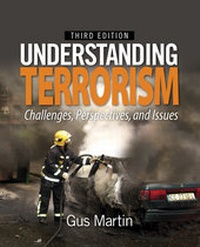
Understanding Terrorism
Challenges, Perspectives and Issues
3rd Edition
Published on 6. March 2009
Book
Paperback/Softback
664 pages
978-1-4129-7059-4 (ISBN)
Description
"Understanding Terrorism: Challenges, Perspectives, and Issues, Third Edition" offers a comprehensive and complete exploration of the phenomenon of modern terrorist violence. It is a core textbook for undergraduates studying terrorism, homeland security, international security, criminal justice administration, political conflict, armed conflict and social movements. The third edition delves deeper into homeland security issues, and all elements of the book, including theories, case studies, maps, tables, and pedagogy are fully updated.
More details
Edition
3rd Revised edition
Language
English
Place of publication
Thousand Oaks
United States
Target group
College/higher education
Edition type
Revised edition
Illustrations
Illustrations, maps
Dimensions
Height: 229 mm
Width: 178 mm
ISBN-13
978-1-4129-7059-4 (9781412970594)
Copyright in bibliographic data and cover images is held by Nielsen Book Services Limited or by the publishers or by their respective licensors: all rights reserved.
Schweitzer Classification
Other editions
Previous edition
Book
04/2006
2nd Edition
SAGE Publications Inc
€57.13
Article exhausted; check for reprint
Person
C. Augustus "Gus" Martin is Assistant Vice President for Faculty Affairs at California State University, Dominguez Hills, where he is also the former chair of the Department of Public Administration & Public Policy. He has served on the faculty of the Graduate School of Public and International Affairs, University of Pittsburgh, where he was an Administration of Justice professor. His research and professional interests are terrorism and extremism, juvenile justice, administration of justice, and fair housing. He has served as a panelist for university and community symposia and interviews on the subjects of administration of justice, terrorism, and fair housing. He has also been a consultant to government and private agencies. Prior to joining academia, he was a "floor" legislative assistant to Congressman Charles B. Rangel of New York and Special Counsel to the Attorney General of the U.S. Virgin Islands. In addition, he served as managing attorney for the Fair Housing Partnership of Greater Pittsburgh, where he was also director of a program created under a federal consent decree to desegregate public and assisted housing.
Content
PART I. TERRORISM: A CONCEPTUAL REVIEW 1. Terrorism: First Impressions First Considerations Conceptual Considerations: Understanding Political Violence Recent Attacks in the United States: Symbolism and Aftermath Terrorism and Criminal Skill: Three Cases in Point The Past as Prologue: Historical Perspectives on Terrorism Chapter Summary 2. The Nature of the Beast: Defining Terrorism Understanding Extremism: The Foundation of Terrorism Defining Terrorism: An Ongoing Debate A Definitional Problem: Perspectives on Terrorism The Political Violence Matrix Chapter Summary 3. Beginnings: The Causes of Terrorism Political Violence as the Fruit of Injustice Political Violence as Strategic Choice The Morality of Political Violence Chapter Summary PART II. THE TERRORISTS 4. Terror From Above: State Terrorism The State as Terrorist: A State Terrorism Paradigm Violence Abroad: State Terrorism as Foreign Policy Violence at Home: State Terrorism as Domestic Policy The Problem of Accountability: Monitoring State Terrorism Chapter Summary 5. Terror From Below: Dissident Terrorism The Rebel as Terrorist: A Dissident Terrorism Paradigm Warring Against the State: Antistate Dissident Terrorism Warring Against a People: Communal Terrorism Operational Shifts: Dissidents and the New Terrorism Chapter Summary 6. Violence in the Name of the Faith: Religious Terrorism Primary and Secondary Motives: The Idiosyncratic Quality of Religious Terrorism Historical Cases in Point: Fighting, Dying, and Killing in the Name of the Faith State-Sponsored Religious Terrorism in the Modern Era Dissident Religious Terrorism in the Modern Era The Future of Religious Terrorism Chapter Summary 7. Violent Ideologies: Terrorism From the Left and Right Reactionaries and Radicals: The Classical Ideological Continuum Left-Wing Ideologies and Activism Class Struggle and National Liberation: The Terrorist Left Right-Wing Activism and Extremism Race and Order: The Terrorist Right Violent Ideologies in the New Era of Terrorism Chapter Summary 8. Terrorist Spillovers: International Terrorism Defining International Terrorism Globalized Revolution: Reasons for International Terrorism Globalized Solidarity: International Terrorist Networks The International Dimension of the New Terrorism Postscript: The "Stateless Revolutionaries" Chapter Summary 9. Emerging Terrorist Environments: Gender-Selective Political Violence and Criminal Dissident Terrorism Culture and Conflict: Gender-Selected Victims of Terrorist Violence Protecting the Enterprise: Criminal Dissident Terrorism A Global Problem: Regional Cases of Criminal Dissident Terrorism Chapter Summary PART III. THE TERRORIST TRADE 10. Tools of the Trade: Tactics and Targets of Terrorists The Purpose: Terrorist Objectives The Means: Terrorist Methods The Focus: Terrorist Targets The Outcome: Is Terrorism Effective? Chapter Summary 11. The Information Battleground: Terrorist Violence and the Role of the Media Two Perspectives: The Media and Governments Exploring the Role of the Media A New Battleground: The War for the Information High Ground The Public's Right to Know: Regulating the Media Chapter Summary PART IV. FINAL ANALYSIS 12. The American Case: Terrorism in the United States An Introduction to the American Case Background to Terrorism: Leftist Activism and Ideological Extremism in America Left-Wing Terrorism in the United States Background to Terrorism: Rightist Activism and Ideological Extremism in America Right-Wing Terrorism in the United States International Terrorism in the United States Chapter Summary 13. Responding to Terror: The Options Background: The Scope of Options Warlike Operations: Counterterrorism and the Use of Force Operations Other Than War: Repressive Options Operations Other Than War: Conciliatory Options Applying the Rule of Law: Legalistic Options Chapter Summary 14. What Next? The Future of Terrorism An Overview of Near-Term Projections The Future of Terrorism: New Threats Controlling Terrorism: New Challenges Prospects for Terrorism in the United States Chapter Summary Appendix A: Map References Appendix B: Historical Examples Glossary