

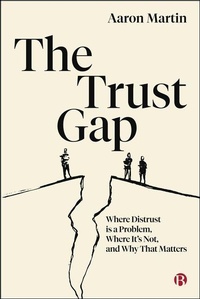
The Trust Gap
Where Distrust Is a Problem, Where It's Not, and Why That Matters
1st Edition
Published on 5. May 2026
Book
Paperback/Softback
166 pages
978-1-5292-5560-7 (ISBN)
Description
The idea that a wave of distrust has swept over established democracies in recent years is commonly accepted. This book presents a contrary view. Drawing on various datasets, it reveals a disconnect between the popular commentary and the empirical reality.
The Trust Gap suggests that the most extreme cases - such as the US and the UK - distort our thinking about trust. It looks beyond trust in government to examine trust in a range of institutions, including courts, universities and the media. In doing so, it suggests that while countries such as the US do face a crisis of trust, many established democracies demonstrate resilience rather than vulnerability.
Using the framework of trust gaps, this book offers a stocktake on the state of trust in the 21st century, contributing a more nuanced and hopeful account than the headlines suggest.
The Trust Gap suggests that the most extreme cases - such as the US and the UK - distort our thinking about trust. It looks beyond trust in government to examine trust in a range of institutions, including courts, universities and the media. In doing so, it suggests that while countries such as the US do face a crisis of trust, many established democracies demonstrate resilience rather than vulnerability.
Using the framework of trust gaps, this book offers a stocktake on the state of trust in the 21st century, contributing a more nuanced and hopeful account than the headlines suggest.
Reviews / Votes
"Far from institutional trust being in free-fall, The Trust Gap highlights that in fact there are substantial contrasts in trends both within and across long-established democracies like Spain and Sweden, or the US and Canada. The book provides a useful corrective to the tabloid headlines and uses systematic survey data to explore the reasons behind varying patterns, including the role of institutional performance. An accessible and readable study, this will be invaluable for researchers, scholars and policymakers." Pippa Norris, Harvard University "A smart, mythbusting look at trust today, showing where confidence really holds up and what that means for healthy democracies." Andrew Leigh, Australian MP and author of 'The Shortest History of Economics' "In this must-read book, Martin provides the freshest take that I've seen on political trust in decades." Marc Hetherington, University of North Carolina at Chapel HillMore details
Edition
First Edition
Language
English
Place of publication
Bristol
United Kingdom
Target group
College/higher education
Product notice
Paperback (trade)
Unsewn / adhesive bound
Illustrations
8 s/w Tabellen, 45 s/w Abbildungen
8 Tables, black and white; 45 Illustrations, black and white
Dimensions
Height: 234 mm
Width: 156 mm
Thickness: 9 mm
Weight
240 gr
ISBN-13
978-1-5292-5560-7 (9781529255607)
Copyright in bibliographic data and cover images is held by Nielsen Book Services Limited or by the publishers or by their respective licensors: all rights reserved.
Schweitzer Classification
Other editions
Additional editions
E-Book
05/2026
1st Edition
Bristol University Press
€28.99
Available for download
Book
approx. 05/2026
1st Edition
Bristol University Press
€105.50
Not yet published
Person
Aaron Martin is Associate Professor of Political Science at the University of Melbourne, Australia. He is the author of two books, Young People and Politics and, with Keith Dowding, Policy Agendas in Australia, and has published widely on public opinion and political behaviour.
Content
Introduction: Dissecting the 'Crisis Of Trust'
1. Why Institutional Trust Matters
2. Trust Gap One: Who We Trust and Who We Don't
3. Trust Gap Two: Who Trusts?
4. Trust Gap Three: How High Quality of Government/High Trust Countries Make Policy Work
5. Trust Gap Four: Trust in the Media Versus Trust in Experts
6. Bridging Trust Gaps
1. Why Institutional Trust Matters
2. Trust Gap One: Who We Trust and Who We Don't
3. Trust Gap Two: Who Trusts?
4. Trust Gap Three: How High Quality of Government/High Trust Countries Make Policy Work
5. Trust Gap Four: Trust in the Media Versus Trust in Experts
6. Bridging Trust Gaps