

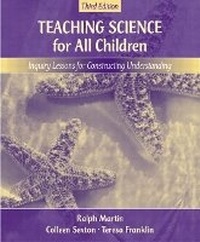
Teaching Science for All Children
Inquiry Lessons for Constructing Understanding
3rd Edition
Published on 15. October 2004
Book
Paperback/Softback
272 pages
978-0-205-43152-6 (ISBN)
Description
This compact, paperback volume offers a wealth of lessons, activities, and teaching materials for preservice and inservice teachers alike.
Inquiry Lessons for Constructing Understanding constitutes the second half of the "parent" text, Teaching Science for All Children, 4/e-in other words, Part II: "Inquiry Lessons for Teaching Science. The two introductory chapters provide information on the 4-E learning cycle, proper science concept formation, and some science safety essentials (Ch. 1) as well as how to apply educational technology to the classroom (Ch. 2). In addition, each lesson is correlated with the grade levels and concepts recommended by the NSES framework.
Inquiry Lessons for Constructing Understanding constitutes the second half of the "parent" text, Teaching Science for All Children, 4/e-in other words, Part II: "Inquiry Lessons for Teaching Science. The two introductory chapters provide information on the 4-E learning cycle, proper science concept formation, and some science safety essentials (Ch. 1) as well as how to apply educational technology to the classroom (Ch. 2). In addition, each lesson is correlated with the grade levels and concepts recommended by the NSES framework.
More details
Edition
3rd edition
Language
English
Place of publication
United States
Publishing group
Pearson Education (US)
Target group
Professional and scholarly
Dimensions
Height: 234 mm
Width: 10 mm
Thickness: 10 mm
Weight
429 gr
ISBN-13
978-0-205-43152-6 (9780205431526)
Copyright in bibliographic data and cover images is held by Nielsen Book Services Limited or by the publishers or by their respective licensors: all rights reserved.
Schweitzer Classification
Other editions
New editions
Ralph Martin | Colleen Sexton | Teresa Franklin
Teaching Science for All Children
Inquiry Lessons for Constructing Understanding, MyLabSchool Edition
Book
02/2005
3rd Edition
Pearson
€70.95
Article is exhausted; no reprint
Previous edition
Ralph Martin | Colleen Sexton | Teresa Franklin
Science for All Children
Lessons for Constructing Understanding
Book
07/2002
2nd Edition
Pearson
€49.70
Article exhausted; check for reprint
Content
Preface.
1. Who, What, Why, and How? Things You Want to Know About Our Book.
For Whom is This Book Prepared?
What Does this Book Strive to Do?
Our Beliefs About Learning and Teaching.
Beliefs Into Action, A Learning Cycle: Exploration, Explanation, Expansion, and Evaluation.
Safe Science.
Chapter Summary.
2. Does Educational Technology Make a Difference? Using Educational Technology to Enrich Your Science Lessons.
What is Educational Technology?
The National Educational Technology Standards.
Why Use Educational Technology? Levels of Use, The Networked Classroom - Removing the Walls.
How Can Educational Technology be Applied in the Context of Science Teaching?
Chapter Summary.
3. Lessons for Constructing Understanding.
Section I: Life Science Lessons.
Section II; Physical Science Lessons.
Section III: Earth and Space Science Lessons.
Appendices.
Appendix A.
National Science Education Standards: Content Standards for K-4 and 5-8.
Appendix B.
A NSTA Position Statement: Guidelines for Responsible Use of Animals in the Classroom.
Appendix C.
A NSTA Position Statement: Liability of Teachers for Laboratory Safety and Field Trips.
Appendix D.
A NSTA Position Statement: Laboratory Science.
References.
Index.
1. Who, What, Why, and How? Things You Want to Know About Our Book.
For Whom is This Book Prepared?
What Does this Book Strive to Do?
Our Beliefs About Learning and Teaching.
Beliefs Into Action, A Learning Cycle: Exploration, Explanation, Expansion, and Evaluation.
Safe Science.
Chapter Summary.
2. Does Educational Technology Make a Difference? Using Educational Technology to Enrich Your Science Lessons.
What is Educational Technology?
The National Educational Technology Standards.
Why Use Educational Technology? Levels of Use, The Networked Classroom - Removing the Walls.
How Can Educational Technology be Applied in the Context of Science Teaching?
Chapter Summary.
3. Lessons for Constructing Understanding.
Section I: Life Science Lessons.
Section II; Physical Science Lessons.
Section III: Earth and Space Science Lessons.
Appendices.
Appendix A.
National Science Education Standards: Content Standards for K-4 and 5-8.
Appendix B.
A NSTA Position Statement: Guidelines for Responsible Use of Animals in the Classroom.
Appendix C.
A NSTA Position Statement: Liability of Teachers for Laboratory Safety and Field Trips.
Appendix D.
A NSTA Position Statement: Laboratory Science.
References.
Index.