

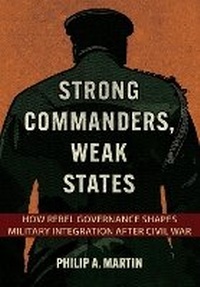
Strong Commanders, Weak States
How Rebel Governance Shapes Military Integration After Civil War
Published on 15. January 2025
Book
Hardback
270 pages
978-1-5017-7901-5 (ISBN)
Description
In Strong Commanders, Weak States, Philip A. Martin investigates a fundamental political challenge faced by post-conflict states: how to create obedient national militaries from the remnants of insurgent forces.
When civil wars end, non-state armed groups often integrate into post-conflict militaries. Yet rebel-military integration does not always happen smoothly. In some cases, former rebels cooperate with new leaders, forming powerful national armies that underpin postwar stability. In others, they resist the authority of new leaders, maintaining clandestine armed networks that disrupt centralized state-building.
Martin argues that how field commanders of non-state armed groups governed during the war explains this variation. Rebel commanders who build accountable governance systems gain strong social support from rebel-ruled communities, becoming locally embedded. Thanks to these community ties, which persist after the war, these embedded commanders have the leverage to push the central government for concessions, resist directives to disarm fighters, or even orchestrate coup d'etats. Conversely, rebel commanders who governed coercively are less likely to sustain community ties. Without the ability to mobilize collective action after the war, these non-embedded commanders have stronger incentives to cooperate with new regime leaders.
Wielding in-depth evidence from Cote d'Ivoire and cases of rebel-military integration elsewhere, Martin shows that good governance during wartime can-ironically-lead to poor postwar state consolidation. Rather than preparing insurgents to be successful state builders, effective rebel governance can hinder post-conflict state-building. As costly peace operations come under increasing scrutiny, Strong Commanders, Weak States offers fresh guidance on how transitions to peace can better succeed.
When civil wars end, non-state armed groups often integrate into post-conflict militaries. Yet rebel-military integration does not always happen smoothly. In some cases, former rebels cooperate with new leaders, forming powerful national armies that underpin postwar stability. In others, they resist the authority of new leaders, maintaining clandestine armed networks that disrupt centralized state-building.
Martin argues that how field commanders of non-state armed groups governed during the war explains this variation. Rebel commanders who build accountable governance systems gain strong social support from rebel-ruled communities, becoming locally embedded. Thanks to these community ties, which persist after the war, these embedded commanders have the leverage to push the central government for concessions, resist directives to disarm fighters, or even orchestrate coup d'etats. Conversely, rebel commanders who governed coercively are less likely to sustain community ties. Without the ability to mobilize collective action after the war, these non-embedded commanders have stronger incentives to cooperate with new regime leaders.
Wielding in-depth evidence from Cote d'Ivoire and cases of rebel-military integration elsewhere, Martin shows that good governance during wartime can-ironically-lead to poor postwar state consolidation. Rather than preparing insurgents to be successful state builders, effective rebel governance can hinder post-conflict state-building. As costly peace operations come under increasing scrutiny, Strong Commanders, Weak States offers fresh guidance on how transitions to peace can better succeed.
More details
Series
Language
English
Place of publication
Ithaca
United States
Target group
College/higher education
Product notice
Paper over boards
Illustrations
1 map, 9 graphs - 9 Graphs - 1 Maps
Dimensions
Height: 229 mm
Width: 152 mm
Weight
907 gr
ISBN-13
978-1-5017-7901-5 (9781501779015)
Copyright in bibliographic data and cover images is held by Nielsen Book Services Limited or by the publishers or by their respective licensors: all rights reserved.
Schweitzer Classification
Other editions
Additional editions
Philip A. Martin
Strong Commanders, Weak States
How Rebel Governance Shapes Military Integration After Civil War
E-Book
01/2025
Cornell University Press
€29.99
Available for download
Person
Philip A. Martin is Assistant Professor at the Schar School of Policy and Government at George Mason University, where he is also the Assistant Director of the Center for Security Policy Studies.
Content
Introduction: Rebels, Commanders, and Military Integration after War
1. A Theory of Commander Embeddedness
2. Rebel Rule in the Ivorian Civil War (2002-2011)
3. Commander Embeddedness in Postwar Cote d'Ivoire (2011-2017)
4. Ex-Rebel Commanders and the Ivorian State
5. Tracing Commander Embeddedness in Four Case Studies
6. Commander Resistance after Rebel-Military Integration (1946-2019)
Conclusion: Field Commanders, War, and the State
1. A Theory of Commander Embeddedness
2. Rebel Rule in the Ivorian Civil War (2002-2011)
3. Commander Embeddedness in Postwar Cote d'Ivoire (2011-2017)
4. Ex-Rebel Commanders and the Ivorian State
5. Tracing Commander Embeddedness in Four Case Studies
6. Commander Resistance after Rebel-Military Integration (1946-2019)
Conclusion: Field Commanders, War, and the State