

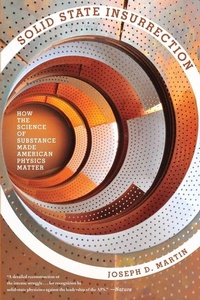
Solid State Insurrection
How the Science of Substance Made American Physics Matter
Will be published approx. on 27. August 2019
Book
Paperback/Softback
312 pages
978-0-8229-6603-6 (ISBN)
Description
Solid state physics, the study of the physical properties of solid matter, was the most populous subfield of Cold War American physics. Despite prolific contributions to consumer and medical technology, such as the transistor and magnetic resonance imaging, it garnered less professional prestige and public attention than nuclear and particle physics.
Solid State Insurrection argues that solid state physics was essential to securing the vast social, political, and financial capital Cold War physics enjoyed in the twentieth century. Solid state's technological bent, and its challenge to the "pure science" ideal many physicists cherished, helped physics as a whole respond more readily to Cold War social, political, and economic pressures. Its research kept physics economically and technologically relevant, sustaining its cultural standing and policy influence long after the sheen of the Manhattan Project had faded. With this book, Joseph D. Martin brings a new perspective to some of the most enduring questions about the role of physics in American history.
Solid State Insurrection argues that solid state physics was essential to securing the vast social, political, and financial capital Cold War physics enjoyed in the twentieth century. Solid state's technological bent, and its challenge to the "pure science" ideal many physicists cherished, helped physics as a whole respond more readily to Cold War social, political, and economic pressures. Its research kept physics economically and technologically relevant, sustaining its cultural standing and policy influence long after the sheen of the Manhattan Project had faded. With this book, Joseph D. Martin brings a new perspective to some of the most enduring questions about the role of physics in American history.
Reviews / Votes
A detailed reconstruction of the intense struggle . . . for recognition by solid-state physicists against the leadership of the APS. * Nature * For more than half a century, the number of physicists focused on atomic matter in bulk have greatly outnumbered the small priesthood devoted to high-energy physics. In this richly textured and fascinating historical study, Martin charts how solid state physicists plied intellectual pluralism and institutional savvy to become the dominant branch of the American physics community. * David Kaiser * Martin gives us a coherent monograph about the thing in its entirety; solid state physics, at least in its American form, from beginning to end. * Physics in Perspective * Joseph Martin gives us both a feisty, reader-friendly defense of applied 'small science' and a meticulous history of American physicists' philosophical disagreements over reductionism and bureaucratic fights over the names of conferences and journals. For too long, historians heeded the 'Schmutzphysik' slights of particle physicists. With this book, Martin paints instead the thrills and fundamental insights of solid state physics. * Cyrus C. M. Mody * This book will appeal to physicists and historians of modern science and to those interested in how social demands and government priorities influenced research directions in contemporary physics. * J.W. Dauben, CUNY Herbert H. Lehman College *More details
Language
English
Place of publication
Pittsburgh PA
United States
Target group
Professional and scholarly
Product notice
Paperback (trade)
Unsewn / adhesive bound
Illustrations
13 black & white photographs
Dimensions
Height: 228 mm
Width: 153 mm
Thickness: 22 mm
Weight
387 gr
ISBN-13
978-0-8229-6603-6 (9780822966036)
Copyright in bibliographic data and cover images is held by Nielsen Book Services Limited or by the publishers or by their respective licensors: all rights reserved.
Schweitzer Classification
Person
Joseph D. Martin is a teaching associate in the Department of History and Philosophy of Science at the University of Cambridge. He edits Physics in Perspective and currently serves as Vice Chair of the Forum on the History of Physics for the American Phys