

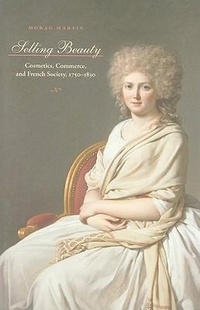
Selling Beauty
Cosmetics, Commerce, and French Society, 1750-1830
Published on 30. November 2009
Book
Hardback
240 pages
978-0-8018-9309-4 (ISBN)
Description
Morag Martin's history of the cosmetic industry in France examines the evolution of popular tastes and standards of beauty during the late 18th and early 19th centuries. As the French citizenry rebelled against the excesses of the aristocracy, there was a parallel shift in consumer beauty practices. Powdered wigs, alabaster white skin, and rouged cheeks disappeared in favor of a more natural and simple style. Selling Beauty challenges expectations about past fashions and offers a unique look into consumer culture and business practices. Martin introduces readers to the social and economic world of cosmetic production and consumption, recounts criticisms against the use of cosmetics from a variety of voices, and examines how producers and retailers responded to quickly evolving fashions. Martin shows that the survival of the industry depended on its ability to find customers among the emerging working and middle classes. But the newfound popularity of cosmetics raised serious questions.
Critics-from radical philosophes to medical professionals-complained that the use of cosmetics was a threat to social morals and questioned the healthfulness of products that contained arsenic, mercury, and lead. Cosmetic producers embraced these withering criticisms, though, skillfully addressing these concerns in their marketing campaigns, reassuring consumers of the moral and physical safety of their products. Rather than disappearing along with the Old Regime, the commerce of cosmetics, reimagined and redefined, flourished in the early 19th century, as political ideals and Enlightenment philosophies radically altered popular sentiment.
Critics-from radical philosophes to medical professionals-complained that the use of cosmetics was a threat to social morals and questioned the healthfulness of products that contained arsenic, mercury, and lead. Cosmetic producers embraced these withering criticisms, though, skillfully addressing these concerns in their marketing campaigns, reassuring consumers of the moral and physical safety of their products. Rather than disappearing along with the Old Regime, the commerce of cosmetics, reimagined and redefined, flourished in the early 19th century, as political ideals and Enlightenment philosophies radically altered popular sentiment.
Reviews / Votes
Selling Beauty is a well-written and impressively researched book. -- Jennifer M. Jones H-France 2010 This book makes a scholarly and critical contribution to histories of the consumer revolution, commercial culture, and gender. -- John Shovlin American Historical Review 2010More details
Series
Language
English
Place of publication
Baltimore, MD
United States
Target group
Professional and scholarly
Product notice
Unsewn / adhesive bound
Paper over boards
With dust jacket
Illustrations
13 s/w Photographien bzw. Rasterbilder
13 Halftones, black and white
Dimensions
Height: 237 mm
Width: 164 mm
Thickness: 22 mm
Weight
459 gr
ISBN-13
978-0-8018-9309-4 (9780801893094)
DOI
10.1353/book.3456
Copyright in bibliographic data and cover images is held by Nielsen Book Services Limited or by the publishers or by their respective licensors: all rights reserved.
Schweitzer Classification
Other editions
Additional editions
E-Book
11/2009
Johns Hopkins University Press
€45.49
Available for download
Person
Morag Martin is an associate professor of history at the College at Brockport, State University of New York.
Content
Acknowledgments
Introduction
1. The Practices of Beauty: The Creation of a Consumer Market
2. A Market for Beauty: The Production of Cosmetics
3. Advertising Beauty: The Culture of Publicity
4. Maligning Beauty: The Critics Take on Artifice
5. Domesticating Beauty: The Medical Supervision of Women's Toilette
6. Selling Natural Artifice: Entrepreneurs Redefine the Commerce of Cosmetics
7. Selling the Orient: From the Exotic Harem to Napoleon's Colonial Enterprise
8. Selling Masculinity: The Commercial Competition over Men's Hair
Conclusion
Notes
Bibliography
Index
Introduction
1. The Practices of Beauty: The Creation of a Consumer Market
2. A Market for Beauty: The Production of Cosmetics
3. Advertising Beauty: The Culture of Publicity
4. Maligning Beauty: The Critics Take on Artifice
5. Domesticating Beauty: The Medical Supervision of Women's Toilette
6. Selling Natural Artifice: Entrepreneurs Redefine the Commerce of Cosmetics
7. Selling the Orient: From the Exotic Harem to Napoleon's Colonial Enterprise
8. Selling Masculinity: The Commercial Competition over Men's Hair
Conclusion
Notes
Bibliography
Index