

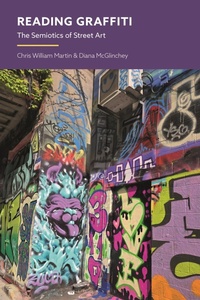
Reading Graffiti
The Semiotics of Street Art
Will be published approx. on 12. November 2026
Book
Hardback
192 pages
978-1-350-47528-1 (ISBN)
Description
This book examines the language of the varied types of graffiti and street art while uncovering the contemporary uses and purpose behind our need to tag out our existence through letters and images on buildings and city blocks.
Graffiti is as much about our need for art as expression-providing voice for the voiceless-as it is our need for beauty, social criticism, or civil disruption in our environments. This book takes an approach to understanding the ways in which graffiti and street art has changed the way we look at our environments, our social institutions, and ourselves.
The book is informed by an immersive literature review, research at the Museum of Graffiti in Miami, Florida, research, and conversations with local street artists practicing in genres like stickers/slaps, lettering, murals, miniatures/installations, culture jamming and ad busting. It is also informed by fieldnotes of street art tours around the world to explore the semiotic landscape of locales and the impact on the local street art cultures.
Through the polysemy of the word "graffiti" we see cultural history and modern-day actors, graffiti becomes a thing and a practice. It is human and it is historical.
Graffiti is as much about our need for art as expression-providing voice for the voiceless-as it is our need for beauty, social criticism, or civil disruption in our environments. This book takes an approach to understanding the ways in which graffiti and street art has changed the way we look at our environments, our social institutions, and ourselves.
The book is informed by an immersive literature review, research at the Museum of Graffiti in Miami, Florida, research, and conversations with local street artists practicing in genres like stickers/slaps, lettering, murals, miniatures/installations, culture jamming and ad busting. It is also informed by fieldnotes of street art tours around the world to explore the semiotic landscape of locales and the impact on the local street art cultures.
Through the polysemy of the word "graffiti" we see cultural history and modern-day actors, graffiti becomes a thing and a practice. It is human and it is historical.
Reviews / Votes
Reading Graffiti: The Semiotics of Street Art offers an outstanding and comprehensive exploration of graffiti. It skillfully examines the artistic dimensions of graffiti, while also exploring its social and cultural significance; legal arguments about who owns public space and the rights to the city; and the dramaturgical role of graffiti artists themselves. Insightful and thought-provoking, this work is an essential resource for anyone interested in understanding graffiti. -- Michael Rees, Lecturer in Sociology, Nottingham Trent UniversityMore details
Language
English
Place of publication
London
United Kingdom
Publishing group
Bloomsbury Publishing PLC
Target group
Professional and scholarly
College/higher education
Product notice
sewn/stitched
Cloth over boards
With dust jacket
Illustrations
10 bw illus
Dimensions
Height: 234 mm
Width: 156 mm
Thickness: 25 mm
Weight
454 gr
ISBN-13
978-1-350-47528-1 (9781350475281)
Copyright in bibliographic data and cover images is held by Nielsen Book Services Limited or by the publishers or by their respective licensors: all rights reserved.
Schweitzer Classification
Persons
Chris William Martin is a Professor of Social Science at Algonquin College, Ottawa, Canada.
Content
List of Figures
List of Tables
Acknowledgements
Introduction
1. Graffiti and The City: What is the Purpose of (Street) Art?
2. On Disrupting Civil Inattention
3. Into the Alley: Deviance and the Criminality of Graffiti
4. Semiotic Guerillas: Who Owns What?
5. Humans Behind the Spray Can: The Dramaturgy of Street Art
6. From the Ephemeral to the Permanent: The Relationship Between Graffiti and Tattooing
Conclusion
Appendix
References
Index
Glossary of Street Art Terminology
List of Tables
Acknowledgements
Introduction
1. Graffiti and The City: What is the Purpose of (Street) Art?
2. On Disrupting Civil Inattention
3. Into the Alley: Deviance and the Criminality of Graffiti
4. Semiotic Guerillas: Who Owns What?
5. Humans Behind the Spray Can: The Dramaturgy of Street Art
6. From the Ephemeral to the Permanent: The Relationship Between Graffiti and Tattooing
Conclusion
Appendix
References
Index
Glossary of Street Art Terminology