

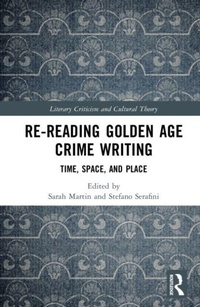
Re-Reading Golden Age Crime Writing
Description
Re-Reading Golden Age Crime Writing: Time, Space, and Place intervenes in debates on crime literature by offering the first sustained analysis of British and American Golden Age fiction, broadly spanning the 1910s to the 1950s, through the interrelated yet analytically distinct frameworks of time, space, and place.
It shows how each dimension shapes both the genre and individual texts, and how their interactions generate specific narrative, thematic, and ideological effects. Building on recent scholarship that understands crime fiction as mobile, composite, and open to continual reinterpretation, the volume foregrounds the thematic richness, theoretical sophistication, and experimental energies of Golden Age writing. It proposes a coherent critical framework and flexible set of tools for rethinking the genre. Drawing on paradigms such as Bakhtin's chronotope, islandness, heterotopia, human geography, hauntology, psychogeography, and spatial discourse analysis, the contributors demonstrate how time, space, and place structure narrative possibility, organise perception, and mediate questions of crime, knowledge, justice, and power.
Combining diverse theoretical paradigms, the book shows how these dimensions shape narrative possibility and mediate questions of crime, knowledge, justice, and power, reconceptualising the genre's formal and ideological complexity.
More details
Other editions
Additional editions

Persons
Sarah Martin is a Visiting Lecturer in Crime Fiction at the University of Chester where she recently gained her PhD. She is Co-Director of Golden Age Mysteries ltd., who run the Agatha Christie and Golden Age of Crime conferences, and has published widely on Golden Age Detective Fiction.
Stefano Serafini an EU Marie Sk¿odowska-Curie Postdoctoral Fellow at Georgetown University and the University of Padua. He is the author of Gothic Italy: Crime, Science and Literature after Unification (University of Toronto Press, 2024) and Italian Crime Fiction Revisited: Authority, Detection, and the Supernatural, 1861-1941 (Palgrave Macmillan, 2025).
Content
Introduction Sarah Martin and Stefano Serafini; Chapter 1. 'It doesn't keep particularly good time': Adolescence, Time and Timelessness in the Early Nancy Drew Books; Chapter 2. Time Out in and from Murder Is Easy; 'I had no idea that I was contributing to the rewriting of history': Chapter 3. Temporality, Hauntological Spectres, and the Time-Travelling Detective in Josephine Tey's The Daughter of Time; Chapter 4. 'Everything is Known on Board a Ship': The Heterotopic Closed Community in Rufus King's Murder by Latitude; Chapter 5. Wild Spaces: Domestic Bewilderment in the Novels of Christianna Brand; Chapter 6. Subverting the Surplus Woman: The Psychogeographic Spinster Detective in Unnatural Death; Chapter 7. 'Tir nan Og Is Just One Jump West': Therapeutic Landscapes in Josephine Tey's The Singing Sands; Chapter 8. 'When things become a little abnormal': Place and Character Psychology in Gladys Mitchell's The Rising of the Moon; Chapter 9. 'Here be dragons to be slain': Dorothy L. Sayers, Place and Disruptive Detection