

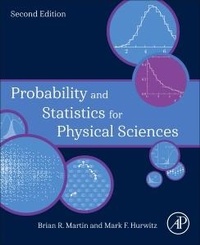
Probability and Statistics for Physical Sciences
2nd Edition
Published on 7. December 2023
Book
Paperback/Softback
416 pages
978-0-443-18969-2 (ISBN)
Description
Probability and Statistics for Physical Sciences, Second Edition is an accessible guide to commonly used concepts and methods in statistical analysis used in the physical sciences. This brief yet systematic introduction explains the origin of key techniques, providing mathematical background and useful formulas. The text does not assume any background in statistics and is appropriate for a wide-variety of readers, from first-year undergraduate students to working scientists across many disciplines.
More details
Edition
2nd edition
Language
English
Place of publication
San Diego
United States
Publishing group
Elsevier Science Publishing Co Inc
Target group
College/higher education
Product notice
Paperback (trade)
Unsewn / adhesive bound
Dimensions
Height: 231 mm
Width: 191 mm
Thickness: 25 mm
Weight
839 gr
ISBN-13
978-0-443-18969-2 (9780443189692)
Copyright in bibliographic data and cover images is held by Nielsen Book Services Limited or by the publishers or by their respective licensors: all rights reserved.
Schweitzer Classification
Other editions
Additional editions
Brian Martin | Mark Hurwitz
Probability and Statistics for Physical Sciences
E-Book
09/2023
2nd Edition
Academic Press
€70.95
Available for download
Previous edition
Book
02/2012
Academic Press
€59.41
Article exhausted; check for reprint
Persons
Prof. Brian R. Martin graduated from Birmingham University with a BSc in Physics and then moved to University College London (1962-1965) to take a PhD in Theoretical Physics. He was a Ford Foundation Fellow at the Institute for Theoretical Physics, Copenhagen University, Copenhagen; a NATO Postdoctoral Fellowship at the Neils Bohr Institute, Copenhagen; and a Research Associate in the Physics Department of Brookhaven National Laboratory, New York. Returning to University College London, he served as a Lecturer, then a Reader and Professor, before becoming Head of Department (1993-2004). Professor Martin retired as Professor Emeritus in October 2005. Dr. Mark F. Hurwitz graduated from Northwestern University with a BS in Mechanical Engineering and then worked as an engineer at Xerox Corporation while earning an MS in Mechanical and Aerospace Engineering at the University of Rochester. He earned a PhD at Cornell University in Theoretical and Applied Mechanics during an extensive R&D career in the filtration and separations industry at Pall Corporation, where he was inventor of 12 US patents with multiple foreign cognates. Returning to Cornell University, he was an Adjunct Professor in the Robert Frederick Smith School of Chemical and Biomolecular Engineering, before moving to administration and becoming the Chief Research Compliance Officer.
Content
1. Statistics, Experiments, and Data
2. Probability
3. Probability Distributions I: Basic Concepts
4. Probability Distributions II: Examples
5. Sampling and Estimation
6. Sampling Distributions Associated with the Normal Distribution
7. Parameter Estimation I: Maximum Likelihood and Minimum Variance
8. Parameter Estimation II: Least-Squares and Other Methods
9. Interval Estimation
10. Hypothesis Testing I: Parameters
11. Hypothesis Testing II: Other Tests
Appendices
1. Miscellaneous Mathematics
2. Optimization of Nonlinear Functions
3. Statistical Tables
4. Answers to Selected Problems
2. Probability
3. Probability Distributions I: Basic Concepts
4. Probability Distributions II: Examples
5. Sampling and Estimation
6. Sampling Distributions Associated with the Normal Distribution
7. Parameter Estimation I: Maximum Likelihood and Minimum Variance
8. Parameter Estimation II: Least-Squares and Other Methods
9. Interval Estimation
10. Hypothesis Testing I: Parameters
11. Hypothesis Testing II: Other Tests
Appendices
1. Miscellaneous Mathematics
2. Optimization of Nonlinear Functions
3. Statistical Tables
4. Answers to Selected Problems