

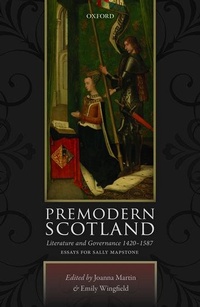
Premodern Scotland
Literature and Governance 1420-1587
Published on 22. June 2017
Book
Hardback
268 pages
978-0-19-878752-5 (ISBN)
Description
Premodern Scotland: Literature and Governance 1420-1587 brings together original essays by a group of international scholars to offer fresh and ground-breaking research into the 'advice to princes' tradition and related themes of good self- and public governance in Older Scots literature, and in Latin literature composed in Scotland in the fifteenth, sixteenth, and early seventeenth centuries.
The volume brings to the fore texts both from and about the royal court in a variety of genres, including satire, tragedy, complaint, dream vision, chronicle, epic, romance, and devotional and didactic treatise, and considers texts composed for noble readers and for a wider readership able to access printed material. The writers and texts studied include Bower's Scotichronicon, Henryson's Testament of Cresseid, and Gavin Douglas's Eneados. Lesser known authors and texts also receive much-needed critical attention, and include Richard Holland's, The Buke of the Howlat, chronicles by Andrew of Wyntoun, Hector Boece, and John Bellenden, and poetry by sixteenth-century writers such as Robert Sempill, John Rolland of Dalkeith, and William Lauder. Non-literary texts, such as the Parliamentary 'Aberdeen Articles' further deepen the discussion of the volume's theme. Writing from south of the Border, which provoked creative responses in Scots authors, and which were themselves inflected by the idea of Scotland and its literature, are also considered and include the Troy Book by John Lydgate, and Malory's Le Morte Darthur. With a focus on historical and material context, contributors explore the ways in which these texts engage with notions of the self and with advisory subjects both specific to particular Stewart monarchs and of more general political applicability in Scotland in the late medieval and early modern periods.
The volume brings to the fore texts both from and about the royal court in a variety of genres, including satire, tragedy, complaint, dream vision, chronicle, epic, romance, and devotional and didactic treatise, and considers texts composed for noble readers and for a wider readership able to access printed material. The writers and texts studied include Bower's Scotichronicon, Henryson's Testament of Cresseid, and Gavin Douglas's Eneados. Lesser known authors and texts also receive much-needed critical attention, and include Richard Holland's, The Buke of the Howlat, chronicles by Andrew of Wyntoun, Hector Boece, and John Bellenden, and poetry by sixteenth-century writers such as Robert Sempill, John Rolland of Dalkeith, and William Lauder. Non-literary texts, such as the Parliamentary 'Aberdeen Articles' further deepen the discussion of the volume's theme. Writing from south of the Border, which provoked creative responses in Scots authors, and which were themselves inflected by the idea of Scotland and its literature, are also considered and include the Troy Book by John Lydgate, and Malory's Le Morte Darthur. With a focus on historical and material context, contributors explore the ways in which these texts engage with notions of the self and with advisory subjects both specific to particular Stewart monarchs and of more general political applicability in Scotland in the late medieval and early modern periods.
Reviews / Votes
Martin and Wingfield have excelled as editors in bringing together essays that both reflect and honor the scholarship of Mapstone and her influence on the academic work of so many in the field of Older Scots, and demonstrate the complexity of the state of the field. This is a particularly welcome volume that will prompt further examination of the texts and themes it showcases, not only from its contributors but also through its influence on future scholarship. * Kate Ash-Irisarri, Speculum * This excellent collection of essays showcases the work of some of the leading early and mid-career scholars of Older Scots literature and culture ... turn with pleasure to the careful scholarship of the essays in Premodern Scotland. * John J. McGavin, Modern Language Review *More details
Language
English
Place of publication
Oxford
United Kingdom
Product notice
sewn/stitched
Cloth over boards
Illustrations
2 halftones
Dimensions
Height: 236 mm
Width: 152 mm
Thickness: 23 mm
Weight
590 gr
ISBN-13
978-0-19-878752-5 (9780198787525)
Copyright in bibliographic data and cover images is held by Nielsen Book Services Limited or by the publishers or by their respective licensors: all rights reserved.
Schweitzer Classification
Other editions
Additional editions
E-Book
06/2017
1st Edition
OUP eBook
€54.49
Available for download
E-Book
06/2017
1st Edition
OUP eBook
€54.49
Available for download
Persons
Joanna Martin is Associate Professor of Middle English and Older Scots at the University of Nottingham, having been a Darby Fellow at Lincoln College, Oxford. She has published on aspects of Middle English writing, including that of Gower and Lydgate, on Anglo-Scottish literary relations, and on Older Scots literary and book history. She is the author of Kingship and Love in Scottish Poetry (Ashgate, 2008) and The Maitland Quarto: A New Edition of Cambridge, Magdalene College, Pepys Library MS 1408, published for the Scottish Text Society in 2015.
Emily Wingfield is a Lecturer in English at the University of Birmingham. Previously she held a Junior Research Fellowship at Churchill College, Cambridge, and completed her D.Phil. on 'The Manuscripts and Print Contexts of Older Scots Romance' at Oxford. She has published widely on Older Scots romance and book history, and completed a monograph on The Trojan Legend in Medieval Scottish Literature (D.S. Brewer, 2014).
Emily Wingfield is a Lecturer in English at the University of Birmingham. Previously she held a Junior Research Fellowship at Churchill College, Cambridge, and completed her D.Phil. on 'The Manuscripts and Print Contexts of Older Scots Romance' at Oxford. She has published widely on Older Scots romance and book history, and completed a monograph on The Trojan Legend in Medieval Scottish Literature (D.S. Brewer, 2014).
Content
- Foreword
- Introduction: 'He Rewlis Weill That Weill Him Self Can Gyd'
- Part I
- 1: Emily Wingfield: 'Qwhen Alexander Our Kynge Was Dede': Kingship and Good Governance in Andrew of Wytoun's Original Chronicle'
- 2: Kylie Murray: Appetite, Desire, and Excess in Bower's Scotichronicon and Older Scots Poetry
- 3: Rebecca Marsland: Lament For The Dead In Fifteenth-Century Scotland
- 4: W.H.E. Sweet: The 'Vther Quair' as the Troy Book: The Influence of Lydgate on Henryson's Testament of Cresseid
- 5: Anne Kelly: Richard Holland's Buke of the Howlat and Chaucer
- 6: Kate McClune: 'He Was But A Yong Man': Age, Kingship, and Arthur
- 7: Anna McHugh: The Aberdeen Articles: A Twice-Told Tale
- 8: Melissa Coll-Smith: Royal Devotion and Cultic Promotion: James IV's Dedications to Saints
- Part II
- 9: Nicola Royan: The Noble Identity of Gavin Douglas
- 10: Thomas Rutlege: Reading and Writing History: John Bellenden's Livy
- 11: Ryoko Harikae: 'Daunting' The Isles, Borders, and Highland: Imperial Kingship in John Bellenden's Chronicles of Scotland and the Mar Lodge Translation
- 12: Joanna Martin: William Lauder: The Speculum Principis in the Sixteenth Century
- 13: Sarah Couper: Informed Choice: The Knowing Morality of John Rolland's Court of Venus
- 14: Tricia McElroy: The Uses of Genre and Gender in 'The Dialogue of the Twa Wyfeis'
- 15: Sebastiaan Verweij: King Darius in the Archives
- Afterword