

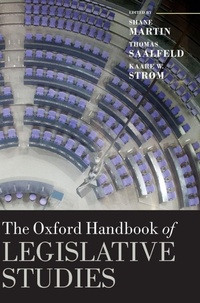
The Oxford Handbook of Legislative Studies
Published on 19. June 2014
Book
Hardback
776 pages
978-0-19-965301-0 (ISBN)
Description
Legislatures are political bodies essential to democracy and the rule of law. They present social scientists with numerous intriguing puzzles, with far-reaching implications for our understanding of political institutions. Why, and how, have these ancient assemblies, established in pre-democratic times, survived the transition to mass democracies? How have they adapted? How do they structure such processes as budgeting, legislation, and executive oversight? How do their members get selected, and what consequences flow from differences in these rules? What roles do committees and political parties play in contemporary legislatures? What functions do legislatures perform in autocratic, semi-democratic or recently democratized societies? What explains the similarities and differences in legislative rules, powers and recruitment? What are the policy and other consequences of variation in how legislatures are organized and function?
The 33 chapters in The Oxford Handbook of Legislative Studies, written by 47 of the most distinguished legislative scholars, provide a comprehensive and up-to-date description and assessment of the state of the art in legislative studies. Key themes explored include theoretical paradigms and methodological approaches to the study of legislatures, representation and legislative careers, internal organization, the role of parties within legislatures and the role of legislatures in policy making and accountability. The Handbook also explores the emergence of parliaments in historical and contemporary contexts, including new democracies and trans-national institutions.
The 33 chapters in The Oxford Handbook of Legislative Studies, written by 47 of the most distinguished legislative scholars, provide a comprehensive and up-to-date description and assessment of the state of the art in legislative studies. Key themes explored include theoretical paradigms and methodological approaches to the study of legislatures, representation and legislative careers, internal organization, the role of parties within legislatures and the role of legislatures in policy making and accountability. The Handbook also explores the emergence of parliaments in historical and contemporary contexts, including new democracies and trans-national institutions.
Reviews / Votes
This Handbook is fundamental reading for all scholars devoted to the study of political institutions, political parties and legislative studies. * Eugenio Salvati, Political Studies Review *More details
Series
Language
English
Place of publication
Oxford
United Kingdom
Target group
College/higher education
Dimensions
Height: 250 mm
Width: 175 mm
Thickness: 46 mm
Weight
1493 gr
ISBN-13
978-0-19-965301-0 (9780199653010)
Copyright in bibliographic data and cover images is held by Nielsen Book Services Limited or by the publishers or by their respective licensors: all rights reserved.
Schweitzer Classification
Other editions
Additional editions
Shane Martin | Thomas Saalfeld | Kaare W. Strom
The Oxford Handbook of Legislative Studies
Book
07/2016
Oxford University Press
€68.40
Shipment within 15-20 days
Shane Martin | Thomas Saalfeld | Kaare W. Strøm
The Oxford Handbook of Legislative Studies
E-Book
06/2014
1st Edition
OUP eBook
€24.99
Available for download
Shane Martin | Thomas Saalfeld | Kaare W. Strøm
The Oxford Handbook of Legislative Studies
E-Book
06/2014
1st Edition
OUP eBook
€24.99
Available for download
Persons
Shane Martin is Reader in Comparative Politics, University of Leicester.
Thomas Saalfeld is Professor of Political Science at the University of Bamberg and the founding Director of the Bamberg Graduate School of Social Sciences.
Kaare W. Strom is Distinguished Professor of Political Science at the University of California, San Diego.
Thomas Saalfeld is Professor of Political Science at the University of Bamberg and the founding Director of the Bamberg Graduate School of Social Sciences.
Kaare W. Strom is Distinguished Professor of Political Science at the University of California, San Diego.
Editor
Reader in Comparative PoliticsReader in Comparative Politics, University of Leicester
Professor of Political Science and the founding Director of the Bamberg Graduate School of Social SciencesProfessor of Political Science and the founding Director of the Bamberg Graduate School of Social Sciences, University of Bamberg
Distinguished Professor of Political ScienceDistinguished Professor of Political Science, University of California, San Diego
Content
PART I: THEORIES; PART II: METHODS; PART III: REPRESENTATION AND LEGISLATIVE CAREERS; PART IV: ORGANISATION AND RULES; PART V: PARTIES IN THE LEGISLATURE; PART VI: POLICY MAKING AND OVERSIGHT; PART VII: EXPANDING THE SCOPE OF LEGISLATIVE ANALYSIS