

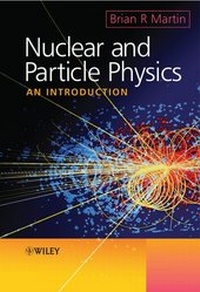
Nuclear and Particle Physics
An Introduction
1st Edition
Published on 3. March 2006
Book
Hardback
428 pages
978-0-470-01999-3 (ISBN)
Description
This text is an accessible, balanced introduction to nuclear and particle physics and is suitable for those taking short courses in the subject. It provides a readable and up-to-date overview of both the theoretical and experimental aspects of nuclear and particle physics. It also includes a comprehensive set of problems at the end of each chapter, plus solutions.
Reviews / Votes
"Enthusiastically recommended as a useful addition to any college or university library." (CHOICE, December 2006)More details
Edition
1., Auflage
Language
English
Place of publication
Chichester
United Kingdom
Publishing group
John Wiley and Sons Ltd
Target group
Professional and scholarly
Illustrations
Illustrations
Dimensions
Height: 25 cm
Width: 18.1 cm
Weight
956 gr
ISBN-13
978-0-470-01999-3 (9780470019993)
Schweitzer Classification
Other editions
New editions
Book
02/2009
2nd Edition
Wiley
€172.00
Article exhausted; check for reprint
Person
Professor Brian R Martin, Department of Physics and Astronomy, University College London, UK
Content
Preface.
Notes.
Physical Constants and Conversion Factors.
1. Basic Concepts.
1.1 History.
1.2 Relativity and antiparticles.
1.3 Symmetries and conversion laws.
1.4 Interactions and Feynman diagrams.
1.5 Particle exchange: forces and potentials.
1.6 Observable quantities: cross sections and decay rates.
1.7 Units: length, mass and energy.
Problems.
2. Nuclear Phenomenology.
2.1 Mass spectroscopy and binding energies.
2.2 Nuclear shapes and sizes.
2.3 Nuclear instability.
2.4 Radioactive decay.
2.5 Semi-empirical mass formula: the liquid drop model.
2.6 B-decay phenomenology.
2.7 Fission.
2.8 Y-decays.
2.9 Nuclear reactions.
Problems.
3. Particle Phenomenology.
3.1 Leptons
3.2 Quarks.
3.3 Hadrons.
Problems.
4. Experimental Methods.
4.1 Overview.
4.2 Accelerations and beams.
4.3 Particle interactions with matter.
4.4 Particle detectors.
4.5 Layered detectors.
Problems.
5. Quark Dynamics: the Strong Interaction.
5.1 Colour.
5.2 Quantum chromodynamics (QCD).
5.3 Heavy quark bound states.
5.4 The strong coupling constant and asymptotic freedom.
5.5 Jets and gluons.
5.6 Colour counting.
5.7 Deep inelastic scattering and nucleon structure.
Problems.
6. Electroweak Interactions.
6.1 Charged and neutral currents.
6.2 Symmetries of the weak interaction.
6.3 Spin structure of the weak interactions.
6.4 W and Zo bosons.
6.5 Weak interactions of hadrons.
6.6 Neutral messon decays.
6.7 Neutral currents and the unified theory.
Problems.
7. Models and Theories of Nuclear Physics.
7.1 The nucleon-nucleon potential.
7.2 Fermi gas model.
7.3 Shell model.
7.4 Non-spherical nuclei.
7.5 Summary of nuclear structure models.
7.6 cx -decay.
7.7 B-decay.
7.8 Y-emission and internal conversion.
Problems.
8. Applications of Nuclear Physics.
8.1 Fission.
8.2 Fusion.
8.3 Biomedical applications.
Problems.
9. Outstanding Questions and Future Prospects.
9.1 Particle physics.
9.2 Nuclear physics.
Appendix A: Some Results in Quantum Mechanics.
A.1 Barrier Penetration.
A.2 Density of states.
A.3 Perturbation theory and the second golden rule.
Appendix B: Relativistic Kinematics.
B.1 Morentz transformations and four-vectors.
B.2 Frames of reference.
B.3 Invariants.
Problems.
Appendix C: Rutherford Scattering.
C.1 Classical physics.
C.2 Quantum mechanics.
Problems.
Appendix D: Solutions to Problems.
Bibliography.
References.
Index.
Notes.
Physical Constants and Conversion Factors.
1. Basic Concepts.
1.1 History.
1.2 Relativity and antiparticles.
1.3 Symmetries and conversion laws.
1.4 Interactions and Feynman diagrams.
1.5 Particle exchange: forces and potentials.
1.6 Observable quantities: cross sections and decay rates.
1.7 Units: length, mass and energy.
Problems.
2. Nuclear Phenomenology.
2.1 Mass spectroscopy and binding energies.
2.2 Nuclear shapes and sizes.
2.3 Nuclear instability.
2.4 Radioactive decay.
2.5 Semi-empirical mass formula: the liquid drop model.
2.6 B-decay phenomenology.
2.7 Fission.
2.8 Y-decays.
2.9 Nuclear reactions.
Problems.
3. Particle Phenomenology.
3.1 Leptons
3.2 Quarks.
3.3 Hadrons.
Problems.
4. Experimental Methods.
4.1 Overview.
4.2 Accelerations and beams.
4.3 Particle interactions with matter.
4.4 Particle detectors.
4.5 Layered detectors.
Problems.
5. Quark Dynamics: the Strong Interaction.
5.1 Colour.
5.2 Quantum chromodynamics (QCD).
5.3 Heavy quark bound states.
5.4 The strong coupling constant and asymptotic freedom.
5.5 Jets and gluons.
5.6 Colour counting.
5.7 Deep inelastic scattering and nucleon structure.
Problems.
6. Electroweak Interactions.
6.1 Charged and neutral currents.
6.2 Symmetries of the weak interaction.
6.3 Spin structure of the weak interactions.
6.4 W and Zo bosons.
6.5 Weak interactions of hadrons.
6.6 Neutral messon decays.
6.7 Neutral currents and the unified theory.
Problems.
7. Models and Theories of Nuclear Physics.
7.1 The nucleon-nucleon potential.
7.2 Fermi gas model.
7.3 Shell model.
7.4 Non-spherical nuclei.
7.5 Summary of nuclear structure models.
7.6 cx -decay.
7.7 B-decay.
7.8 Y-emission and internal conversion.
Problems.
8. Applications of Nuclear Physics.
8.1 Fission.
8.2 Fusion.
8.3 Biomedical applications.
Problems.
9. Outstanding Questions and Future Prospects.
9.1 Particle physics.
9.2 Nuclear physics.
Appendix A: Some Results in Quantum Mechanics.
A.1 Barrier Penetration.
A.2 Density of states.
A.3 Perturbation theory and the second golden rule.
Appendix B: Relativistic Kinematics.
B.1 Morentz transformations and four-vectors.
B.2 Frames of reference.
B.3 Invariants.
Problems.
Appendix C: Rutherford Scattering.
C.1 Classical physics.
C.2 Quantum mechanics.
Problems.
Appendix D: Solutions to Problems.
Bibliography.
References.
Index.