

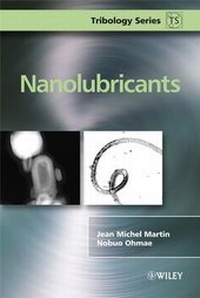
Nanolubricants
Will be published approx. on 18. April 2008
Book
Hardback
246 pages
978-0-470-06552-5 (ISBN)
Description
The technology involved in lubrication by nanoparticles is a rapidly developing scientific area and one that has been watched with interest for the past ten years. Nanolubrication offers a solution to many problems associated with traditional lubricants that contain sulphur and phosphorus; and though for some time the production of nanoparticles was restricted by the technologies available, today synthesis methods have been improved to such a level that it is possible to produce large quantities relatively cheaply and efficiently.
Nanolubricants develops a new concept of lubrication, based on these nanoparticles, and along with the authors' own research it synthesises the information available on the topic of nanolubrication from existing literature and presents it in a concise form.
* Describes the many advantages and potential applications of nanotechnology in the tribological field.
* Offers a full review of the state-of-the-art as well as much original research that is yet unpublished.
* Includes sections on boundary lubrication by colloïdal systems, nanolubricants made of metal dichalcogenides, carbon-based nanolubricants, overbased detergent salts, nanolubricants made of metals and boron-based solid nanolubricants and lubrication additives.
* Authored by highly regarded experts in the field with contributions from leading international academics.
Nanolubricants will appeal to postgraduate students, academics and researchers in mechanical engineering, chemical engineering and materials science. It should also be of interest to practising engineers with petroleum companies and mechanical manufacturers.
More details
Product info
gebunden
Series
Edition
1. Auflage
Language
English
Place of publication
New York
United States
Target group
Professional and scholarly
Product notice
sewn/stitched
Cloth over boards
Dimensions
Height: 252 mm
Width: 172 mm
Thickness: 25 mm
Weight
610 gr
ISBN-13
978-0-470-06552-5 (9780470065525)
Schweitzer Classification
Other editions
Additional editions
Persons
Jean Michel Martin is a professor at the Ecole Centrale de Lyon in France where he served for 5 years as director of the materials science department. He has authored 130 journal papers and 4 book chapters.
Nobuo Ohmae is a professor at Kobo University in Japan, where he has served as head of department of mechanical engineering and chaired the International Tribology Conference in 2005. He has authored 135 journal articles and 10 book chapters.
Nobuo Ohmae is a professor at Kobo University in Japan, where he has served as head of department of mechanical engineering and chaired the International Tribology Conference in 2005. He has authored 135 journal articles and 10 book chapters.
Content
Preface.
List of Acronyms.
1 Colloidal Lubrication (Jean Michel Martin and Nobuo Ohmae).
1.1 Stability of Colloids Dispersed in a Base Oil.
1.2 Lubrication by Micellar Systems.
1.3 Lubrication by Metallic Nanoparticles.
1.4 Colloids Embedded in a Coating.
References.
2 Nanoparticles Made of Metal Dichalcogenides (Lucile Joly-Pottuz and Fabrice Dassenoy).
2.1 Tribological Properties of 2H-MoS2.
2.2 IF-MoS2 and IF-WS2 Fullerene-like Nanoparticles.
2.3 IF-MoS2 and IF-WS2 as Additives in Boundary Lubrication.
2.4 NT-MoS2 and NT-WS2 Nanotubes as Lubricant Additives.
2.5 Lubrication by a Mixture of Fullerenes.
2.6 Tribological Properties of Mo-S-I Nanowires.
2.7 Raman Tribometry on IF-MS2.
2.8 Lubrication Mechanism of IF-MS2: 'A Drug Delivery' Model.
2.9 Conclusion 88
Acknowledgements.
References.
3 Carbon-Based Nanolubricants (Lucile Joly-Pottuz and Nobuo Ohmae).
3.1 Graphite Onion Synthesis and Characterization.
3.2 Tribological Properties of Different Carbon Onions.
3.3 Possible Lubrication Mechanism of Carbon Onions.
3.4 Nanotube Synthesis and Characterization.
3.5 Friction-Reducing and Antiwear Properties of Different Nanotubes.
3.6 Possible Mechanism of Action of the Nanotubes.
3.7 Conclusion.
Acknowledgements.
References.
4 Reverse Micelles and Encapsulated Nanoparticle Approaches (Jean Louis Mansot and Jean Michel Martin).
4.1 Introduction.
4.2 Overview of the Structures of Stoichiometric and Overbased Soap Additives.
4.3 Behaviour of the Micelles at the Solid-Liquid Interface.
4.4 Tribologic Properties of Colloidal Systems.
4.5 Conclusion and Perspectives.
References.
5 Nanolubricants Made of Metals (Weimin Liu and Xiaobo Wang).
5.1 Introduction.
5.2 Nanolubricants Made of Coinage Metal Nanoparticles.
5.3 Nanolubricants Made of Low Melting Point Metal Nanoparticles.
5.4 Nanolubricants Made of Low Melting Point Metal Alloy Nanoparticles.
5.5 Mechanism of Metal Nanoparticles Used as Oil Additives.
5.6 Perspective.
References.
6 Boron-Based Solid Nanolubricants and Lubrication Additives (Ali Erdemir).
6.1 Introduction.
6.2 Brief Overview of Boron and Its Self-Lubricating Compounds.
6.3 Lubrication by Colloidal Boric Acid Nanoparticles and Other Boron Compounds.
6.4 Lubrication Mechanism of Nano-Boric Acid Colloids in Oils.
6.5 Summary.
Acknowledgement.
References.
Appendix Tribometers Used for the Studies of Chapters 2 and 3.
A.1 Environmental Pin-on-Flat Tribometer.
A.2 Mobile Pin-on-Flat Tribometer.
A.3 Ultrahigh Vacuum Tribometer.
Reference.
Index.