

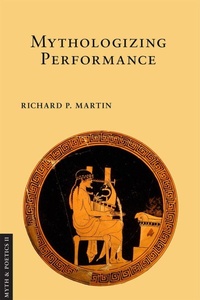
Mythologizing Performance
Published on 15. October 2020
Book
Hardback
540 pages
978-1-5017-1309-5 (ISBN)
Description
Building on numerous original close readings of works by Homer, Hesiod, and other ancient Greek poets, Richard P. Martin articulates a broad and precise poetics of archaic Greek verse. The ancient Greek hexameter poetry of such works as the Iliad and the Odyssey differ from most modern verbal art because it was composed for live, face-to-face performance, often in a competitive setting, before an audience well versed in mythological and ritual lore. The essays collected here span Martin's acclaimed career and explore ways of reading this poetic heritage using principles and evidence from the comparative study of oral traditions, literary and speech-act theories, and the ethnographic record.
Among topics analyzed in depth are the narrative structures of Homer's epics, the Hesiodic Works and Days, and the Homeric Hymn to Apollo; the characterization of poetic and musical performers within the poems; the social context for verses ascribed to the legendary singer Orpheus; the significance of various rituals as stylized by poetic performances; and the interrelations, at the level of diction and theme, among the major genres of epic and hymn, as well as "genres of speaking" such as lament, praise, advice, and proverbial wisdom.
Among topics analyzed in depth are the narrative structures of Homer's epics, the Hesiodic Works and Days, and the Homeric Hymn to Apollo; the characterization of poetic and musical performers within the poems; the social context for verses ascribed to the legendary singer Orpheus; the significance of various rituals as stylized by poetic performances; and the interrelations, at the level of diction and theme, among the major genres of epic and hymn, as well as "genres of speaking" such as lament, praise, advice, and proverbial wisdom.
Reviews / Votes
"Martin's book is a major collection from one of the most significant scholars of archaic poetry working in the past several decades. In this richly synoptic and synthetic meditation on the complex workings of archaic poetry, Martin builds on and brilliantly transfigures the implications of oral poetics for any study of archaic (and Hellenistic) poetry-and indeed for poetics as a whole." -- Laura Slatkin, Professor of Classics, New York UniversityMore details
Series
Language
English
Place of publication
Ithaca
United States
Target group
College/higher education
Professional and scholarly
Product notice
Paper over boards
Dimensions
Height: 236 mm
Width: 161 mm
Thickness: 41 mm
Weight
896 gr
ISBN-13
978-1-5017-1309-5 (9781501713095)
Copyright in bibliographic data and cover images is held by Nielsen Book Services Limited or by the publishers or by their respective licensors: all rights reserved.
Schweitzer Classification
Other editions
Additional editions
Richard P. Martin
Mythologizing Performance
E-Book
02/2025
Cornell University Press
€0.00
Available for download
Person
Richard P. Martin is the Antony and Isabelle Raubitschek Professor of Classics at Stanford University. Among his many books are Classical Mythology and The Language of Heroes.
Content
Introduction
Part I: Epic Genre and Technique
1. Epic as Genre
2. Similes and Performance
3. Formulas and Speeches: The Usefulness of Parry's Method
4. Wrapping Homer Up: Cohesion, Discourse, and Deviation in the Iliad
Part II: Mythic Hymnists, Historical Performers
5. Apollo's Kithara and Poseidon's Crash-Test: Ritual and Contest in the Evolution of Greek Aesthetics
6. The Senses of an Ending: Myth, Ritual, and Poetic Exodia in Performance
7. Synchronic Aspects of Homeric Performance: The Evidence of the Hymn to Apollo
8. Rhapsodizing Orpheus
9. Golden Verses: Voice and Authority in the Tablets
Part III: Hesiodic Constructions
10. Hesiod and the Didactic Double
11. Hesiod's Metanastic Poetics
12. Hesiod, Odysseus, and the Instruction of Princes
13. Pulp Epic: The Catalogue and the Shield
Part IV: The Backward Look
14. Keens from the Absent Chorus: Troy to Ulster
15. Telemachus and the Last Hero Song
16. Until It Ends: Varieties of Iliadic Anticipation
17. Distant Landmarks: Homer and Hesiod
Part I: Epic Genre and Technique
1. Epic as Genre
2. Similes and Performance
3. Formulas and Speeches: The Usefulness of Parry's Method
4. Wrapping Homer Up: Cohesion, Discourse, and Deviation in the Iliad
Part II: Mythic Hymnists, Historical Performers
5. Apollo's Kithara and Poseidon's Crash-Test: Ritual and Contest in the Evolution of Greek Aesthetics
6. The Senses of an Ending: Myth, Ritual, and Poetic Exodia in Performance
7. Synchronic Aspects of Homeric Performance: The Evidence of the Hymn to Apollo
8. Rhapsodizing Orpheus
9. Golden Verses: Voice and Authority in the Tablets
Part III: Hesiodic Constructions
10. Hesiod and the Didactic Double
11. Hesiod's Metanastic Poetics
12. Hesiod, Odysseus, and the Instruction of Princes
13. Pulp Epic: The Catalogue and the Shield
Part IV: The Backward Look
14. Keens from the Absent Chorus: Troy to Ulster
15. Telemachus and the Last Hero Song
16. Until It Ends: Varieties of Iliadic Anticipation
17. Distant Landmarks: Homer and Hesiod