

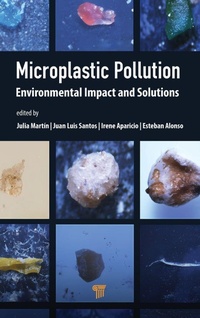
Microplastic Pollution
Environmental Impact and Solutions
1st Edition
Published on 3. November 2025
Book
Hardback
356 pages
978-981-5129-77-9 (ISBN)
Description
Microplastic pollution is an increasingly important issue in science, industry, and politics. This book presents global case studies from fields such as materials science, analytical chemistry, toxicology, and public health. It explores the widespread presence of microplastics in the environment and details the methods used for their detection, separation, and identification in complex environmental samples. The book examines the fate and transport of microplastics in wastewater treatment plants and natural ecosystems, providing regional classifications and identifying key sources. It also discusses how microplastics act as vectors for hazardous chemicals and how exposure and co-exposure to these pollutants affect aquatic and terrestrial organisms. By combining diverse scientific perspectives, this book offers a comprehensive understanding of the environmental challenges posed by microplastics and aims to support research, policymaking, and strategies for pollution control and environmental protection.
More details
Language
English
Place of publication
Singapore
Target group
Professional and scholarly
College/higher education
Academic and Postgraduate
Illustrations
2 s/w Abbildungen, 30 farbige Abbildungen, 5 Farbfotos bzw. farbige Rasterbilder, 2 s/w Zeichnungen, 25 farbige Zeichnungen, 10 s/w Tabellen
10 Tables, black and white; 25 Line drawings, color; 2 Line drawings, black and white; 5 Halftones, color; 30 Illustrations, color; 2 Illustrations, black and white
Dimensions
Height: 235 mm
Width: 157 mm
Thickness: 24 mm
Weight
686 gr
ISBN-13
978-981-5129-77-9 (9789815129779)
Copyright in bibliographic data and cover images is held by Nielsen Book Services Limited or by the publishers or by their respective licensors: all rights reserved.
Schweitzer Classification
Other editions
Additional editions
Julia Martin | Juan Luis Santos | Irene Aparicio
Microplastic Pollution
Environmental Impact and Solutions
E-Book
11/2025
Taylor & Francis
€225.99
Available for download
Julia Martin | Juan Luis Santos | Irene Aparicio
Microplastic Pollution
Environmental Impact and Solutions
E-Book
11/2025
Taylor & Francis
€225.99
Available for download
Persons
Julia Martin is assistant professor of analytical chemistry, and her most relevant scientific contributions are in the field of environmental analytical chemistry, focusing on the dynamics of priority and emerging contaminants in different environmental scenarios and industrial facilities. She has participated in 25 research projects and contracts with companies and public institutions. She has published more than 120 scientific articles (h-index 42) and 30 book chapters.
Juan Luis Santos is full professor in the Department of Analytical Chemistry of the University of Seville, Spain. He is member of the research group Anquimed since 2004. He is an expert in chromatography and mass spectrometric analysis, has participated in more than 50 research projects and contracts, and is co-author of more than 130 scientific papers focused on the dynamics of organic and inorganic pollutants in the environment and on evaluating the environmental impact of these pollutants on organisms within affected environmental compartments.
Irene Aparicio is a full professor; secretary of the Department of Analytical Chemistry of the University of Seville, Spain; and a member of the research group Anquimed (Industrial and Environmental Chemical Analysis), since 2004. Her research is focused on the development of analytical methodologies for the determination of organic contaminants, mainly pharmaceuticals and metabolites, in environmental matrices and their application to fate, removal, and risk assessment studies.
Esteban Alonso is a full professor and director of the Department of Analytical Chemistry at the University of Seville. In 2004, he founded the research group Anquimed (Industrial and Environmental Chemical Analysis), with the purpose of improving specifically the knowledge about the dynamics of priority and emerging pollutants in several environmental scenarios and industrial installations. Before joining the University of Seville, he worked at the Center for New Water Technologies, a non-profit association of private firms and government agencies focused on the field of novel water technologies.
Juan Luis Santos is full professor in the Department of Analytical Chemistry of the University of Seville, Spain. He is member of the research group Anquimed since 2004. He is an expert in chromatography and mass spectrometric analysis, has participated in more than 50 research projects and contracts, and is co-author of more than 130 scientific papers focused on the dynamics of organic and inorganic pollutants in the environment and on evaluating the environmental impact of these pollutants on organisms within affected environmental compartments.
Irene Aparicio is a full professor; secretary of the Department of Analytical Chemistry of the University of Seville, Spain; and a member of the research group Anquimed (Industrial and Environmental Chemical Analysis), since 2004. Her research is focused on the development of analytical methodologies for the determination of organic contaminants, mainly pharmaceuticals and metabolites, in environmental matrices and their application to fate, removal, and risk assessment studies.
Esteban Alonso is a full professor and director of the Department of Analytical Chemistry at the University of Seville. In 2004, he founded the research group Anquimed (Industrial and Environmental Chemical Analysis), with the purpose of improving specifically the knowledge about the dynamics of priority and emerging pollutants in several environmental scenarios and industrial installations. Before joining the University of Seville, he worked at the Center for New Water Technologies, a non-profit association of private firms and government agencies focused on the field of novel water technologies.
Content
1. Microplastic Contamination: An Introduction to an Emerging Issue (Prof. Julia Martin et al., Scopus ID: 35488348500) 2. Analysis of Microplastics in Environmental Water by Pyrolysis-GC/MS (Prof. Luicia H.M.L.M. Santos et al., Scopus ID: 55947204900) 3. Analysis of Microplastics and Small Microplastics (<100 ?m) in Natural Waters via Micro-FTIR (Prof. Fabiana Corami et al., Scopus ID: 7801412352) 4. Occurrence, Characteristics, and Removal of Microplastics in Wastewater Treatment Plants (Prof. F.J. Bayo Bernal et al., Scopus ID: 7004332116) 5. Distribution of Marine Debris in the Mangroves of a Lagoon System (Prof. Behara Satyanarayana et al., Scopus ID: 7003346054) 6. Microplastic Pollution in Mountain Environments (Prof. Paolo Pastorino and Damia Barcelo, Scopus ID: 6701494091) 7. Microplastic Pollution in Antarctic Environments (Prof. Gabriel E. De-la-Torre et al., Scopus ID: 57219465541) 8. Microplastics as a Vector of Hazardous Contaminants: Plastic Chemicals, Digestive Physiology and the Need for Chemical Simplification (Prof. Farhan R. Khan et al., Scopus ID: 35315742500) 9. Microplastics as Potential Vector of Antibiotics in Aquatic Media: Environmental Implications (Prof. Esteban Alonso et al., Scopus ID: 55890374200) 10. Effects of Petroleum and Bio-micro(nano)plastics on Aquatic Organisms (Prof. Miguel Oliveira et al., Scopus ID: 57219552003)