

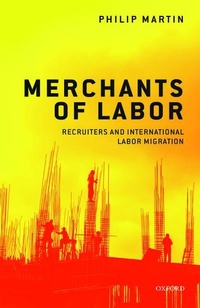
Merchants of Labor
Recruiters and International Labor Migration
Published on 3. August 2017
Book
Hardback
240 pages
978-0-19-880802-2 (ISBN)
Description
Some 10 million migrant workers cross national borders each year and, if they pay an average $1,000 to recruiters, moving workers over borders is a $10 billion a year business. Merchants of Labor examines the businesses that move low-skilled workers over national borders, asking how much they collect from migrant workers and what can be done to reduce worker-paid migration costs.
For-profit recruiters are likely to be an enduring feature of international labor migration, which makes developing tools to improve the management of their activities ever more crucial. The UN recognized in the Sustainable Development Goals for 2030 the need to measure what workers pay to get jobs in other countries with the goal of reducing worker-paid costs so that workers and their families can benefit more from international labor migration.
Using cost data from over 3,000 workers, Merchants of Labor examines the often murky world of labor brokers, travel agents, and others who move low-skilled workers from one country to another in order to explore lower worker-paid migration costs. It explains the three core functions of labor markets-- recruitment, remuneration, and retention-- and shows how national borders increase recruitment costs. New data on what workers pay to get jobs in other countries are presented, and incentives to complement enforcement are explored as a way to induce recruiters to protect migrant workers.
For-profit recruiters are likely to be an enduring feature of international labor migration, which makes developing tools to improve the management of their activities ever more crucial. The UN recognized in the Sustainable Development Goals for 2030 the need to measure what workers pay to get jobs in other countries with the goal of reducing worker-paid costs so that workers and their families can benefit more from international labor migration.
Using cost data from over 3,000 workers, Merchants of Labor examines the often murky world of labor brokers, travel agents, and others who move low-skilled workers from one country to another in order to explore lower worker-paid migration costs. It explains the three core functions of labor markets-- recruitment, remuneration, and retention-- and shows how national borders increase recruitment costs. New data on what workers pay to get jobs in other countries are presented, and incentives to complement enforcement are explored as a way to induce recruiters to protect migrant workers.
More details
Language
English
Place of publication
Oxford
United Kingdom
Target group
College/higher education
Product notice
sewn/stitched
Cloth over boards
Dimensions
Height: 238 mm
Width: 156 mm
Thickness: 22 mm
Weight
495 gr
ISBN-13
978-0-19-880802-2 (9780198808022)
Copyright in bibliographic data and cover images is held by Nielsen Book Services Limited or by the publishers or by their respective licensors: all rights reserved.
Schweitzer Classification
Other editions
Additional editions
E-Book
07/2017
1st Edition
OUP eBook
€29.99
Available for download
E-Book
07/2017
1st Edition
OUP eBook
€29.99
Available for download
Person
Philip Martin is Professor of Agricultural and Resource Economics at the University of California, Davis. He edits Rural Migration News, has served on several federal commissions, and testifies frequently before Congress. He is an award-winning author who works for UN agencies around the world on labor and migration issues.
Content
PART I. LABOR MIGRATION AND LABOR MARKETS; PART II. WHAT DO WORKERS PAY?; PART III. REGULATING RECRUITMENT