

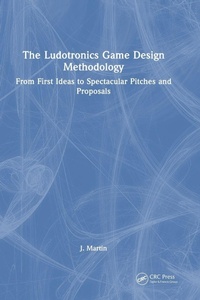
The Ludotronics Game Design Methodology
From First Ideas to Spectacular Pitches and Proposals
1st Edition
Published on 24. August 2023
Book
Hardback
264 pages
978-1-032-36962-4 (ISBN)
Description
This book supports readers to transition to more advanced independent game projects by deepening their understanding of the concept development process. It covers how to make concepts sufficiently viable, ambitious, and innovative to warrant the creation of a polished prototype in preparation of a publisher pitch.
The book is divided into six sections. After a brief tutorial (Preliminary Phase), readers embark on a journey along the book's methodology. They travel through successive conceptual phases (Preparations, Procedures, Processes, and Propositions); advance through levels and action beats in each of these phases; master challenges (conceptual tasks) and overcome level bosses (design decisions) that become successively harder; collect items (fulfilled documentation tasks); and "win" the game by having progressed from a raw, initial idea to a full-fledged, polished game treatment. Additional resources for the book are available at ludotronics.net.
This book is designed to support junior and senior year BA or MA students in game design programs, as well as novice indie developers and those in the early stages of their game design career.
The book is divided into six sections. After a brief tutorial (Preliminary Phase), readers embark on a journey along the book's methodology. They travel through successive conceptual phases (Preparations, Procedures, Processes, and Propositions); advance through levels and action beats in each of these phases; master challenges (conceptual tasks) and overcome level bosses (design decisions) that become successively harder; collect items (fulfilled documentation tasks); and "win" the game by having progressed from a raw, initial idea to a full-fledged, polished game treatment. Additional resources for the book are available at ludotronics.net.
This book is designed to support junior and senior year BA or MA students in game design programs, as well as novice indie developers and those in the early stages of their game design career.
More details
Language
English
Place of publication
London
United Kingdom
Publishing group
Taylor & Francis Ltd
Target group
College/higher education
Undergraduate Advanced and Undergraduate Core
Illustrations
65 s/w Zeichnungen, 65 s/w Abbildungen
65 Line drawings, black and white; 65 Illustrations, black and white
Dimensions
Height: 260 mm
Width: 183 mm
Thickness: 20 mm
Weight
723 gr
ISBN-13
978-1-032-36962-4 (9781032369624)
Copyright in bibliographic data and cover images is held by Nielsen Book Services Limited or by the publishers or by their respective licensors: all rights reserved.
Schweitzer Classification
Other editions
Additional editions
J. Martin
The Ludotronics Game Design Methodology
From First Ideas to Spectacular Pitches and Proposals
E-Book
08/2023
1st Edition
CRC Press
€67.49
Available for download
J. Martin
The Ludotronics Game Design Methodology
From First Ideas to Spectacular Pitches and Proposals
E-Book
08/2023
1st Edition
CRC Press
€67.49
Available for download
J. Martin
The Ludotronics Game Design Methodology
From First Ideas to Spectacular Pitches and Proposals
Book
08/2023
1st Edition
CRC Press
€71.60
Shipment within 10-20 days
Person
J. Martin is Professor of Game Design at the Mediadesign University for Applied Sciences, Duesseldorf, Germany.
Content
Phase 01: Preliminaries. 1. Level One: The Thing. 2. Level Two: The Map. 3. Level Three: The Stage. Phase 02: Preparations. 1. Level One: Spawning Ideas. 2. Level Two: Panning for the Core. 3. Level Three: Tough Investigations. 4. Level Four: An Army of Avatars. 5. Level Five: Enter the Value Matrix. 6. Level Six: Serve with Distinction. Phase 03: Procedures. 1. Level One: The Enchanted Theme. 2. Level Two: The Design-Driven Goal. 3. Level Three: The Desire-Driven Goal. Phase 04: Processes. 1. Level One: Integral Perspectives I. 2. Level Two: Interactivity. 3. Level Three: Plurimediality. 4. Level Four: Narrativity. 5. Level Five: Architectonics. 6. Level Six: Integral Perspectives II. Phase 05: Propositions. 1. Level One: Prototyping. 2. Level Two: Polishing. 3. Level Three: Presenting. Phase 06: Postmortems. 1. Level One: References. 2. Level Two: Rightsholders. 3. Level Three: Responses.