

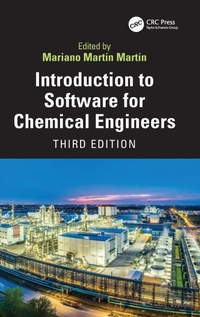
Introduction to Software for Chemical Engineers
3rd Edition
Published on 24. March 2025
Book
Hardback
864 pages
978-1-032-75096-5 (ISBN)
Description
The field of chemical engineering and its link to computer science is in constant evolution, and engineers have an ever-growing variety of tools at their disposal to tackle everyday problems. Introduction to Software for Chemical Engineers, Third Edition provides a quick guide to the use of various computer packages for chemical engineering applications. It covers a range of software applications, including Excel and general mathematical packages such as MATLAB (R), MathCAD, R, and Python. Coverage also extends to process simulators such as CHEMCAD, HYSYS and Aspen; equation-based modeling languages such as gPROMS; optimization software such as GAMS, AIMS and Julia; and specialized software like CFD or DEM codes. The different packages are introduced and applied to solve typical problems in fluid mechanics, heat and mass transfer, mass and energy balances, unit operations, reactor engineering, and process and equipment design and control.
This new edition is updated throughout to reflect software updates and new packages. It emphasizes the addition of SimaPro due to the importance of life cycle assessment, as well as general statistics software, SPSS, and Minitab that readers can use to analyze lab data. The book also includes new chapters on flowsheeting drawing, process control, and LOOP Pro, as well as updates to include Pyomo as an optimization platform, reflecting current trends. The text offers a global idea of the capabilities of the software used in the chemical engineering field and provides examples for solving real-world problems.
Written by leading experts, this handbook is a must-have reference for chemical engineers looking to grow in their careers through the use of new and improving computer software. Its user-friendly approach to simulation and optimization, as well as its example-based presentation of the software, makes it a perfect teaching tool for both undergraduate- and graduate-level readers.
This new edition is updated throughout to reflect software updates and new packages. It emphasizes the addition of SimaPro due to the importance of life cycle assessment, as well as general statistics software, SPSS, and Minitab that readers can use to analyze lab data. The book also includes new chapters on flowsheeting drawing, process control, and LOOP Pro, as well as updates to include Pyomo as an optimization platform, reflecting current trends. The text offers a global idea of the capabilities of the software used in the chemical engineering field and provides examples for solving real-world problems.
Written by leading experts, this handbook is a must-have reference for chemical engineers looking to grow in their careers through the use of new and improving computer software. Its user-friendly approach to simulation and optimization, as well as its example-based presentation of the software, makes it a perfect teaching tool for both undergraduate- and graduate-level readers.
More details
Edition
3rd edition
Language
English
Place of publication
London
United Kingdom
Publishing group
Taylor & Francis Ltd
Target group
College/higher education
Professional and scholarly
Postgraduate and Professional Reference
Illustrations
476 s/w Abbildungen, 25 farbige Abbildungen, 367 s/w Photographien bzw. Rasterbilder, 76 s/w Tabellen, 25 Farbfotos bzw. farbige Rasterbilder, 109 s/w Zeichnungen
76 Tables, black and white; 109 Line drawings, black and white; 25 Halftones, color; 367 Halftones, black and white; 25 Illustrations, color; 476 Illustrations, black and white
Dimensions
Height: 240 mm
Width: 161 mm
Thickness: 52 mm
Weight
1479 gr
ISBN-13
978-1-032-75096-5 (9781032750965)
Copyright in bibliographic data and cover images is held by Nielsen Book Services Limited or by the publishers or by their respective licensors: all rights reserved.
Schweitzer Classification
Other editions
Additional editions
Mariano Martin Martin
Introduction to Software for Chemical Engineers
E-Book
03/2025
3rd Edition
CRC Press
€251.99
Available for download
Mariano Martin Martin
Introduction to Software for Chemical Engineers
E-Book
03/2025
3rd Edition
CRC Press
€251.99
Available for download
Previous edition
Mariano Martin Martin
Introduction to Software for Chemical Engineers, Second Edition
Book
07/2019
2nd Edition
CRC Press
€279.50
Article exhausted; check for reprint
Person
Mariano Martin Martin is Full Professor of Chemical Engineering at the University of Salamanca and the leader of its Sustainable Processes and Products Lab. He graduated cum laude in an integrated program (BSc+MEng), and acquired a PhD in chemical engineering from the same university. Prof. Martin previously worked as a postdoctoral engineer at Procter & Gamble, where he received the P&G Award for his outstanding contributions to modeling and simulation, and as a Fulbright Postdoctoral Fellow at Carnegie Mellon University. Prof. Martin has been a visiting professor at the University of Wisconsin Madison, CMU, Texas A&M, University of Leeds, University of Birmingham, Plapiqui, Udelar, Universidad de Guanajuato, UNAL, and University of Maribor, among others. He has published over 190 papers, has an h-index of 42 (Scopus), and has edited five other books.
Content
Front Matter. Part I. Modeling and Simulation in the Chemical Engineering CV and Its Application to Industry. 1. Modeling, Simulation and Optimization in the Chemical Engineering Curriculum. 2. Modeling, Simulation and Optimization in the Process and Commodities Industries. Part II. General Tools. 3. Excel for Chemical Engineering. 4. MATLAB (R) for Chemical Engineering. 5. PTC Mathcad for Chemical Engineering. 6. Python and Pyomo for Chemical Engineering. 7. Data Analysis for Chemical Engineers: Introduction to R. 8. Minitab for Chemical Engineering. 9. Statistical Analysis with SPSS for Chemical Engineering. Part III. Detailed Equipment Design and Analysis. 10. Computational Fluid Dynamics and Multiphysics. 11. Discrete Element Method Applications in Process Engineering. Part IV. Process Simulation. 12. Process Flowsheeting in Chemical Engineering. 13. Introduction to gPROMS for Chemical Engineering. 14. EES for Chemical Engineering. 15. Modular Process Simulators. 16. Life Cycle Assessment in Chemical Processes: Introduction to SimaPro. Part V. Process Design and Optimization. 17. Algebraic Modeling and Optimization. 18. Use of GAMS for Optimal Process Synthesis and Operation. 19. AIMMS for Scheduling of Chemical Plants. 20. Plant Location: Supply Chain Management. 21. Dynamics Optimization in Process Systems. 22. Optimization in Chemical and Biological Engineering Using Julia. 23. Fast Deployment of Optimization Applications Using SolverStudio. 24. Use of Lingo for Product Design. 25. Control Station for Chemical Engineering: LOOP PRO.