

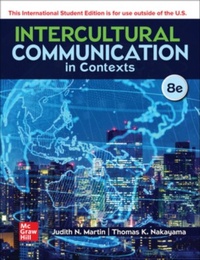
Intercultural Communication in Contexts ISE
8th Edition
Will be published approx. on 23. April 2021
Book
Paperback/Softback
546 pages
978-1-265-90572-9 (ISBN)
Description
Intercultural Communication in Contexts examines communication in multicultural relationships and provides the tools for effective communication amid cultural, ethnic, and religious differences in domestic and global contexts. Students are introduced to the primary approaches for studying intercultural communication along with a theoretical and practical framework for applying the approaches in their own lives.
More details
Edition
8th edition
Language
English
Place of publication
OH
United States
Target group
College/higher education
US School Grade: From College Freshman to College Graduate Student
Illustrations
7 Illustrations
Dimensions
Height: 228 mm
Width: 185 mm
Thickness: 21 mm
Weight
692 gr
ISBN-13
978-1-265-90572-9 (9781265905729)
Copyright in bibliographic data and cover images is held by Nielsen Book Services Limited or by the publishers or by their respective licensors: all rights reserved.
Schweitzer Classification
Other editions
New editions

Judith Martin | Thomas Nakayama
Intercultural Communication in Contexts: 2025 Release ISE
Book
03/2025
9th Edition
McGraw-Hill Education
€94.27
Shipment within 15-20 days
Persons
Judith N. Martin is currently Herberger Professor of Communication in the Hugh Downs School of Human Communication at Arizona State University. She received her Ph.D. in speech communication from the Pennsylvania State University. She also studied at the Universite de Grenoble for a year, and was involved in study aboard administration for a number of years. She also has experience in cross cultural training and has co-authored three books with Prof. Tom Nakayama. Her current research interests focus on: the role of communication in cross cultural transitions, white identity and and communication, and pedagogical issues in teaching intercultural communication.
Thomas K. Nakayama is Professor and Director of the Department of Communications Studies, Northeastern University. He received his Ph.D. in communication studies from the University of Iowa. He has been a Fulbright lecturer at the Universite de Mons-Hainaut in Belgium and Libra Professor at the University of Maine. He has taught at Arizona State University, California State University, San Bernardino and the University of Iowa. His interests are in critical theory, cultural studies, and rhetorical studies.
Thomas K. Nakayama is Professor and Director of the Department of Communications Studies, Northeastern University. He received his Ph.D. in communication studies from the University of Iowa. He has been a Fulbright lecturer at the Universite de Mons-Hainaut in Belgium and Libra Professor at the University of Maine. He has taught at Arizona State University, California State University, San Bernardino and the University of Iowa. His interests are in critical theory, cultural studies, and rhetorical studies.
Content
Part I: Foundations of Intercultural Communication
Chapter 1: Why Study Intercultural Communication?
Chapter 2: The Study of Intercultural Communication
Chapter 3: Culture, Communication, Context, and Power
Chapter 4: History and Intercultural Communication
Part II: Intercultural Communication Processes
Chapter 5: Identity and Intercultural Communication
Chapter 6: Language and Intercultural Communication
Chapter 7: Nonverbal Codes and Cultural Space
Part III: Intercultural Communication Applications
Chapter 8: Understanding Intercultural Transitions
Chapter 9: Popular Culture and Intercultural Communication
Chapter 10: Culture, Communication, and Intercultural Relationships
Chapter 11: Culture, Communication, and Conflict
Chapter 12: Striving for Engaged and Effective Intercultural Communication
Chapter 1: Why Study Intercultural Communication?
Chapter 2: The Study of Intercultural Communication
Chapter 3: Culture, Communication, Context, and Power
Chapter 4: History and Intercultural Communication
Part II: Intercultural Communication Processes
Chapter 5: Identity and Intercultural Communication
Chapter 6: Language and Intercultural Communication
Chapter 7: Nonverbal Codes and Cultural Space
Part III: Intercultural Communication Applications
Chapter 8: Understanding Intercultural Transitions
Chapter 9: Popular Culture and Intercultural Communication
Chapter 10: Culture, Communication, and Intercultural Relationships
Chapter 11: Culture, Communication, and Conflict
Chapter 12: Striving for Engaged and Effective Intercultural Communication