

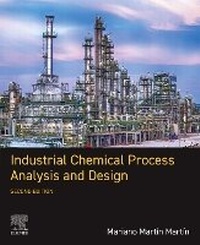
Industrial Chemical Process Analysis and Design
2nd Edition
Published on 12. December 2025
Book
Paperback/Softback
530 pages
978-0-443-36420-4 (ISBN)
Description
Industrial Chemical Process Analysis and Design, Second Edition uses chemical engineering principles to explain the transformation of basic raw materials into major chemical products. The book discusses traditional processes to create products like nitric acid, sulphuric acid, ammonia, and methanol, as well as more novel products like bioethanol and biodiesel.
In addition to providing full code and datasets for download, detailed discussion of advanced in technology, this edition also contains three new chapters. Firstly, covering polymers, including H and L D PE, PMMA, PC, biobased and full analysis of each, including full code for modelling across popular software. Secondly , evaluating phosphoric acid production and fertilizers, and Finally, the third new chapter focuses on blast furnaces - outlining not only the traditional technologies using C as reducing agent, but also analysis of novel technologies using hydrogen. This book will be a comprehensive guide to students and academics working with the latest techniques in process optimization at graduate level and above, including some upper undergraduate researchers. This book will also be very valuable for academics looking to teach or lecture in chemical process engineering. This books will also be a very useful resource for anyone within the process industry - to introduce the analysis of novel technologies as well as the modelling examples including recent software such as python, gProms or even Excel or Matlab to solve reactor modelling and units operation but also process simulators applied to typical chemical processes.
In addition to providing full code and datasets for download, detailed discussion of advanced in technology, this edition also contains three new chapters. Firstly, covering polymers, including H and L D PE, PMMA, PC, biobased and full analysis of each, including full code for modelling across popular software. Secondly , evaluating phosphoric acid production and fertilizers, and Finally, the third new chapter focuses on blast furnaces - outlining not only the traditional technologies using C as reducing agent, but also analysis of novel technologies using hydrogen. This book will be a comprehensive guide to students and academics working with the latest techniques in process optimization at graduate level and above, including some upper undergraduate researchers. This book will also be very valuable for academics looking to teach or lecture in chemical process engineering. This books will also be a very useful resource for anyone within the process industry - to introduce the analysis of novel technologies as well as the modelling examples including recent software such as python, gProms or even Excel or Matlab to solve reactor modelling and units operation but also process simulators applied to typical chemical processes.
More details
Edition
2nd edition
Language
English
Place of publication
Philadelphia
United States
Target group
College/higher education
Dimensions
Height: 276 mm
Width: 216 mm
Weight
1000 gr
ISBN-13
978-0-443-36420-4 (9780443364204)
Copyright in bibliographic data and cover images is held by Nielsen Book Services Limited or by the publishers or by their respective licensors: all rights reserved.
Schweitzer Classification
Other editions
Additional editions
Mariano Martín Martín
Industrial Chemical Process Analysis and Design
E-Book
12/2025
2nd Edition
Elsevier
€136.99
Available for download
Previous edition
Mariano Martin Martin
Industrial Chemical Process Analysis and Design
Book
07/2016
Elsevier
€85.41
Shipment within 15-20 days
Person
Dr. Martin is full Professor of Chemical engineering at the University of Salamanca and member of the Royal Academy of Sciences of Spain. Mariano Martin graduated with honors in the integrated BSc and MSc in Chemical engineering at USAL in 2003. Prof. Martin completed his PhD on the analysis of multiphase reactors and received the Outstanding Thesis award in 2008 also at USAL. He joined Procter & Gamble as a postdoctoral Engineer at their technical center of Newcastle Upon Tyne where he led the last challenge in the laundry business for which he obtained the P&G award for its outstanding contribution to modelling and simulation. He was Fulbright Postdoc at Carnegie Mellon University for almost two years on the systematic design of renewable based processes before accepting the challenge of building a process systems laboratory in the oldest university in Spain. Dr. Martin's research interests focus on the systematic optimal design of processes and products using renewable based resources towards a more sustainable power, chemical and process industry. Prof Martin has been visiting prof. at CMU (US), Univ. Texas A&M (US), Univ Leeds (UK), Univ Birmingham (UK), Plapiqui (Argentina), Udelar (Uruguay) or Univ Maribor (Slovenia) among others. El Prof. Martin has been included within the 1% Top researchers in chemical engineering in the ranking by Univ. Stanford, he has authored over 200 papers in peer reviewed journals (h=45 SCOPUS), 65 book chapters, 2 monographic books and 3 textbooks for Elsevier, Springer in CRC Press. Prof. Martin has graduated 11 PhD's and over 60 Master students. He is senior member of the AIChE and executive editor of Chem. Eng. Sci, associate editor of J. Clean Production, LAAR and sits in the editorial board of Com. Chem Eng., Int. J Green Energy, PIOS among others.
Content
1. Introduction: Historical view of the evolution of the chemical Industry
2. Principles of process design
3. Air as raw material
4. Water as raw material
5. Synthesis gases and their use
6. Nitric acid production
7. Sulfuric acid production
8. Phosphoric acid, phosphates and fertilizers production
9. Iron production
10. Biomass processing
11. Polymers production
2. Principles of process design
3. Air as raw material
4. Water as raw material
5. Synthesis gases and their use
6. Nitric acid production
7. Sulfuric acid production
8. Phosphoric acid, phosphates and fertilizers production
9. Iron production
10. Biomass processing
11. Polymers production