

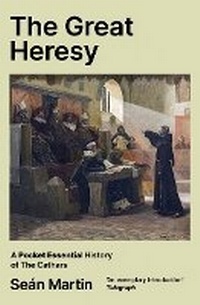
The Great Heresy
A Pocket Essential History Of The Cathars
Will be published approx. on 26. November 2026
Book
Paperback/Softback
256 pages
978-0-85730-637-1 (ISBN)
Description
Catharism was the most successful heresy of the Middle Ages.
Flourishing principally in the Languedoc and Italy, the Cathars taught that the world is evil and must be transcended through a simple life of prayer, work, fasting and nonviolence. They believed themselves to be the heirs of the true form of Christianity going back to the Apostles and the Gnostics, and completely rejected the Catholic Church and all its trappings, regarding it as the Church of Satan; Cathar services and ceremonies, by contrast, were held in fields, barns and in people's homes.
Finding support from the nobility in the fractious political situation in southern France, where the Church was lax, corrupt and unpopular, the Cathars also enjoyed widespread popularity among peasants and artisans. And again unlike the Church, the Cathars respected women, and women played a major role in the movement. Alarmed at the success of Catharism, the Church launched the Albigensian Crusade to exterminate the heresy. While previous Crusades had been directed against Muslims in the Middle East or pagans in the Baltic, the Albigensian Crusade was the first Crusade to be directed against fellow Christians, and was also the first European genocide. With the fall of the Cathar fortress of Montsegur in 1244, and the Italian fortress of Sirmione in 1276, Catharism was largely obliterated, although the faith survived into the fourteenth century. The Church founded the Inquisition to ensure that the heresy would not return.
But the Church was never able to completely eradicate the myth of the Cathars, and the heresy became a powerful symbol for 19th century Languedocian separatists, the German archaeologist Otto Rahn, and the philosopher Simone Weil. Today, the mystique surrounding the Cathars is as strong as ever. Sean Martin sympathetically recounts their story and the myths associated with them in this informative, lively and gripping book.
Flourishing principally in the Languedoc and Italy, the Cathars taught that the world is evil and must be transcended through a simple life of prayer, work, fasting and nonviolence. They believed themselves to be the heirs of the true form of Christianity going back to the Apostles and the Gnostics, and completely rejected the Catholic Church and all its trappings, regarding it as the Church of Satan; Cathar services and ceremonies, by contrast, were held in fields, barns and in people's homes.
Finding support from the nobility in the fractious political situation in southern France, where the Church was lax, corrupt and unpopular, the Cathars also enjoyed widespread popularity among peasants and artisans. And again unlike the Church, the Cathars respected women, and women played a major role in the movement. Alarmed at the success of Catharism, the Church launched the Albigensian Crusade to exterminate the heresy. While previous Crusades had been directed against Muslims in the Middle East or pagans in the Baltic, the Albigensian Crusade was the first Crusade to be directed against fellow Christians, and was also the first European genocide. With the fall of the Cathar fortress of Montsegur in 1244, and the Italian fortress of Sirmione in 1276, Catharism was largely obliterated, although the faith survived into the fourteenth century. The Church founded the Inquisition to ensure that the heresy would not return.
But the Church was never able to completely eradicate the myth of the Cathars, and the heresy became a powerful symbol for 19th century Languedocian separatists, the German archaeologist Otto Rahn, and the philosopher Simone Weil. Today, the mystique surrounding the Cathars is as strong as ever. Sean Martin sympathetically recounts their story and the myths associated with them in this informative, lively and gripping book.
Reviews / Votes
Sean Martin's "Pocket Essential" is an exemplary introduction to the Cathars -- Christopher Bland * The Telegraph * This little book is a remarkable account of an obscure religious order in Europe in the Middle Ages. It is most definitely thought-provoking.... in only 164 pages author Sean Martin manages to do something that more prolific writers have failed to do with volume upon volume of exhaustively and ridiculously over-researched text; provide a concise and focused rendering of a topic of historical interest and do so in a way that is not condescending, pedantic or self-complimentary. Martin's style of writing is simple, but never dull as he relates the history of Catharism... This is history at its best and a great read -- Chris Schwarzkopf * Bookstove *More details
Language
English
Place of publication
Harpenden, Herts
United Kingdom
Dimensions
Height: 198 mm
Width: 129 mm
ISBN-13
978-0-85730-637-1 (9780857306371)
Copyright in bibliographic data and cover images is held by Nielsen Book Services Limited or by the publishers or by their respective licensors: all rights reserved.
Schweitzer Classification
Person
Sean Martin is a writer, poet and filmmaker. He is the author of The Knights Templar, The Cathars, The Gnostics, The Black Death, Alchemy and Alchemists, A Short History ofDisease and, for Kamera Books, Andrei Tarkovsky and New Waves in Cinema. His films include Lanterna Magicka: Bill Douglas & the Secret History of Cinema (released by the BFI), Folie a Deux and a series of documentaries on the filmmaker Andrei Tarkovsky: Tarkovsky's Andrei Rublev: A Journey (released by Criterion), The Dream in the Mirror (released by Criterion), The Last Dream: Andrei Tarkovsky and The Sacrifice and A Dream of Italy: Tarkovsky and Nostalghia. Martin won the Wigtown Poetry Prize in 2011, and his collection of poems, The Girl Who Got onto the Ferry in Citizen Kane, is published by Templar Poetry.