

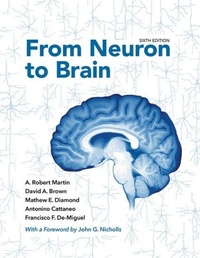
From Neuron to Brain
6th Edition
Published on 15. March 2021
Book
Hardback
912 pages
978-1-60535-439-2 (ISBN)
Description
From Neuron to Brain, Sixth Edition, provides a readable, up-to-date book for use in undergraduate, graduate, and medical school courses in neuroscience. As in previous editions, the emphasis is on experiments made by electrical recordings, molecular and cellular biological techniques, and behavioral studies on the nervous system, from simple reflexes to cognitive functions. Lines of research are followed from the inception of an idea to new findings being made in laboratories and clinics today.
From Neuron to Brain will be of interest to anyone--with or without a specialized background in biological sciences--who is curious about the workings of the nervous system.
From Neuron to Brain will be of interest to anyone--with or without a specialized background in biological sciences--who is curious about the workings of the nervous system.
Reviews / Votes
From Neuron to Brain provides the best available coverage of topics for my course, in a format and level of detail that is appropriate for advanced undergraduates. * Stephen Meriney, University of Pittsburgh* From Neuron to Brain contextualizes neuroscience through experimental findings. It allows students to explore neuroscience through the rich stories of experimental discovery * which is a much richer and more fulfilling way to be introduced to the field.J. David Spafford, University of Waterloo
* "Many textbooks are a catalog of discovered facts. From Neuron to Brain contextualizes neuroscience through experimental findings. Students explore neuroscience through the rich stories of experimental discovery. It is a much richer and fulfilling way to be introduced to the field."
- J. David Spafford, University of Waterloo "I like using From Neuron to Brain for this introductory neurobiology course, because it covers many topics of my course very well, especially the basic principles of electrical and chemical signaling along with the corresponding techniques. It is a reasonable length and is not as large as Principles of Neural Science by Kandel et al."
- Daniel M. Suter, Purdue University
More details
Edition
6th Revised edition
Language
English
Place of publication
New York
United States
Target group
College/higher education
Edition type
Revised edition
Illustrations
580
Dimensions
Height: 287 mm
Width: 227 mm
Thickness: 40 mm
Weight
2163 gr
ISBN-13
978-1-60535-439-2 (9781605354392)
Copyright in bibliographic data and cover images is held by Nielsen Book Services Limited or by the publishers or by their respective licensors: all rights reserved.
Schweitzer Classification
Persons
A. Robert Martin is Professor Emeritus in the Department of Physiology at the University of Colorado School of Medicine.
David A. Brown is Professor of Pharmacology in the Department of Neuroscience, Physiology, and Pharmacology at University College London.
Mathew E. Diamond is Professor of Cognitive Neuroscience at the International School for Advanced Studies in Trieste (SISSA).
Antonio Cattaneo is Professor of Physiology at the Scuola Normale Superiore in Pisa.
Francisco F. De-Miguel is Professor of Neuroscience at the Instituto de Fisiologia Celular-Neurociencias of the Universidad Nacional Autonoma de Mexico (UNAM).
David A. Brown is Professor of Pharmacology in the Department of Neuroscience, Physiology, and Pharmacology at University College London.
Mathew E. Diamond is Professor of Cognitive Neuroscience at the International School for Advanced Studies in Trieste (SISSA).
Antonio Cattaneo is Professor of Physiology at the Scuola Normale Superiore in Pisa.
Francisco F. De-Miguel is Professor of Neuroscience at the Instituto de Fisiologia Celular-Neurociencias of the Universidad Nacional Autonoma de Mexico (UNAM).
Content
Part I: Introduction to the Nervous System 1.Principles of Signaling and Organization
2.Signaling in the Visual System 3. Functional Architecture of the Visual Cortex Part II: Electrical Properties of Neurons and Glia 4. Ion Channels and Signaling 5. Structure of Ion Channels 6. Ionic Basis of the Resting Potential
7. Ionic Basis of the Action Potential 8. Electrical Signaling in Neurons 9. Ion Transport across Cell Membranes 10. Properties and Functions of Neuroglial Cells Part III: Intercellular Communication 11. Mechanisms of Direct Synaptic Transmission
12. Indirect Mechanisms of Synaptic Transmission
13.Release of Neurotransmitters at Synapses
14. Neurotransmitters in the Central Nervous System 15. Transmitter Synthesis, Storage, Transport, and Inactivation 16. Synaptic Plasticity
17. The Molecular and Cellular Biology of Synaptic Plasticity
18. Mechanisms of Extrasynaptic Transmission Part IV: Integrative Mechanisms 19. Autonomic Nervous System 20. Walking, Flying, and Swimming: Cellular Mechanisms of Sensory-motor Behavior in Invertebrates
Part V: Sensation 21. Sensory Transduction
22. Transduction and Transmission in the Retina 23. Touch, Pain, and Texture Sensation
24. Auditory and Vestibular Sensation 25. Constructing Perception 26. Initiation and Control of Coordinated Muscular Movements Part V: Development and Regeneration of the Nervous System 27. Development of the Nervous System
28. Critical Periods in Sensory Systems 29. Regeneration and Repair of Synaptic Connections after Injury Part VI: Conclusion 30. Open Questions Appendix A. Current Flow in Electrical Circuits Appendix B. Metabolic Pathways for the Synthesis and Inactivation of Low-Molecular-Weight Transmitters
Appendix C. Structures and Pathways of the Brain
2.Signaling in the Visual System 3. Functional Architecture of the Visual Cortex Part II: Electrical Properties of Neurons and Glia 4. Ion Channels and Signaling 5. Structure of Ion Channels 6. Ionic Basis of the Resting Potential
7. Ionic Basis of the Action Potential 8. Electrical Signaling in Neurons 9. Ion Transport across Cell Membranes 10. Properties and Functions of Neuroglial Cells Part III: Intercellular Communication 11. Mechanisms of Direct Synaptic Transmission
12. Indirect Mechanisms of Synaptic Transmission
13.Release of Neurotransmitters at Synapses
14. Neurotransmitters in the Central Nervous System 15. Transmitter Synthesis, Storage, Transport, and Inactivation 16. Synaptic Plasticity
17. The Molecular and Cellular Biology of Synaptic Plasticity
18. Mechanisms of Extrasynaptic Transmission Part IV: Integrative Mechanisms 19. Autonomic Nervous System 20. Walking, Flying, and Swimming: Cellular Mechanisms of Sensory-motor Behavior in Invertebrates
Part V: Sensation 21. Sensory Transduction
22. Transduction and Transmission in the Retina 23. Touch, Pain, and Texture Sensation
24. Auditory and Vestibular Sensation 25. Constructing Perception 26. Initiation and Control of Coordinated Muscular Movements Part V: Development and Regeneration of the Nervous System 27. Development of the Nervous System
28. Critical Periods in Sensory Systems 29. Regeneration and Repair of Synaptic Connections after Injury Part VI: Conclusion 30. Open Questions Appendix A. Current Flow in Electrical Circuits Appendix B. Metabolic Pathways for the Synthesis and Inactivation of Low-Molecular-Weight Transmitters
Appendix C. Structures and Pathways of the Brain