

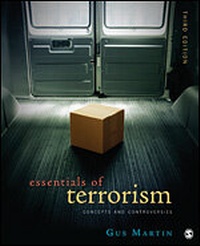
Essentials of Terrorism
Concepts and Controversies
3rd Edition
Published on 9. April 2013
Book
Paperback/Softback
368 pages
978-1-4522-5665-8 (ISBN)
Description
Essentials of Terrorism is a concise resource for understanding the multifaceted subject of modern terrorism. The book is a foundational text that can be readily used in conjunction with other resources such as topical texts, specialized publications, journal articles, and readers. It is designed for university students and professionals, and is directed to academic and professional courses of instruction whose subject areas include terrorism, homeland security, international security, criminal justice administration, political conflict, armed conflict, and social movements.
More details
Edition
3rd Revised edition
Language
English
Place of publication
Thousand Oaks
United States
Target group
College/higher education
Professional and scholarly
Edition type
Revised edition
Dimensions
Height: 232 mm
Width: 187 mm
Weight
613 gr
ISBN-13
978-1-4522-5665-8 (9781452256658)
Copyright in bibliographic data and cover images is held by Nielsen Book Services Limited or by the publishers or by their respective licensors: all rights reserved.
Schweitzer Classification
Other editions
New editions
Book
04/2016
4th Edition
SAGE Publications Inc
€106.66
Article exhausted; check for reprint
Previous edition
Book
05/2010
2nd Edition
SAGE Publications Inc
€71.98
Article exhausted; check for reprint
Person
Clarence Augustus "Gus" Martin is Professor Emeritus in the Department of Criminal Justice Administration at California State University, Dominguez Hills, where he teaches courses on criminal law, terrorism and extremism, and the criminal justice system. He served as the founding Chair of the department and as the founding Director of the School of Public Service and Justice. He also served as Associate Vice President for Human Resources Management, Acting Associate Dean of the College of Business Administration and Public Policy, Associate Vice President for Faculty Affairs, and Chair of the Department of Public Administration. He began his academic career as a member of the faculty of the Graduate School of Public and International Affairs, University of Pittsburgh, where he was an Administration of Justice professor. His current research and professional interests are terrorism and extremism, homeland security, and the administration of justice.
Dr. Martin is author of several books on the subjects of terrorism and homeland security, including Understanding Terrorism: Challenges, Perspectives, and Issues (SAGE Publications, 2025); Terrorism and WMDs: Awareness and Response, Third Edition (with John Pichtel, CRC Press, 2025); Understanding Homeland Security (SAGE Publications, 2024); The Handbook of Homeland Security (with Scott Romaniuk and Martin Scott Catino; Routledge, 2023); Essentials of Terrorism: Concepts and Controversies (SAGE Publications, 2022); Terrorism: An International Perspective (with Fynnwin Prager; SAGE Publications, 2019); The SAGE Encyclopedia of Terrorism, Second Edition (SAGE Publications, 2011); Terrorism and Homeland Security (SAGE, 2011); and The New Era of Terrorism: Selected Readings (SAGE Publications, 2004). He is also author of Juvenile Justice: Process and Systems (SAGE Publications, 2005).
Prior to joining academia, Dr. Martin served as Managing Attorney for the Fair Housing Partnership of Greater Pittsburgh, where he was also director of a program created under a federal consent decree to desegregate public and assisted housing. He was also Special Counsel to the Attorney General of the U.S. Virgin Islands on the island of St. Thomas. As Special Counsel, he occupied a personal and confidential position in the central office of the Department of Justice; sat as hearing officer for disciplinary hearings and departmental grievances; served as chair of the Drug Policy Committee; served as liaison to the intergovernmental Law Enforcement Coordinating Committee as well as to the Narcotics Strike Force; and provided daily legal and policy advice to the Attorney General. Prior to serving as Special Counsel, he was a "floor" Legislative Assistant to Congressman Charles B. Rangel of New York. As Legislative Assistant, he researched, evaluated and drafted legislation in areas of foreign policy, foreign aid, human rights, housing, education, social services, and poverty; he also drafted House floor statements, Congressional Record inserts, press releases, and news articles; and he composed speeches, briefing materials, and legislative correspondence.
Dr. Martin received his A.B. degree from Harvard College, J.D. from Duquesne University Thomas R. Kline School of Law, and Ph.D. from the Graduate School of Public and International Affairs at the University of Pittsburgh.
Dr. Martin is author of several books on the subjects of terrorism and homeland security, including Understanding Terrorism: Challenges, Perspectives, and Issues (SAGE Publications, 2025); Terrorism and WMDs: Awareness and Response, Third Edition (with John Pichtel, CRC Press, 2025); Understanding Homeland Security (SAGE Publications, 2024); The Handbook of Homeland Security (with Scott Romaniuk and Martin Scott Catino; Routledge, 2023); Essentials of Terrorism: Concepts and Controversies (SAGE Publications, 2022); Terrorism: An International Perspective (with Fynnwin Prager; SAGE Publications, 2019); The SAGE Encyclopedia of Terrorism, Second Edition (SAGE Publications, 2011); Terrorism and Homeland Security (SAGE, 2011); and The New Era of Terrorism: Selected Readings (SAGE Publications, 2004). He is also author of Juvenile Justice: Process and Systems (SAGE Publications, 2005).
Prior to joining academia, Dr. Martin served as Managing Attorney for the Fair Housing Partnership of Greater Pittsburgh, where he was also director of a program created under a federal consent decree to desegregate public and assisted housing. He was also Special Counsel to the Attorney General of the U.S. Virgin Islands on the island of St. Thomas. As Special Counsel, he occupied a personal and confidential position in the central office of the Department of Justice; sat as hearing officer for disciplinary hearings and departmental grievances; served as chair of the Drug Policy Committee; served as liaison to the intergovernmental Law Enforcement Coordinating Committee as well as to the Narcotics Strike Force; and provided daily legal and policy advice to the Attorney General. Prior to serving as Special Counsel, he was a "floor" Legislative Assistant to Congressman Charles B. Rangel of New York. As Legislative Assistant, he researched, evaluated and drafted legislation in areas of foreign policy, foreign aid, human rights, housing, education, social services, and poverty; he also drafted House floor statements, Congressional Record inserts, press releases, and news articles; and he composed speeches, briefing materials, and legislative correspondence.
Dr. Martin received his A.B. degree from Harvard College, J.D. from Duquesne University Thomas R. Kline School of Law, and Ph.D. from the Graduate School of Public and International Affairs at the University of Pittsburgh.
Content
Part I: Understanding Terrorism: A Conceptual Review
Chapter 1. Defining Terrorism
Chapter 2. Historical Perspectives and Ideological Origins
Chapter 3. Causes of Terrorist Violence
Chapter 4. Terrorist Violence and the Role of the Media
Part II: Terrorist Environments
Chapter 5. Terrorism by the State
Chapter 6. Terrorism by Dissidents
Chapter 7. Religious Terrorism
Chapter 8. International Terrorism
Chapter 9. Domestic Terrorism in the United States
Part III: The Terrorist Battleground
Chapter 10. Counterterrorism and the War on Terrorism
Chapter 11. Homeland Security
Chapter 12. Future Trends and Projections
Appendix A: Map References
Appendix B (Online): National Intelligence Estimate: The Terrorist Threat to the US Homeland
Appendix C (Online): 2011 Worldwide Threat Assessment of the U.S. Intelligence Community
Appendix D (Online): 2012 Worldwide Threat Assessment of the U.S. Intelligence Community
Appendix E (Online): 2010 Quadrennial Homeland Security Review Report
Appendix F (Online): Historical Examples
Glossary
Notes
Chapter 1. Defining Terrorism
Chapter 2. Historical Perspectives and Ideological Origins
Chapter 3. Causes of Terrorist Violence
Chapter 4. Terrorist Violence and the Role of the Media
Part II: Terrorist Environments
Chapter 5. Terrorism by the State
Chapter 6. Terrorism by Dissidents
Chapter 7. Religious Terrorism
Chapter 8. International Terrorism
Chapter 9. Domestic Terrorism in the United States
Part III: The Terrorist Battleground
Chapter 10. Counterterrorism and the War on Terrorism
Chapter 11. Homeland Security
Chapter 12. Future Trends and Projections
Appendix A: Map References
Appendix B (Online): National Intelligence Estimate: The Terrorist Threat to the US Homeland
Appendix C (Online): 2011 Worldwide Threat Assessment of the U.S. Intelligence Community
Appendix D (Online): 2012 Worldwide Threat Assessment of the U.S. Intelligence Community
Appendix E (Online): 2010 Quadrennial Homeland Security Review Report
Appendix F (Online): Historical Examples
Glossary
Notes