

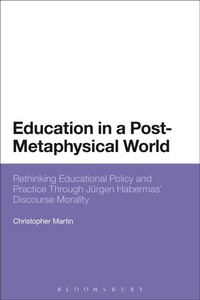
Education in a Post-Metaphysical World
Rethinking Educational Policy and Practice Through Juergen Habermas' Discourse Morality
Published on 10. April 2014
Book
Paperback/Softback
192 pages
978-1-4725-6912-7 (ISBN)
Description
What does it mean to say that a person has been educated? This question forms the basis of global education policy debates; from the way governments establish funding for national school systems, to the way children are treated in the classroom. Should there be a common ethical core to such polices? What kind of educational process should aboriginal groups in Labrador, Canada, have a moral right to, and should this process be different from what children in New York's boroughs have claim to? Should a school-based curriculum, such as the UK's National Curriculum, make well-being a central concern or are there other ethical dimensions to be addressed? Christopher Martin explores these questions and argues that the best way to consider them is to view education as a matter of public moral understanding. He brings together traditions of thought central to philosophy of education, such as R.S. Peters, and connects this tradition to the moral philosophy and critical theory of Jurgen Habermas, whose theory of Discourse Morality has previously been given little attention in education circles.
Reviews / Votes
This book provides further evidence that Christopher Martin is today one of the most interesting and promising young philosophers in the field of educational philosophy. His reading and application of Habermas' Discourse Theory of Morality is a bold and important contribution to contemporary scholarship in educational policy and will no doubt prove to be fruitfully contentious over the coming years. * Walter Okshevsky, Associate Professor of Philosophy and Education, Memorial University, Canada * In Education in a Post-Metaphysical World, Christopher Martin shows in a highly elaborated way how the articulation and the justification of norms and criteria of education can be carried out by the practice of public moral reasoning. In doing so he makes a great contribution to the conceptual analysis of education (and so to the philosophy of education in general). In addition, his book should also be seen as an important educationalist enrichment of the model of Discourse Ethics itself. * Krassimir Stojanov, Professor and Chair of Philosophy of Education and Educational Theory at the Catholic University of Eichstaett-Ingolstadt, Germany * With an eye on educational policy and teacher practice Christopher Martin scrutinizes the concept of education very clearly in its normative connotation. He legitimizes his conviction that the educational domain is a moral theme in its own right as opposed to a merely ad hoc, empirical or philosophically applied consideration. Theoretically speaking, his critical reconstruction of Habermas' Discourse Morality contributes to that conviction in a very creative way. * Siebren Miedema, Professor of Educational Foundations and Professor of Religious Education, VU University Amsterdam, Netherlands * Martin deftly brings together disparate developments in ethics, political theory, and education and does so in a straightforward and concise fashion. In particular, he shows us that conceptual analysis, long thought to be moribund in philosophy of education, remains a vital force in analysing certain contemporary political issues, such as the (political) question of Aboriginal education. A strongly recommended read. * Scott Johnston, Associate Professor of Education, Queen's University, Canada *More details
Language
English
Place of publication
London
United Kingdom
Publishing group
Bloomsbury Publishing PLC
Target group
College/higher education
Professional and scholarly
Dimensions
Height: 234 mm
Width: 156 mm
Thickness: 11 mm
Weight
324 gr
ISBN-13
978-1-4725-6912-7 (9781472569127)
Copyright in bibliographic data and cover images is held by Nielsen Book Services Limited or by the publishers or by their respective licensors: all rights reserved.
Schweitzer Classification
Other editions
Additional editions
Christopher Martin
Education in a Post-Metaphysical World
Rethinking Educational Policy and Practice Through JueRgen Habermas' Discourse Morality
E-Book
11/2012
1st Edition
Bloomsbury Academic USA
€42.99
Available for download
Christopher Martin
Education in a Post-Metaphysical World
Rethinking Educational Policy and Practice Through JueRgen Habermas' Discourse Morality
E-Book
11/2012
1st Edition
Bloomsbury Academic USA
€42.99
Available for download
Person
Christopher Martin is Assistant Professor of Education at the University of British Columbia, Kelowna, Canada.
Content
Introduction
Part I: Education and the Sources of Normativity
1. What Kind of Concept is the Concept of Education?
2. Education, Worthwhileness and the Good
3. R.S. Peters' Theory of Justification
4. Jurgen Habermas' Discourse Morality
Interlude: Kantian Constructivism and Education
Part II: Discourse Morality and Education
5. Applying Habermas' Discourse Principle to Education
6. Norms, Reasons and and Complex Proceduralism in Discourse Morality
Conclusion: Complex Proceduralism and Public Understanding
References
Index
Part I: Education and the Sources of Normativity
1. What Kind of Concept is the Concept of Education?
2. Education, Worthwhileness and the Good
3. R.S. Peters' Theory of Justification
4. Jurgen Habermas' Discourse Morality
Interlude: Kantian Constructivism and Education
Part II: Discourse Morality and Education
5. Applying Habermas' Discourse Principle to Education
6. Norms, Reasons and and Complex Proceduralism in Discourse Morality
Conclusion: Complex Proceduralism and Public Understanding
References
Index