

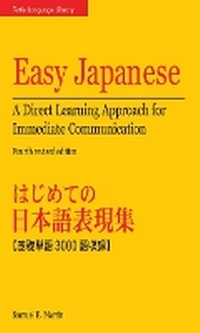
Easy Japanese
A Direct Learning Approach for Immediate Communication (Japanese Phrasebook)
4th Edition
Published on 15. November 2006
Book
Paperback/Softback
224 pages
978-0-8048-3746-0 (ISBN)
Description
This is a carefully structured, self-study book for learning colloquial spoken Japanese.
Easy Japanese will have you speaking Japanese in no time at all. Each lesson presents a few of the most common features of the language in sentences which are short, easy, and immediately useful. The first thirteen lessons show you there is a lot that can be said with just a word or two. The later lessons introduce more variety and explain a few of the fine points. The sentences reflect how the Japanese language is really spoken. They are short but colloquial, abrupt but not rude. Each lesson contains first a number a number of Japanese phrases. After the phrases, there is some material for practice. These are short conversations mad up entirely of the phrases you have learned in the lesson (or in preceding lessons). Each of these conversations built around a rather simple situation. Finally there are some tips to help you learn the material and to tell you a few other things helpful in talking with Japanese natives.
After the lessons, there is a basic vocabulary of some common Japanese words and their English equivalents. The Japanese verbs are presented both in the polite present (-mas') and the plain resent (-u or -ru). At the end of the book there are indexes of Japanese hiragana and katakana.
Key highlights of this book are:
30 short, easy-to-follow lessons with practical exercises.
A Japanese-English dictionary of over 3,000 most commonly used words.
Writing charts of the hiragana and katakana Japanese syllabaries.
Easy Japanese will have you speaking Japanese in no time at all. Each lesson presents a few of the most common features of the language in sentences which are short, easy, and immediately useful. The first thirteen lessons show you there is a lot that can be said with just a word or two. The later lessons introduce more variety and explain a few of the fine points. The sentences reflect how the Japanese language is really spoken. They are short but colloquial, abrupt but not rude. Each lesson contains first a number a number of Japanese phrases. After the phrases, there is some material for practice. These are short conversations mad up entirely of the phrases you have learned in the lesson (or in preceding lessons). Each of these conversations built around a rather simple situation. Finally there are some tips to help you learn the material and to tell you a few other things helpful in talking with Japanese natives.
After the lessons, there is a basic vocabulary of some common Japanese words and their English equivalents. The Japanese verbs are presented both in the polite present (-mas') and the plain resent (-u or -ru). At the end of the book there are indexes of Japanese hiragana and katakana.
Key highlights of this book are:
30 short, easy-to-follow lessons with practical exercises.
A Japanese-English dictionary of over 3,000 most commonly used words.
Writing charts of the hiragana and katakana Japanese syllabaries.
More details
Edition
Fourth Edition
Language
English
Place of publication
Boston
United States
Dimensions
Height: 191 mm
Width: 108 mm
Weight
227 gr
ISBN-13
978-0-8048-3746-0 (9780804837460)
Copyright in bibliographic data and cover images is held by Nielsen Book Services Limited or by the publishers or by their respective licensors: all rights reserved.
Schweitzer Classification
Other editions
Additional editions
Samuel E. Martin
Easy Japanese
A Direct Learning Approach for Immediate Communication (Japanese Phrasebook)
E-Book
08/2013
Tuttle Publishing
€4.49
Available for download
Previous edition

Samuel E. Martin
Easy Japanese
Book
12/1989
3rd Edition
Tuttle Publishing
€29.89
Article exhausted; check for reprint
Person
Samuel E. Martin received his undergraduate and master's degree in Oriental languages from the University of California at Berkeley and his Ph.D. in linguistics from Yale University. He is the author of several books, including A Reference Grammar of Japanese.