

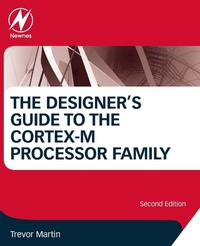
The Designer's Guide to the Cortex-M Processor Family
A Tutorial Approach
2nd Edition
Published on 9. June 2016
Book
Paperback/Softback
490 pages
978-0-08-100629-0 (ISBN)
Description
The Designer's Guide to the Cortex-M Microcontrollers gives you an easy-to-understand introduction to the concepts required to develop programs in C with a Cortex-M based microcontroller. The book begins with an overview of the Cortex-M family, giving architectural descriptions supported with practical examples, enabling you to easily develop basic C programs to run on the Cortex-M0/M0+/M3 and M4 and M7. It then examines the more advanced features of the Cortex architecture such as memory protection, operating modes, and dual stack operation.
Once a firm grounding in the Cortex-M processor has been established the book introduces the use of a small footprint RTOS and the CMSIS-DSP library. The book also examines techniques for software testing and code reuse specific to Cortex-M microcontrollers. With this book you will learn: the key differences between the Cortex-M0/M0+/M3 and M4 and M7; how to write C programs to run on Cortex-M based processors; how to make the best use of the CoreSight debug system; the Cortex-M operating modes and memory protection; advanced software techniques that can be used on Cortex-M microcontrollers; how to use a Real Time Operating System with Cortex-M devices; how to optimize DSP code for the Cortex-M4; and how to build real time DSP systems.
Once a firm grounding in the Cortex-M processor has been established the book introduces the use of a small footprint RTOS and the CMSIS-DSP library. The book also examines techniques for software testing and code reuse specific to Cortex-M microcontrollers. With this book you will learn: the key differences between the Cortex-M0/M0+/M3 and M4 and M7; how to write C programs to run on Cortex-M based processors; how to make the best use of the CoreSight debug system; the Cortex-M operating modes and memory protection; advanced software techniques that can be used on Cortex-M microcontrollers; how to use a Real Time Operating System with Cortex-M devices; how to optimize DSP code for the Cortex-M4; and how to build real time DSP systems.
More details
Edition
2nd edition
Language
English
Place of publication
Oxford
United Kingdom
Publishing group
Elsevier Science & Technology
Target group
Professional and scholarly
Professional embedded systems engineers, software engineers developing embedded systems, students studying embedded systems using ARM technology.
Product notice
Paperback (trade)
Illustrations
Approx. 195 illustrations
Dimensions
Height: 231 mm
Width: 184 mm
Thickness: 27 mm
Weight
948 gr
ISBN-13
978-0-08-100629-0 (9780081006290)
Copyright in bibliographic data and cover images is held by Nielsen Book Services Limited or by the publishers or by their respective licensors: all rights reserved.
Schweitzer Classification
Other editions
New editions
Book
12/2022
3rd Edition
Elsevier
€71.75
Shipment within 15-20 days
Additional editions
E-Book
06/2016
2nd Edition
Newnes
€46.95
Available for download
Previous edition
Book
04/2013
Newnes
€51.38
Article exhausted; check for reprint
Person
Trevor Martin graduated from Brunel University in 1988 with an Honors degree in electrical and electronics engineering. In the same year, he began work as a junior hardware engineer at Philips Medical Systems. He joined Hitex in 1992 as a technical specialist for 8-bit microcontroller development tools. This included the 8051,68HC11\05\08 microcontrollers. He also gained experience with networking protocols such as CAN, USB, and TCP/IP. Since 2000, he has been supporting ARM-based microcontrollers, initially ARM7 and ARM9 CPU then moving to Cortex-M processor. To promote these devices, he has worked closely with both NXP and ST and also TI and Freescale to a lesser extent. Since 2005, he has written a number of "Insider's Guide? books that are introductory tutorials to ARM-based microcontroller families such as LPC2000, STR9, and STM32. He also runs regular training courses, a general Cortex Microcontroller workshop and also device-specific courses.
Content
1. Introduction to the Cortex-M processor family
2. Developing software for the Cortex-M family
3. Cortex-M Architecture
4. Cortex Microcontroller Software Interface Standard
5. Advanced Architectural features
6. Cortex-M7 Architecture
7. Debugging with CoreSight
8. Practical DSP for the Cortex-M4
9. Developing with CMSIS-RTOS
10. Practical RTOS Techniques
11. Test Driven Development
12. Designing Software Components
13. Closing Thoughts
2. Developing software for the Cortex-M family
3. Cortex-M Architecture
4. Cortex Microcontroller Software Interface Standard
5. Advanced Architectural features
6. Cortex-M7 Architecture
7. Debugging with CoreSight
8. Practical DSP for the Cortex-M4
9. Developing with CMSIS-RTOS
10. Practical RTOS Techniques
11. Test Driven Development
12. Designing Software Components
13. Closing Thoughts