

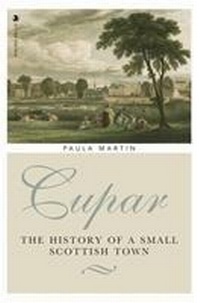
Cupar
The History of a Small Scottish Town
Will be published approx. on 5. September 2026
Book
Paperback/Softback
288 pages
978-1-912476-73-2 (ISBN)
Description
Cupar was created a royal burgh in 1328, though its name is Pictish, suggesting that there had been an important settlement there since the 7th or 8th century if not earlier. Until the 16th century it was among the richest royal burghs in Scotland, but declined in the 17th century, its trade handicapped by its distance from the sea. It flourished once again as a centre of the linen industry in the 18th century. As the county town of Fife, and a town which serviced travellers on their way from Edinburgh to Dundee and Aberdeen, Cupar became a 'leisure town', attracting well-off retired people and country gentry to its balls, horse races, theatre and library, as well as the services offered by banks, lawyers and doctors (and brothels).
But by the mid 19th century the railway carried travellers through without stopping, industrial development shifted to west Fife where coal was plentiful, and St Andrews took over as the cultural centre of east Fife. Because the town did not develop major industries, it retains its medieval town plan and many fine buildings from its Georgian heyday.
But by the mid 19th century the railway carried travellers through without stopping, industrial development shifted to west Fife where coal was plentiful, and St Andrews took over as the cultural centre of east Fife. Because the town did not develop major industries, it retains its medieval town plan and many fine buildings from its Georgian heyday.
Reviews / Votes
Paula Martin edits the International Journal of Nautical Archaeology, and is a tutor with the Open University. As an archaeologist and teacher, she enjoys explaining places through their surviving buildings and townscape (sometimes the spaces can be as important as the buildings). She is currently working with a historian, an archaeologist and an architectural historian on a project studying a variety of burghs for Historic Scotland. She lives near Cupar.More details
Language
English
Place of publication
Edinburgh
United Kingdom
Publishing group
Birlinn General
Product notice
Paperback (trade)
Unsewn / adhesive bound
Illustrations
16pp b/w plates
Dimensions
Height: 234 mm
Width: 156 mm
Thickness: 22 mm
Weight
381 gr
ISBN-13
978-1-912476-73-2 (9781912476732)
Copyright in bibliographic data and cover images is held by Nielsen Book Services Limited or by the publishers or by their respective licensors: all rights reserved.
Schweitzer Classification
Person
Paula Martin edits the International Journal of Nautical Archaeology, and is a tutor with the Open University. She is currently working with a historian, an archaeologist and an architectural historian on a project studying a variety of burghs for Historic Scotland. She lives near Cupar.