

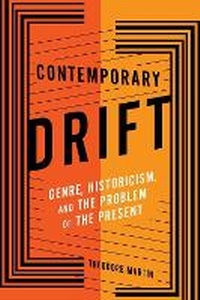
Contemporary Drift
Genre, Historicism, and the Problem of the Present
Will be published approx. on 23. May 2017
Book
Hardback
264 pages
978-0-231-18192-1 (ISBN)
Description
What does it mean to call something "contemporary"? More than simply denoting what's new, it speaks to how we come to know the present we're living in and how we develop a shared story about it. The story of trying to understand the present is an integral, yet often unnoticed, part of the literature and film of our moment. In Contemporary Drift, Theodore Martin argues that the contemporary is not just a historical period but also a conceptual problem, and he claims that contemporary genre fiction offers a much-needed resource for resolving that problem. Contemporary Drift combines a theoretical focus on the challenge of conceptualizing the present with a historical account of contemporary literature and film. Emphasizing both the difficulty and the necessity of historicizing the contemporary, the book explores how recent works of fiction depict life in an age of global capitalism, postindustrialism, and climate change.
Through new histories of the novel of manners, film noir, the Western, detective fiction, and the postapocalyptic novel, Martin shows how the problem of the contemporary preoccupies a wide range of novelists and filmmakers, including Zadie Smith, Colson Whitehead, Vikram Chandra, China Mieville, Kelly Reichardt, and the Coen brothers. Martin argues that genre provides these artists with a formal strategy for understanding both the content and the concept of the contemporary. Genre writing, with its mix of old and new, brings to light the complicated process by which we make sense of our present and determine what belongs to our time.
Through new histories of the novel of manners, film noir, the Western, detective fiction, and the postapocalyptic novel, Martin shows how the problem of the contemporary preoccupies a wide range of novelists and filmmakers, including Zadie Smith, Colson Whitehead, Vikram Chandra, China Mieville, Kelly Reichardt, and the Coen brothers. Martin argues that genre provides these artists with a formal strategy for understanding both the content and the concept of the contemporary. Genre writing, with its mix of old and new, brings to light the complicated process by which we make sense of our present and determine what belongs to our time.
Reviews / Votes
Why are some of the most predictable genres still very much around? Why does the present moment feel different and yet seem impossible to comprehend? Theodore Martin makes significant headway toward answering the second question by addressing the first, or why there now appears to be a resurgence of popular genres. His enviably simple critical apparatus offers a concise theory of our moment in cultural history. This exceptional book makes the present crisis of critical theory both intelligible and fun. -- Nancy Armstrong, Duke University Through a series of brilliant readings of revived and emergent genres-westerns, noir, postapocalyptic fiction-which invent ways of thinking about temporalities directly shaped by the dynamics of advanced capitalism, Martin works against the one-sidedness of recent debates to show how form and history inform one another in contemporary fiction. Revealing how aesthetic objects can become a resource for reimagining historicism in a present rendered simultaneously more encompassing and more elusive than ever, Contemporary Drift is a must-read for those who study the culture of the present and the aesthetics of capitalism. -- Sianne Ngai, Stanford University Contemporary Drift is a stunning study that brings expert close-reading skills and theoretical acumen to bear on the question of how works of art do not simply exist in, but actively reflect upon, the experience of being contemporary. Martin's book moves effortlessly between general reflections on the nature of literature and film and a more specific account of the contemporary moment, and between literature and the various nonliterary frameworks with which it engages. Thoroughly researched, well argued, and engagingly written, Contemporary Drift will become a standard reference for scholars interested in the study of contemporary literature. -- Andrew Hoberek, University of Missouri This exceptionally fluid and well-constructed study asks how fictional narratives address contemporaneity. Boldly contesting the literary critical taste for historicism, Martin turns toward genre analysis, arguing that each of the genres he investigates exhibits a distinctive form of temporal 'drift' or 'drag.' The resulting discussions explore both novels and films; they are beautifully written and certain to be important for any scholar interested in carefully thinking through the problems posed by genre and narrative temporality more generally. Strongly recommended. -- Caren Irr, Brandeis UniversityMore details
Series
Language
English
Place of publication
New York
United States
Target group
Professional and scholarly
Product notice
Trade binding
Illustrations
23 b&w photographs
Dimensions
Height: 229 mm
Width: 152 mm
ISBN-13
978-0-231-18192-1 (9780231181921)
Copyright in bibliographic data and cover images is held by Nielsen Book Services Limited or by the publishers or by their respective licensors: all rights reserved.
Schweitzer Classification
Other editions
Additional editions
Book
07/2019
Columbia University Press
€27.24
Article not available at the moment
E-Book
06/2017
1st Edition
Columbia University Press
from
€24.95
Available for download
Person
Theodore Martin is assistant professor of English at the University of California, Irvine.
Content
Acknowledgments Introduction: The Concept of the Contemporary 1. Decade: Period Pieces 2. Revival: Situating Noir 3. Waiting: Mysterious Circumstances 4. Weather: Western Climes 5. Survival: Work and Plague Conclusion: How to Historicize the Present Notes Bibliography Index