

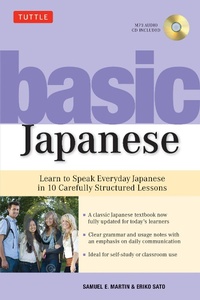
Basic Japanese
Learn to Speak Everyday Japanese in 10 Carefully Structured Lessons (Audio Recordings Included)
Published on 10. October 2012
Book
Paperback/Softback
320 pages
978-4-8053-0962-9 (ISBN)
Description
Basic Japanese takes a friendly and innovative approach to beginner Japanese, emphasizing the structure of the Japanese language rather than just vocabulary.
This method was pioneered by the author, Samuel E. Martin. Once considered controversial, modern linguists now agree that the structurally based approach for learning a language allows for more efficient retention than the traditional repetition-based approach. It is especially useful for self-study and first-time learners as well as in a classroom setting. The native-speaker audio recordings help to reinforce pronunciation and build listening comprehension.
Each lesson is set up to ease learners into not just understanding the new material but mastering it, using a four-step method:
Step 1: Basic Sentences: Each lesson begins with the key to quick mastery of spoken Japanese-learning and understanding new sentence patterns. Vocabulary is learned in context. A Basic Vocabulary section lists only essential words and phrases that are relevant to the theme of the lesson.
Step 2: Structure Notes: Next the learner is guided through complete, in-depth explanations of the sentences' grammar essentials, to aid in mastering the sentence patterns.
Step 3: Conversation: Authentic dialogue teaches the way people naturally speak, putting into practice the lesson's sentence patterns with everyday topics.
Step 4: Exercises: An opportunity for practicing-and for strengthening your understanding of the lesson's key points and ability to read Japanese.
All media content is accessible on the Tuttle Publishing website.
This method was pioneered by the author, Samuel E. Martin. Once considered controversial, modern linguists now agree that the structurally based approach for learning a language allows for more efficient retention than the traditional repetition-based approach. It is especially useful for self-study and first-time learners as well as in a classroom setting. The native-speaker audio recordings help to reinforce pronunciation and build listening comprehension.
Each lesson is set up to ease learners into not just understanding the new material but mastering it, using a four-step method:
Step 1: Basic Sentences: Each lesson begins with the key to quick mastery of spoken Japanese-learning and understanding new sentence patterns. Vocabulary is learned in context. A Basic Vocabulary section lists only essential words and phrases that are relevant to the theme of the lesson.
Step 2: Structure Notes: Next the learner is guided through complete, in-depth explanations of the sentences' grammar essentials, to aid in mastering the sentence patterns.
Step 3: Conversation: Authentic dialogue teaches the way people naturally speak, putting into practice the lesson's sentence patterns with everyday topics.
Step 4: Exercises: An opportunity for practicing-and for strengthening your understanding of the lesson's key points and ability to read Japanese.
All media content is accessible on the Tuttle Publishing website.
Reviews / Votes
"This book excels at differentiating really similar concepts, even adding more to the never-ending question of 'What is the difference between [this character] and [this character]?' The vocabulary words are also thematically arranged, usually with illustrations for some words for better memory reinforcement. Pronunciation in the CD tracks actually sounds natural compared to other learning materials" --Japan Reference blogMore details
Language
English
Place of publication
Boston
United States
Edition type
Bilingual edition
Illustrations
includes MP3 Audio CD; approx 40 line drawings
Dimensions
Height: 229 mm
Width: 154 mm
Thickness: 25 mm
Weight
505 gr
ISBN-13
978-4-8053-0962-9 (9784805309629)
Copyright in bibliographic data and cover images is held by Nielsen Book Services Limited or by the publishers or by their respective licensors: all rights reserved.
Schweitzer Classification
Other editions
New editions
Samuel E. Martin | Eriko Sato
Basic Japanese
Learn to Speak Japanese in 10 Easy Lessons (Fully Revised and Expanded with Manga Illustrations, Audio Downloads & Japanese Dictionary)
Book
11/2017
Tuttle Publishing
€19.00
Available (delivery time upon request)
Persons
Samuel E. Martin was a master teacher of the Japanese language and a major force in language learning in the postwar U.S. He received his undergraduate and master's degrees in Oriental languages from the University of California at Berkeley and his Ph.D. in linguistics from Yale University. At Yale he served as chairman of the Department of East and South Asian Languages and Literatures and the Department of Linguistics. He is the author of numerous books and papers on Japanese and Korean, including the definitive A Reference Grammar of Japanese and A Reference Grammar of Korean.
Eriko Sato is Associate Professor of Japanese and translation studies at the State of University of New York at Stony Brook, where she is also the Director of the Japanese Teacher Education Program. She has authored and co-authored over a dozen books, including Japanese Stories for Language Learners, Essential Japanese Grammar and Learning Japanese Kanji.She has also authored or co-authored Contemporary Japanese, Japanese Demystified, Japanese for Dummies, Complete Japanese Grammar, Japanese Phrases for Dummies, Basic Japanese and My First Japanese Kanji Book.
Eriko Sato is Associate Professor of Japanese and translation studies at the State of University of New York at Stony Brook, where she is also the Director of the Japanese Teacher Education Program. She has authored and co-authored over a dozen books, including Japanese Stories for Language Learners, Essential Japanese Grammar and Learning Japanese Kanji.She has also authored or co-authored Contemporary Japanese, Japanese Demystified, Japanese for Dummies, Complete Japanese Grammar, Japanese Phrases for Dummies, Basic Japanese and My First Japanese Kanji Book.