

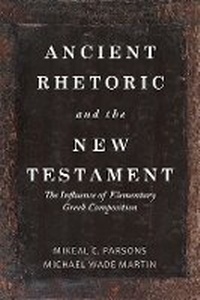
Ancient Rhetoric and the New Testament
The Influence of Elementary Greek Composition
Published on 2. August 2018
Book
Hardback
978-1-4813-0980-6 (ISBN)
Description
For the ancient Greeks and Romans, eloquence was essential to public life and identity, perpetuating class status and power. The three-tiered study of rhetoric was thus designed to produce sons worthy of and equipped for public service. Rhetorical competency enabled the elite to occupy their proper place in society.
The oracular and literary techniques represented in Greco-Roman education proved to be equally central to the formation of the New Testament. Detailed comparisons of the sophisticated rhetorical conventions, as cataloged in the ancient rhetorical handbooks (e.g., Quintilian), reveal to what degree and frequency the New Testament was shaped by ancient rhetoric's invention, argument, and style.
But Ancient Rhetoric and the New Testament breaks new ground. Instead of focusing on more advanced rhetorical lessons that elite students received in their school rooms, Michael Martin and Mikeal Parsons examine the influence of the progymnasmata - the preliminary compositional exercises that bridge the gap between grammar and rhetoric proper - and their influence on the New Testament.
Martin and Parsons use Theon's (50-100 CE) compendium as a baseline to measure the way primary exercises shed light on the form and style of the New Testament's composition. Each chapter examines a specific rhetorical exercise and its unique hortatory or instructional function, and offers examples from ancient literature before exploring the use of these techniques in the New Testament.
By studying the rhetoric of beginners rather than experts, Martin and Parsons demonstrate that the New Testament was not simply the product of an elite scholastic culture. ""Rhetoric was in the air,"" acting as a stock feature of the public discourse from which the New Testament arose. Martin and Parsons demonstrate that attention to the intimate relationship between medium (the how) and message (the what) is not new. The New Testament used common strategies to communicate its uncommon Gospel.
The oracular and literary techniques represented in Greco-Roman education proved to be equally central to the formation of the New Testament. Detailed comparisons of the sophisticated rhetorical conventions, as cataloged in the ancient rhetorical handbooks (e.g., Quintilian), reveal to what degree and frequency the New Testament was shaped by ancient rhetoric's invention, argument, and style.
But Ancient Rhetoric and the New Testament breaks new ground. Instead of focusing on more advanced rhetorical lessons that elite students received in their school rooms, Michael Martin and Mikeal Parsons examine the influence of the progymnasmata - the preliminary compositional exercises that bridge the gap between grammar and rhetoric proper - and their influence on the New Testament.
Martin and Parsons use Theon's (50-100 CE) compendium as a baseline to measure the way primary exercises shed light on the form and style of the New Testament's composition. Each chapter examines a specific rhetorical exercise and its unique hortatory or instructional function, and offers examples from ancient literature before exploring the use of these techniques in the New Testament.
By studying the rhetoric of beginners rather than experts, Martin and Parsons demonstrate that the New Testament was not simply the product of an elite scholastic culture. ""Rhetoric was in the air,"" acting as a stock feature of the public discourse from which the New Testament arose. Martin and Parsons demonstrate that attention to the intimate relationship between medium (the how) and message (the what) is not new. The New Testament used common strategies to communicate its uncommon Gospel.
Reviews / Votes
First-rate scholarship, the book is copiously researched and garnished lavishly with citationsa|New Testament scholars will welcome this book with open arms. -- ChoiceMore details
Language
English
Place of publication
Waco
United States
Target group
Professional and scholarly
Illustrations
3 charts
Dimensions
Height: 231 mm
Width: 157 mm
Thickness: 33 mm
Weight
658 gr
ISBN-13
978-1-4813-0980-6 (9781481309806)
Copyright in bibliographic data and cover images is held by Nielsen Book Services Limited or by the publishers or by their respective licensors: all rights reserved.
Schweitzer Classification
Other editions
Additional editions
Mikeal C. Parsons | Michael Wade Martin
Ancient Rhetoric and the New Testament
The Influence of Elementary Greek Composition
E-Book
11/2018
Baylor University Press
€43.99
Available for download
Persons
Michael Wade Martin is Professor of New Testament at Lubbock Christian University.Mikeal C. Parsons is Professor and Macon Chair of Religion at Baylor University.