

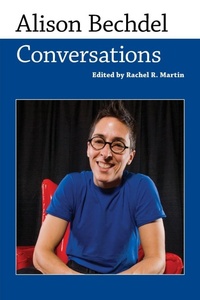
Alison Bechdel
Conversations
Published on 5. October 2018
Book
Paperback/Softback
144 pages
978-1-4968-1927-7 (ISBN)
Description
Due to the huge success of her graphic memoir Fun Home: A Family Tragicomic in 2006 and its subsequent Tony Award-winning musical adaptation in 2009, Alison Bechdel (b. 1960) has recently become a household name. However, Bechdel, who has won numerous awards including a MacArthur Fellowship, has been writing and drawing comics since the early 1980s. Her comic strip Dykes to Watch Out For (DTWOF) stood out as one of the first to depict lesbians in popular culture and is widely hailed as an essential LGBTQ resource.
It is also from this comic strip that the wildly popular Bechdel Test-a test to gauge positive female representation in film-obtained its name. While DTWOF secured Bechdel's role in the comics world and queer community long before her mainstream success, Bechdel now experiences notoriety that few comics artists ever achieve and that women cartoonists have never attained.
Spanning from 1990 to 2017, Alison Bechdel: Conversations collects ten interviews that illustrate how Bechdel uses her own life, relationships, and contemporary events to expose the world to what she has referred to as the ""fringes of acceptability""-the comics genre as well as queer culture and identity. These interviews reveal her intentionality in the use of characters, plots, structure, and cartooning to draw her readers toward disrupting the status quo.
Starting with her earliest interviews on public access television and in little-known comics and queer presses, Rachel R. Martin traces Bechdel's career from her days with DTWOF to her popularity with Fun Home and Are You My Mother? This volume includes her ""one-off"" DTWOF strips from November 2016 and March 2017 (not anthologized anywhere else) and in-depth discussions of her laborious creative process as well as upcoming projects.
It is also from this comic strip that the wildly popular Bechdel Test-a test to gauge positive female representation in film-obtained its name. While DTWOF secured Bechdel's role in the comics world and queer community long before her mainstream success, Bechdel now experiences notoriety that few comics artists ever achieve and that women cartoonists have never attained.
Spanning from 1990 to 2017, Alison Bechdel: Conversations collects ten interviews that illustrate how Bechdel uses her own life, relationships, and contemporary events to expose the world to what she has referred to as the ""fringes of acceptability""-the comics genre as well as queer culture and identity. These interviews reveal her intentionality in the use of characters, plots, structure, and cartooning to draw her readers toward disrupting the status quo.
Starting with her earliest interviews on public access television and in little-known comics and queer presses, Rachel R. Martin traces Bechdel's career from her days with DTWOF to her popularity with Fun Home and Are You My Mother? This volume includes her ""one-off"" DTWOF strips from November 2016 and March 2017 (not anthologized anywhere else) and in-depth discussions of her laborious creative process as well as upcoming projects.
More details
Series
Language
English
Place of publication
Jackson
United States
Target group
Professional and scholarly
Dimensions
Height: 229 mm
Width: 152 mm
Thickness: 10 mm
Weight
245 gr
ISBN-13
978-1-4968-1927-7 (9781496819277)
Copyright in bibliographic data and cover images is held by Nielsen Book Services Limited or by the publishers or by their respective licensors: all rights reserved.
Schweitzer Classification
Other editions
Additional editions

E-Book
10/2018
Penguin Random House South Africa
€24.49
Available for download
Person
Rachel R. Martin, Broad Run, Virginia, is assistant professor of English and humanities at Northern Virginia Community College in Alexandria, Virginia. She has published scholarly work in Feminisms in the World of Neil Gaiman: Essays on the Comics, Poetry and Prose and Women's Rights: Reflections in Popular Culture. Her creative writing has appeared in So to Speak: A Feminist Journal of Language and Arts.