

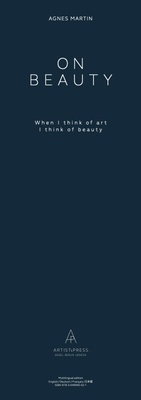
Agnes Martin ON BEAUTY
"When I think of art I think of beauty"
Published on 1. November 2024
Book
Paperback/Softback
24 pages
978-3-949990-02-1 (ISBN)
Description
Publisher's Note
BEAUTY IN A WORLD ON FIRE
Agnes Martin gave her lecture on beauty in April 1989 to a young audience in Santa Fe*. Thirty-five years later we live in a completely different world, while her autonomous, clear and poetic lines still speak for themselves. Living in a world on fire we felt the urge to republish her original manuscript supplemented by new translations. And like the universal horizons of her iconic paintings, her message requires no further introduction nor comment.
Today, beauty is becoming a question of mental survival, an antidote for the mind to better navigate in a dangerous and increasingly harsh world poisoned by polarization. Beauty conceals an effective counter-concept, but its power still doesn't come simply "in the mail". Too often silenced by daily horrors, beauty seems to be gradually disappearing from our everyday lives. For Agnes Martin, "the response to art is the real field of art", its value lies in the sensitive observer, and the artist is in her eyes "a person who can recognize his own failure". In Advice to Young Artists (1972), she encourages an inspired, unconventional artistic life that "leads away from the example of the past". And finally, the experience of beauty inscribed in her very own art has also created her very best examples.
Thus, we are grateful for the kind permission to reproduce in verso one of her untitled signature paintings, a field of light and lightness created 1993 - 1994. In times of uncertainty, her uncompromising plea for beauty remains a particularly valuable artistic legacy, uniquely condensed in between the handwritten lines of this lecture and the universality of her painted horizons: "My paintings have neither object nor space nor line nor anything - no forms. It's about light, about lightness, about fusion, about formlessness, about the breaking up of form. You wouldn't think of form by the sea. You can go into it when you encounter nothing. A world without objects, without interruption, a work without interruption or obstacle. It's about accepting the necessity of simply, directly entering a field of vision, like crossing an empty beach to look at the ocean".
BEAUTY IN A WORLD ON FIRE
Agnes Martin gave her lecture on beauty in April 1989 to a young audience in Santa Fe*. Thirty-five years later we live in a completely different world, while her autonomous, clear and poetic lines still speak for themselves. Living in a world on fire we felt the urge to republish her original manuscript supplemented by new translations. And like the universal horizons of her iconic paintings, her message requires no further introduction nor comment.
Today, beauty is becoming a question of mental survival, an antidote for the mind to better navigate in a dangerous and increasingly harsh world poisoned by polarization. Beauty conceals an effective counter-concept, but its power still doesn't come simply "in the mail". Too often silenced by daily horrors, beauty seems to be gradually disappearing from our everyday lives. For Agnes Martin, "the response to art is the real field of art", its value lies in the sensitive observer, and the artist is in her eyes "a person who can recognize his own failure". In Advice to Young Artists (1972), she encourages an inspired, unconventional artistic life that "leads away from the example of the past". And finally, the experience of beauty inscribed in her very own art has also created her very best examples.
Thus, we are grateful for the kind permission to reproduce in verso one of her untitled signature paintings, a field of light and lightness created 1993 - 1994. In times of uncertainty, her uncompromising plea for beauty remains a particularly valuable artistic legacy, uniquely condensed in between the handwritten lines of this lecture and the universality of her painted horizons: "My paintings have neither object nor space nor line nor anything - no forms. It's about light, about lightness, about fusion, about formlessness, about the breaking up of form. You wouldn't think of form by the sea. You can go into it when you encounter nothing. A world without objects, without interruption, a work without interruption or obstacle. It's about accepting the necessity of simply, directly entering a field of vision, like crossing an empty beach to look at the ocean".
More details
Edition
Limitierte Ausgabe
Language
English
French
German
Other
Place of publication
Berlin-Basel-Geneva
Germany
Edition type
Facsimile edition
Product notice
A4
Illustrations
Poster Publikation 90x90 cm gefaltet mit Banderole
Rückseitig: Kunstdruck 90 x 90 cm von Agnes Martin: Untitled (Friendship) 1993-1994 Oil on Canvas 152.5 a 152.5 cm,
Dimensions
Height: 41.5 cm
Width: 14 cm
Thickness: 5 cm
Weight
125 gr
ISBN-13
978-3-949990-02-1 (9783949990021)
Schweitzer Classification
Person
Author
Malerin
Agnes Bernice Martin was an American abstract painter known for her minimalist style and abstract expressionism. Martin's artistic journey began in New York City, where she immersed herself in modern art and developed a deep interest in abstraction. Despite often being labeled a minimalist, she identified more with abstract expressionism. Growing up in rural Canada and influenced by the New Mexico desert, where she lived for the last several decades of her life, Martin's art was characterised by serene compositions featuring grids and lines. Her works were predominantly monochromatic, employing subtle colours like black, white, and brown. Martin's minimalist approach conveyed tranquility and spirituality, and her paintings often carried positive names reflective of her philosophy.
Agnes Bernice Martin was an American abstract painter known for her minimalist style and abstract expressionism. Martin's artistic journey began in New York City, where she immersed herself in modern art and developed a deep interest in abstraction. Despite often being labeled a minimalist, she identified more with abstract expressionism. Growing up in rural Canada and influenced by the New Mexico desert, where she lived for the last several decades of her life, Martin's art was characterised by serene compositions featuring grids and lines. Her works were predominantly monochromatic, employing subtle colours like black, white, and brown. Martin's minimalist approach conveyed tranquility and spirituality, and her paintings often carried positive names reflective of her philosophy.