

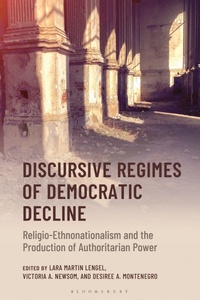
Discursive Regimes of Democratic Decline
Religio-Ethnonationalism and the Production of Authoritarian Power
Will be published approx. on 12. November 2026
Book
Hardback
336 pages
978-1-6669-4454-9 (ISBN)
Description
This edited collection brings together esteemed international scholars to examine how religio-ethnonationalist power is produced, normalized, and resisted through discourse.
Rather than treating democratic decline as a purely institutional or electoral phenomenon, the book foregrounds communicative processes through which exclusionary identities, historical narratives, moral claims, and affective appeals are mobilized to legitimate authoritarian power. As the first book in communication studies to systematically theorize religio-ethnonationalism as a central analytic framework, Democratic Decline advances understanding of how religion, nationalism, and media power intersect in struggles over democracy. Contributors from Ghana, Great Britain, India, Iran, Malaysia, Nigeria, North Macedonia, and the U.S. analyze how discourse functions simultaneously as a mechanism of domination and a site of contestation, shaping memory, identity, citizenship, and political belonging through processes of discursive amnesia, discursive amnesty, discursive cleansing, and discursive resistance.
The book engages a wide range of interdisciplinary conversations, including peace, war, and conflict resolution, legal and policy analysis, colonial and post-colonial inquiry, ethnic and minority rights, post-structuralist discourse theory, civil society, and environmental injustice. Across these intersecting domains, contributors demonstrate how religio-ethnonationalist projects rely on structured forgetting, moralized narratives, and affective polarization to sustain hierarchies of power and exclusion, while also revealing uneven conditions under which resistance emerges.
By centering communication as a site of democratic struggle, Democratic Decline offers readers conceptual tools for identifying how democratic backsliding is communicatively produced and challenged, while foregrounding the ethical and political stakes of memory, identity, power, and resistance in shaping the future of democracy.
Rather than treating democratic decline as a purely institutional or electoral phenomenon, the book foregrounds communicative processes through which exclusionary identities, historical narratives, moral claims, and affective appeals are mobilized to legitimate authoritarian power. As the first book in communication studies to systematically theorize religio-ethnonationalism as a central analytic framework, Democratic Decline advances understanding of how religion, nationalism, and media power intersect in struggles over democracy. Contributors from Ghana, Great Britain, India, Iran, Malaysia, Nigeria, North Macedonia, and the U.S. analyze how discourse functions simultaneously as a mechanism of domination and a site of contestation, shaping memory, identity, citizenship, and political belonging through processes of discursive amnesia, discursive amnesty, discursive cleansing, and discursive resistance.
The book engages a wide range of interdisciplinary conversations, including peace, war, and conflict resolution, legal and policy analysis, colonial and post-colonial inquiry, ethnic and minority rights, post-structuralist discourse theory, civil society, and environmental injustice. Across these intersecting domains, contributors demonstrate how religio-ethnonationalist projects rely on structured forgetting, moralized narratives, and affective polarization to sustain hierarchies of power and exclusion, while also revealing uneven conditions under which resistance emerges.
By centering communication as a site of democratic struggle, Democratic Decline offers readers conceptual tools for identifying how democratic backsliding is communicatively produced and challenged, while foregrounding the ethical and political stakes of memory, identity, power, and resistance in shaping the future of democracy.
Reviews / Votes
A daring book which addresses the timely and pressing challenge of authoritarianism, and the modes of resistance to authoritarianism, across multiple regions, disciplines, and faith traditions. Through a number of fascinating contributions from across the world, it tackles the significant, yet understudied, role which religio-enthnonationalism plays in these complex contemporary phenomena. A must read! -- Sahar Khamis, Associate Professor of Communication, University of Maryland, USAMore details
Series
Language
English
Place of publication
United States
Publishing group
Bloomsbury Publishing Plc
Target group
Professional and scholarly
Product notice
Laminated cover
Dimensions
Height: 229 mm
Width: 153 mm
Thickness: 18 mm
Weight
453 gr
ISBN-13
978-1-6669-4454-9 (9781666944549)
Copyright in bibliographic data and cover images is held by Nielsen Book Services Limited or by the publishers or by their respective licensors: all rights reserved.
Schweitzer Classification
Persons
Lara Martin Lengel is Professor in the School of Communication Studies at Bowling Green State University, USA.
Victoria A. Newsom is Professor of Communication Studies and affiliate faculty in Diversity and Social Justice at Olympic College, USA.
Desiree A. Montenegro is a faculty member at Palo Verde College, and affiliate faculty with the California Department of Corrections and several universities and colleges in greater Los Angeles, USA.
Victoria A. Newsom is Professor of Communication Studies and affiliate faculty in Diversity and Social Justice at Olympic College, USA.
Desiree A. Montenegro is a faculty member at Palo Verde College, and affiliate faculty with the California Department of Corrections and several universities and colleges in greater Los Angeles, USA.
Content
Acknowledgements
Foreword
Priya Kapoor (Portland State University, USA)
Introduction: Discursive Regimes in the Age of Religio-Ethnonationalisms, Authoritarianisms, and Resistance
Victoria A. Newsom (Olympic College in Bremerton, USA), Lara Martin Lengel (Bowling Green State University, USA), and Desiree Montenegro (Palo Verde College, USA)
Section I: Discursive Amnesia and Religio-Ethnonationalisms
1. Theorizing Discursive Amnesia and Religio-Ethnonationalisms
Lara Martin Lengel (Bowling Green State University, USA), Victoria A. Newsom (Olympic College in Bremerton, USA), and Desiree A. Montenegro (Palo Verde College, USA)
2. Contested Histories and Ethno-Nationalism: Colonial Knowledge, Historical Mythmaking, and the Rise of Hindutva in India
Jyoti Mohan (University of Maryland, USA)
3. Invoking an Unhealed Past: Trauma, Memory and Biafra Resurgence, 1999-2023
Nnaemeka Enemchukwu (Southern Illinois University, USA) and Ngozika Obi-Ani (University of Nigeria, Nsukka, Nigeria)
4. Faith, Nation, and Nature: Religious Environmentalism and the Politics of Belonging in the Global South
Jisha Jacob (Bowling Green State University, USA), Julia Asamoa (University of Miami, USA), and Falilatu Saaka (Bowling Green State University, USA)
Section II: Discursive Amnesty in Response to Religio-Ethnonationalisms
5. Theorizing Discursive Amnesty and Religio-Ethnonationalisms
Desiree A. Montenegro (Palo Verde College, USA), Lara Martin Lengel (Bowling Green State University, USA), and Victoria A. Newsom (Olympic College in Bremerton, USA)
6. Discursive Amnesia, Discursive Amnesty, Religio-Ethnonationalism, and Imperialistic Missions
Leela Mogadam (University of Missouri, USA)
7. "We Need to Pray for Our Country": Virtue Signalling and Christian Nationalist Sympathy in White Evangelical Culture
Mark Ward Sr. (Texas A&M University-Victoria, USA)
8. Discursive Amnesty and the Performance of Democracy in North Macedonia
Linda Ziberi, Artan Limani (both RIT Kosovo, Pristina, Kosovo), and Adora Limani (Brown University, USA)
Section III: Discursive Cleansing as Religio-Ethnonationalism
9. Theorizing Discursive Cleansing and Religio-Ethnonationalisms
Victoria A. Newsom (Olympic College in Bremerton, USA), Desiree A. Montenegro (Palo Verde College, USA), and Lara Martin Lengel (Bowling Green State University, USA)
10. The Rise of Antisemitism and Extremist Political Ideology
Stacy Gallin (Emory University, USA)
11. The Pedagogy of Forgetting: How Christian Nationalist Curricula Produces Discursive Cleansing
Marianne Vanderbeke (Bowling Green State University, USA)
12. Contextual Democracy Beyond Binary Opposites: Dialogical Islam and the Post-Essentialist Turn
Mohsen Abbaszadeh Marzbali (University of Mazandaran, Iran)
Section IV: Discursive Resistance to Religio-Ethnonationalisms
13: Theorizing Discursive Resistance to Religio-Ethnonationalisms
Desiree A. Montenegro (Palo Verde College, USA), Victoria A. Newsom (Olympic College in Bremerton, USA), and Lara Martin Lengel (Bowling Green State University, USA)
14. Creating a Shared Identity: Civil Society Resistance to Cypriot Ethnonationalism
Mark Barrow (University of Cambridge, UK)
15. Yogic Resistance: Swami Vivekananda and the Rhetoric of Transcendence
Candice L. Ruh and Leslie J. Harris (both University of Wisconsin-Milwaukee, USA)
16. Ethno-Religious Nationalism: Advancing or Impeding Women's Rights in Malaysia?
(Alicia Lee, Independent Scholar, USA)
17. Neo-Nazi Celebration and Fascist Critique: Radical Religio-Ethnonationalism and Resistance in Balkan Rock
Christian Vukasovich (University of Southern Maine, USA)
Conclusion: Identity, Resistance, and Democratization in the Age of Ethnonationalism
Lara Martin Lengel (Bowling Green State University, USA), Desiree A. Montenegro (Palo Verde College, USA), and Victoria A. Newsom (Olympic College in Bremerton, USA)
Index
About the Contributors
Foreword
Priya Kapoor (Portland State University, USA)
Introduction: Discursive Regimes in the Age of Religio-Ethnonationalisms, Authoritarianisms, and Resistance
Victoria A. Newsom (Olympic College in Bremerton, USA), Lara Martin Lengel (Bowling Green State University, USA), and Desiree Montenegro (Palo Verde College, USA)
Section I: Discursive Amnesia and Religio-Ethnonationalisms
1. Theorizing Discursive Amnesia and Religio-Ethnonationalisms
Lara Martin Lengel (Bowling Green State University, USA), Victoria A. Newsom (Olympic College in Bremerton, USA), and Desiree A. Montenegro (Palo Verde College, USA)
2. Contested Histories and Ethno-Nationalism: Colonial Knowledge, Historical Mythmaking, and the Rise of Hindutva in India
Jyoti Mohan (University of Maryland, USA)
3. Invoking an Unhealed Past: Trauma, Memory and Biafra Resurgence, 1999-2023
Nnaemeka Enemchukwu (Southern Illinois University, USA) and Ngozika Obi-Ani (University of Nigeria, Nsukka, Nigeria)
4. Faith, Nation, and Nature: Religious Environmentalism and the Politics of Belonging in the Global South
Jisha Jacob (Bowling Green State University, USA), Julia Asamoa (University of Miami, USA), and Falilatu Saaka (Bowling Green State University, USA)
Section II: Discursive Amnesty in Response to Religio-Ethnonationalisms
5. Theorizing Discursive Amnesty and Religio-Ethnonationalisms
Desiree A. Montenegro (Palo Verde College, USA), Lara Martin Lengel (Bowling Green State University, USA), and Victoria A. Newsom (Olympic College in Bremerton, USA)
6. Discursive Amnesia, Discursive Amnesty, Religio-Ethnonationalism, and Imperialistic Missions
Leela Mogadam (University of Missouri, USA)
7. "We Need to Pray for Our Country": Virtue Signalling and Christian Nationalist Sympathy in White Evangelical Culture
Mark Ward Sr. (Texas A&M University-Victoria, USA)
8. Discursive Amnesty and the Performance of Democracy in North Macedonia
Linda Ziberi, Artan Limani (both RIT Kosovo, Pristina, Kosovo), and Adora Limani (Brown University, USA)
Section III: Discursive Cleansing as Religio-Ethnonationalism
9. Theorizing Discursive Cleansing and Religio-Ethnonationalisms
Victoria A. Newsom (Olympic College in Bremerton, USA), Desiree A. Montenegro (Palo Verde College, USA), and Lara Martin Lengel (Bowling Green State University, USA)
10. The Rise of Antisemitism and Extremist Political Ideology
Stacy Gallin (Emory University, USA)
11. The Pedagogy of Forgetting: How Christian Nationalist Curricula Produces Discursive Cleansing
Marianne Vanderbeke (Bowling Green State University, USA)
12. Contextual Democracy Beyond Binary Opposites: Dialogical Islam and the Post-Essentialist Turn
Mohsen Abbaszadeh Marzbali (University of Mazandaran, Iran)
Section IV: Discursive Resistance to Religio-Ethnonationalisms
13: Theorizing Discursive Resistance to Religio-Ethnonationalisms
Desiree A. Montenegro (Palo Verde College, USA), Victoria A. Newsom (Olympic College in Bremerton, USA), and Lara Martin Lengel (Bowling Green State University, USA)
14. Creating a Shared Identity: Civil Society Resistance to Cypriot Ethnonationalism
Mark Barrow (University of Cambridge, UK)
15. Yogic Resistance: Swami Vivekananda and the Rhetoric of Transcendence
Candice L. Ruh and Leslie J. Harris (both University of Wisconsin-Milwaukee, USA)
16. Ethno-Religious Nationalism: Advancing or Impeding Women's Rights in Malaysia?
(Alicia Lee, Independent Scholar, USA)
17. Neo-Nazi Celebration and Fascist Critique: Radical Religio-Ethnonationalism and Resistance in Balkan Rock
Christian Vukasovich (University of Southern Maine, USA)
Conclusion: Identity, Resistance, and Democratization in the Age of Ethnonationalism
Lara Martin Lengel (Bowling Green State University, USA), Desiree A. Montenegro (Palo Verde College, USA), and Victoria A. Newsom (Olympic College in Bremerton, USA)
Index
About the Contributors