

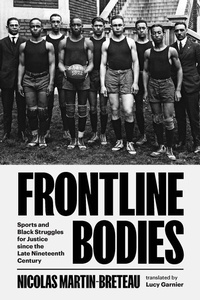
Frontline Bodies
Sports and Black Struggles for Justice since the Late Nineteenth Century
Published on 11. June 2024
Book
Hardback
376 pages
978-1-4214-4864-0 (ISBN)
Description
A captivating exploration of Black American civil rights activism through the lens of sport.
In Frontline Bodies, Nicolas Martin-Breteau argues that sports are not-and have never been-purely about entertainment for Black Americans. Instead, beginning in the 1890s during Reconstruction, Black Americans proactively used athletics as a tactic to fight racial oppression. Since the body was the primary target of anti-Black racial oppression, African Americans turned sports into a key medium in their struggles for dignity, equality, and justice. Although Black photography and art also aimed at displaying the dignity of the Black body, sports arguably had the greatest impact on American and international public opinion.
Martin-Breteau considers the work of Edwin B. Henderson, a prominent Black physical educator, civil rights activist, and historian of Black sports. Training Black children as athletes, Henderson felt, would work both to fortify racial pride and to dismantle racial prejudices-two necessary requirements for a successful political liberation struggle. In this way, physical education became political education. By the end of World War II, the tactic of racial uplift through sports had reached its peak of popularity, only to subsequently lose its appeal among younger activists, many of whom believed that the strategy was ineffective in fighting institutional racism and served mainly as an emulation of middle-class white norms.
By the end of the twentieth century, Martin-Breteau argues, racial uplift through sports had lost its emancipating power. The emphasis on the accumulation of wealth for professional athletes, as well as sports' ability to reinforce anti-Black stereotypes, had become a political problem for true collective liberation. For a marginalized group of people that has been physically excluded from the democratic process, however, sports remain a political resource. By studying the relationship between athletics and politics, Frontline Bodies renews the history of minority bodies and their power of action.
In Frontline Bodies, Nicolas Martin-Breteau argues that sports are not-and have never been-purely about entertainment for Black Americans. Instead, beginning in the 1890s during Reconstruction, Black Americans proactively used athletics as a tactic to fight racial oppression. Since the body was the primary target of anti-Black racial oppression, African Americans turned sports into a key medium in their struggles for dignity, equality, and justice. Although Black photography and art also aimed at displaying the dignity of the Black body, sports arguably had the greatest impact on American and international public opinion.
Martin-Breteau considers the work of Edwin B. Henderson, a prominent Black physical educator, civil rights activist, and historian of Black sports. Training Black children as athletes, Henderson felt, would work both to fortify racial pride and to dismantle racial prejudices-two necessary requirements for a successful political liberation struggle. In this way, physical education became political education. By the end of World War II, the tactic of racial uplift through sports had reached its peak of popularity, only to subsequently lose its appeal among younger activists, many of whom believed that the strategy was ineffective in fighting institutional racism and served mainly as an emulation of middle-class white norms.
By the end of the twentieth century, Martin-Breteau argues, racial uplift through sports had lost its emancipating power. The emphasis on the accumulation of wealth for professional athletes, as well as sports' ability to reinforce anti-Black stereotypes, had become a political problem for true collective liberation. For a marginalized group of people that has been physically excluded from the democratic process, however, sports remain a political resource. By studying the relationship between athletics and politics, Frontline Bodies renews the history of minority bodies and their power of action.
More details
Language
English
Place of publication
Baltimore, MD
United States
Target group
Professional and scholarly
Illustrations
16 s/w Abbildungen, 23 s/w Abbildungen
23 Illustrations, black and white; 16 Illustrations, black and white
Dimensions
Height: 161 mm
Width: 237 mm
Thickness: 32 mm
Weight
646 gr
ISBN-13
978-1-4214-4864-0 (9781421448640)
DOI
10.56021/9781421448640
Copyright in bibliographic data and cover images is held by Nielsen Book Services Limited or by the publishers or by their respective licensors: all rights reserved.
Schweitzer Classification
Other editions
Additional editions
Nicolas Martin-Breteau
Frontline Bodies
Sports and Black Struggles for Justice since the Late Nineteenth Century
E-Book
06/2024
Johns Hopkins University Press
€61.49
Available for download
Persons
Nicolas Martin-Breteau is an associate professor of US and African American history at the University of Lille in France.
Content
Foreword
Acknowledgements
Introduction
Part I: Sports and the Uplifting of Bodies with Character (ca. 1890-1930)
1. "By This Sign We Shall Conquer": Sports, Character, and Racial Uplift
2. "We Need Strong Men Physically": Sports, Education, and Manliness
3. "A Fine, Strong, Resistive Body": Sports, Charm, and Womanhood
Part II: Sports and the Rallying of Powerful Bodies (ca. 1920-1960)
4. "The One Great Assembly": Sports, the New Negro, and the Football Classic
5. Strong and Clean and True like Bright New Steel": Sports, Race Leaders, and Civil Rights
6. "Nazi Practices": Sports, Political Activism, and Racial Desegregation
Part III: Sports and the Contradictions of Bodily Excellence (from 1945)
7. "Democracy in Action": Sports, the Black Bourgeoisie, and the Civil Rights Movement
8. "A Frantic Escape from Freedom": Sports, Institutional Racism, and Black Power
9. "An American Myth?": Sports, Racial Uplift, and Urban Crisis
Conclusion: Self-Uplift and Minority Struggles
Bibliography
Acknowledgements
Introduction
Part I: Sports and the Uplifting of Bodies with Character (ca. 1890-1930)
1. "By This Sign We Shall Conquer": Sports, Character, and Racial Uplift
2. "We Need Strong Men Physically": Sports, Education, and Manliness
3. "A Fine, Strong, Resistive Body": Sports, Charm, and Womanhood
Part II: Sports and the Rallying of Powerful Bodies (ca. 1920-1960)
4. "The One Great Assembly": Sports, the New Negro, and the Football Classic
5. Strong and Clean and True like Bright New Steel": Sports, Race Leaders, and Civil Rights
6. "Nazi Practices": Sports, Political Activism, and Racial Desegregation
Part III: Sports and the Contradictions of Bodily Excellence (from 1945)
7. "Democracy in Action": Sports, the Black Bourgeoisie, and the Civil Rights Movement
8. "A Frantic Escape from Freedom": Sports, Institutional Racism, and Black Power
9. "An American Myth?": Sports, Racial Uplift, and Urban Crisis
Conclusion: Self-Uplift and Minority Struggles
Bibliography