

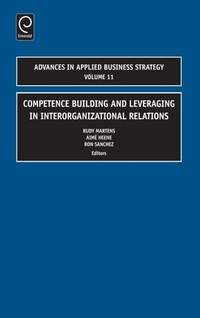
Competence Building and Leveraging in Interorganizational Relations
Will be published approx. on 29. February 2008
Book
Hardback
218 pages
978-0-7623-1466-9 (ISBN)
Description
The competence-based perspective on strategy and management offers an integrative approach to strategy and management theory, research, and practice. Nearly two decades of research, theory development, and application have demonstrated the theoretical coherence, researchability, and practicability of a fundamental focus on organizational competences. The competence-based perspective is now providing a productive broad church for advancing theory development, research, and practice in both strategic and general management.In the twenty-first century, network-based strategies and processes are becoming essential aspects of both firm strategies and operations. We are therefore pleased to present here a new volume focusing on inter-organizational processes for competence building and competence leveraging.The papers in this volume begin with an in-depth literature review by Frederic Prevot of inter-organizational relations in alternative approaches to the creation and management of competences. The next three papers (by Joerg Freiling et al., Gabriel Gaullino and Frederic Prevot, and Heike Proff) elaborate several of these approaches to managing inter-organizational processes for competence building and competence reconstructionapplied in the contexts of the healthcare industry, educational programs, the utilities market, and processes of mergers and acquisitions.New ventures are also important forums for competence building in and among firms, and two papers (by Henri Burgers et al. and by Bhaskar Prasad and Rudy Martens) analyze the impact of corporate venturing on the competence modes that a firm adopts and the role of inter-organizational communication networks on technological innovation processes as an important form of competence building.The role of leadership in effective competence management is examined by Janice Black and Richard Oliver in a paper that identifies the differing leadership skills required in three different competence-building contexts: within a single organization, in a multi-foci organization, and within an industry.Finally, recognizing the difficulty that many firms have in identifying their competences, Graham Hubbard describes a practical approach to determining a firms current capabilities. Case-based analysis using Hubbards framework suggests that business units may actually have a rather small number (fewer than five) of identifiable and strategically significant capabilities that should play in central role in a firms competence-building processes.This volume is produced annually. It offers an integrative approach to strategy and management theory, research, and practice.
More details
Series
Language
English
Place of publication
United States
Publishing group
Emerald Publishing Limited
Target group
Professional and scholarly
Dimensions
Height: 235 mm
Width: 157 mm
Thickness: 16 mm
Weight
471 gr
ISBN-13
978-0-7623-1466-9 (9780762314669)
Copyright in bibliographic data and cover images is held by Nielsen Book Services Limited or by the publishers or by their respective licensors: all rights reserved.
Schweitzer Classification
Other editions
Additional editions
Rudy Martens | Aime Heene | Ron Sanchez
Competence Building and Leveraging in Interorganizational Relations
E-Book
02/2008
1st Edition
Emerald Publishing Limited
€101.99
Available for download
Content
The management of competences in the context of interorganizational relations.
Alliances as a strategy in volatile environments - also for MBA business models?.
Competence-building through organizational recognition or frequency of use: Case study of the Lafarge Group's development of competence in managing post-merger cultural integration.
A competence-based approach to understanding the orchestration of value chains in the development of "new" value architectures.
The impact of corporate venturing on a firm's competence modes.
Increasing technological innovation competence through intra-organizational communication networks.
The distribution of leadership skills across a single-focus company, a multi-focus company, and an industry: three case studies.
Determining capabilities in practice.
List of Contributors.
Introduction.
Edited by.
Copyright page.
Alliances as a strategy in volatile environments - also for MBA business models?.
Competence-building through organizational recognition or frequency of use: Case study of the Lafarge Group's development of competence in managing post-merger cultural integration.
A competence-based approach to understanding the orchestration of value chains in the development of "new" value architectures.
The impact of corporate venturing on a firm's competence modes.
Increasing technological innovation competence through intra-organizational communication networks.
The distribution of leadership skills across a single-focus company, a multi-focus company, and an industry: three case studies.
Determining capabilities in practice.
List of Contributors.
Introduction.
Edited by.
Copyright page.