

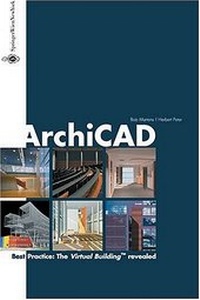
ArchiCAD
Best Practice: The Virtual BuildingT Revealed
1st Edition
Published on 11. August 2004
Book
Hardback
286 pages
978-3-211-40755-4 (ISBN)
Description
ArchiCAD has been on the market since 1984 and has firmly established itself among the available CAD software packages. The number of ArchiCAD users continues to increase and has already exceeded 100.000 by far. Continuous product development has broadened the program's possible spectrum of work applications. Therefore, this book provides comprehensive (background) information and descriptions of the many tools, functions and processes, that explain and document their many practical, research and educational uses.
More details
Other editions

Persons
BOB MARTENS is a visiting professor at Vienna Technical University. He teaches spatial simulation and spatial design. He has been involved in teaching and researching ArchiCAD since 1993.
HERBERT PETER studied architecture at Vienna Technical University. He worked as an ArchiCAD product manager at A-Null for many years and teaches CAD at the Academy of Fine Arts in Vienna.
HERBERT PETER studied architecture at Vienna Technical University. He worked as an ArchiCAD product manager at A-Null for many years and teaches CAD at the Academy of Fine Arts in Vienna.
Content
Preface.-On the Relation between Architecture and CA(A)D: CAAD = Automatic Architecture?; ArchiCAD: Its Inception and Developmental Context.-ArchiCAD as an Intelligent Work Environment: Modeling with Different Tools; Using GDL Object Technology; Hotlink Modules Referencing; Additional Performance Features; Project-related Data Organization; Using Information from the Internal Database; Project-related Communication and Presentation.- Characteristic Applications from Practice: Case Studies from Architecture Offices and Planning Studios; Visualization Strategies; Examples of Non-commercial ArchiCAD Applications.- Development Perspectives: Integrated Building Simulation.- Training Manuals and Reference Sources; Internetlinks; Trademarks; Photo Credits; Index