

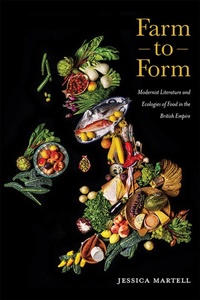
Farm to Form
Modernist Literature and Ecologies of Food in the British Empire
Published on 4. March 2020
Book
Hardback
240 pages
978-1-948908-36-8 (ISBN)
Description
In this groundbreaking book, Jessica Martell investigates the relationship between industrial food and the emergence of literary modernisms in Britain and Ireland. By the early twentieth century, the industrialization of the British Empire's food system had rendered many traditional farming operations, and attendant agrarian ways of life, obsolete. Weaving insights from modernist studies, food studies, and ecocriticism, Farm to Form contends that industrial food made nature "modernist," a term used as literary scholars understand it stylistically disorienting, unfamiliar, and artificial but also exhilarating, excessive, and above all, new. Martell draws in part upon archives in the United Kingdom but also presents imperial foodways as an extended rehearsal for the current era of industrial food supremacy. She analyzes how pastoral mode, anachronism, fragmentation, and polyvocal narration reflect the power of the literary arts to reckon with, and to resist, the new "modernist ecologies" of the twentieth century.
Deeply informed by Martell's extensive knowledge of modern British, Irish, American, and World Literatures, this progressive work positions modernism as central to the study of narratives of resistance against social and environmental degradation. Analyzed works include those of Thomas Hardy, E. M. Forster, Virginia Woolf, Joseph Conrad, George Russell, and James Joyce.
In light of climate change, fossil fuel supremacy, nutritional dearth, and other pressing food issues, modernist texts bring to life an era of crisis and anxiety similar to our own. In doing so, Martell summons the past as a way to employ the modernist term of "defamiliarizing" the present so that entrenched perceptions can be challenged. Our current food regime is both new and constantly evolving with the first industrial food trades. Studying earlier cultural responses to them invites us to return to persistent problems with new insights and renewed passion.
Deeply informed by Martell's extensive knowledge of modern British, Irish, American, and World Literatures, this progressive work positions modernism as central to the study of narratives of resistance against social and environmental degradation. Analyzed works include those of Thomas Hardy, E. M. Forster, Virginia Woolf, Joseph Conrad, George Russell, and James Joyce.
In light of climate change, fossil fuel supremacy, nutritional dearth, and other pressing food issues, modernist texts bring to life an era of crisis and anxiety similar to our own. In doing so, Martell summons the past as a way to employ the modernist term of "defamiliarizing" the present so that entrenched perceptions can be challenged. Our current food regime is both new and constantly evolving with the first industrial food trades. Studying earlier cultural responses to them invites us to return to persistent problems with new insights and renewed passion.
Reviews / Votes
Farm to Form is a well-written, solid piece of scholarship. The selection of writers and texts alone will make this book a must-read, and no one, to my knowledge, has explored to this extent how the rapid transformation of food production, distribution, and marketing touched the choices that writers made in shaping their work." - Bill Conlogue, professor of English, Marywood University and author of Working the GardenMore details
Series
Language
English
Place of publication
Reno
United States
Target group
Professional and scholarly
Product notice
sewn/stitched
Cloth over boards
Illustrations
9 photographs
Dimensions
Height: 231 mm
Width: 155 mm
Thickness: 20 mm
Weight
454 gr
ISBN-13
978-1-948908-36-8 (9781948908368)
Copyright in bibliographic data and cover images is held by Nielsen Book Services Limited or by the publishers or by their respective licensors: all rights reserved.
Schweitzer Classification
Person
Jessica Martell is an assistant professor in the Department of Interdisciplinary Studies at Appalachian State University. Her work has appeared in Modernist Cultures, Journal of Modern Literature, Nineteenth-Century Literature, and Gastronomica: The Journal of Critical Food Studies as well as six scholarly collections. As an executive board member of Blue Ridge Women in Agriculture, a woman-led non-profit, she co-organized Appalachian State University's 2017 High Country Food Summit and advises the High Country Food Hub.
Content
Introduction: Modernist Ecologies and the Food Politics of Empire
Part I
1. Industrial Dairying, the Pastoral, and Thomas Hardy's Tess of the d'Urbervilles
2. Food Chains and Refrigerated Time in E.M. Forster's Howards End
3. Wartime Rationing and Virginia Woolf's Aesthetic Ecologies
Part II
4. Joseph Conrad and the Metabolism of Empire
5. Famine, Food Sovereignty, and the Irish Literary Revival
Coda
"From a Morning World"
Acknowledgments
Part I
1. Industrial Dairying, the Pastoral, and Thomas Hardy's Tess of the d'Urbervilles
2. Food Chains and Refrigerated Time in E.M. Forster's Howards End
3. Wartime Rationing and Virginia Woolf's Aesthetic Ecologies
Part II
4. Joseph Conrad and the Metabolism of Empire
5. Famine, Food Sovereignty, and the Irish Literary Revival
Coda
"From a Morning World"
Acknowledgments