

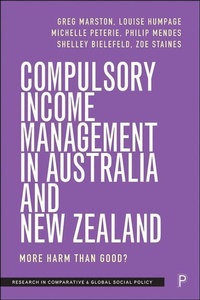
Compulsory Income Management in Australia and New Zealand
More Harm than Good?
1st Edition
Published on 16. June 2022
Book
Hardback
236 pages
978-1-4473-6149-7 (ISBN)
Description
More than a decade on from their conception, this book reflects on the consequences of income management policies in Australia and New Zealand.
Drawing on a three-year study, it explores the lived experience of those for whom core welfare benefits and services are dependent on government conceptions of 'responsible' behaviour. It analyses whether officially claimed positive intentions and benefits of the schemes are outweighed by negative impacts that deepen the poverty and stigma of marginalised and disadvantaged groups.
This novel study considers the future of this form of welfare conditionality and addresses wider questions of fairness and social justice.
Drawing on a three-year study, it explores the lived experience of those for whom core welfare benefits and services are dependent on government conceptions of 'responsible' behaviour. It analyses whether officially claimed positive intentions and benefits of the schemes are outweighed by negative impacts that deepen the poverty and stigma of marginalised and disadvantaged groups.
This novel study considers the future of this form of welfare conditionality and addresses wider questions of fairness and social justice.
More details
Series
Edition
First Edition
Language
English
Place of publication
United Kingdom
Publishing group
Bristol University Press
Target group
Professional and scholarly
Illustrations
Not illustrated
Dimensions
Height: 161 mm
Width: 241 mm
Thickness: 20 mm
Weight
502 gr
ISBN-13
978-1-4473-6149-7 (9781447361497)
Copyright in bibliographic data and cover images is held by Nielsen Book Services Limited or by the publishers or by their respective licensors: all rights reserved.
Schweitzer Classification
Other editions
Additional editions
Greg Marston | Louise Humpage | Michelle Peterie
Compulsory Income Management in Australia and New Zealand
More Harm than Good?
E-Book
06/2022
1st Edition
Policy Press
€52.49
Available for download
Greg Marston | Louise Humpage | Michelle Peterie
Compulsory Income Management in Australia and New Zealand
More Harm than Good?
E-Book
06/2022
1st Edition
Policy Press
€69.99
Available for download
Persons
Greg Marston is Professor in the School of Social Science at The University of Queensland.
Louise Humpage is Honorary Associate Professor in the School of Social Sciences at the University of Auckland.
Philip Mendes is Professor in the Department of Social Work at Monash University.
Shelley Bielefeld is ARC DECRA Fellow and Senior Lecturer in the Griffith Law School and the Law Futures Centre at Griffith University.
Michelle Peterie is Research Fellow in the Sydney Centre for Healthy Societies at The University of Sydney.
Zoe Staines is ARC DECRA Fellow in the School of Social Science at The University of Queensland.
Louise Humpage is Honorary Associate Professor in the School of Social Sciences at the University of Auckland.
Philip Mendes is Professor in the Department of Social Work at Monash University.
Shelley Bielefeld is ARC DECRA Fellow and Senior Lecturer in the Griffith Law School and the Law Futures Centre at Griffith University.
Michelle Peterie is Research Fellow in the Sydney Centre for Healthy Societies at The University of Sydney.
Zoe Staines is ARC DECRA Fellow in the School of Social Science at The University of Queensland.
Content
1. Framing welfare conditionality
2. Why Income Management?
3. Barriers to implementing Compulsory Income Management
4. Identity and emotion
5. Procedural, consumer and contractual rights, and access to justice
6. Resistance and reform: individual and collective agency
7. Voluntary Income Management and financial education
8. Recalibrating social security and reimagining work
2. Why Income Management?
3. Barriers to implementing Compulsory Income Management
4. Identity and emotion
5. Procedural, consumer and contractual rights, and access to justice
6. Resistance and reform: individual and collective agency
7. Voluntary Income Management and financial education
8. Recalibrating social security and reimagining work