

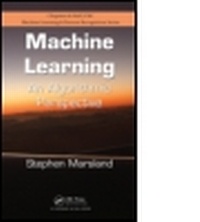
Machine Learning
An Algorithmic Perspective
1st Edition
Published on 8. April 2009
Book
Mixed media product
406 pages
978-1-4200-6718-7 (ISBN)
Description
Traditional books on machine learning can be divided into two groups - those aimed at advanced undergraduates or early postgraduates with reasonable mathematical knowledge and those that are primers on how to code algorithms. The field is ready for a text that not only demonstrates how to use the algorithms that make up machine learning methods, but also provides the background needed to understand how and why these algorithms work. Machine Learning: An Algorithmic Perspective is that text.
Theory Backed up by Practical Examples
The book covers neural networks, graphical models, reinforcement learning, evolutionary algorithms, dimensionality reduction methods, and the important area of optimization. It treads the fine line between adequate academic rigor and overwhelming students with equations and mathematical concepts. The author addresses the topics in a practical way while providing complete information and references where other expositions can be found. He includes examples based on widely available datasets and practical and theoretical problems to test understanding and application of the material. The book describes algorithms with code examples backed up by a website that provides working implementations in Python. The author uses data from a variety of applications to demonstrate the methods and includes practical problems for students to solve.
Highlights a Range of Disciplines and Applications
Drawing from computer science, statistics, mathematics, and engineering, the multidisciplinary nature of machine learning is underscored by its applicability to areas ranging from finance to biology and medicine to physics and chemistry. Written in an easily accessible style, this book bridges the gaps between disciplines, providing the ideal blend of theory and practical, applicable knowledge.
Theory Backed up by Practical Examples
The book covers neural networks, graphical models, reinforcement learning, evolutionary algorithms, dimensionality reduction methods, and the important area of optimization. It treads the fine line between adequate academic rigor and overwhelming students with equations and mathematical concepts. The author addresses the topics in a practical way while providing complete information and references where other expositions can be found. He includes examples based on widely available datasets and practical and theoretical problems to test understanding and application of the material. The book describes algorithms with code examples backed up by a website that provides working implementations in Python. The author uses data from a variety of applications to demonstrate the methods and includes practical problems for students to solve.
Highlights a Range of Disciplines and Applications
Drawing from computer science, statistics, mathematics, and engineering, the multidisciplinary nature of machine learning is underscored by its applicability to areas ranging from finance to biology and medicine to physics and chemistry. Written in an easily accessible style, this book bridges the gaps between disciplines, providing the ideal blend of theory and practical, applicable knowledge.
Reviews / Votes
... liberally illustrated with many programming examples, using Python. It includes a basic primer on Python and has an accompanying website.It has excellent breadth, and is comprehensive in terms of the topics it covers, both in terms of methods and in terms of concepts and theory. ...
I think the author has succeeded in his aim: the book provides an accessible introduction to machine learning. It would be excellent as a first exposure to the subject, and would put the various ideas in context ...
This book also includes the first occurrence I have seen in print of a reference to a zettabyte of data (1021 bytes) - a reference to "all the world's computers" being estimated to contain almost a zettabyte by 2010.
-David J. Hand, International Statistical Review (2010), 78
If you are interested in learning enough AI to understand the sort of new techniques being introduced into Web 2 applications, then this is a good place to start. ... it covers the subject matter of many an introductory course on AI and it has references to the source material and further reading but it is written in a fairly casual style. Overall it works and much of the mathematics is explained in ways that make it fairly clear what is going on ... . This is a suitable introduction to AI if you are studying the subject on your own and it would make a good course text for an introduction and overview of AI.
-I-Programmer, November 2009
More details
Language
English
Place of publication
United Kingdom
Publishing group
Taylor & Francis Ltd
Target group
College/higher education
Undergraduate and graduate students in machine learning and neural networks courses.
Product notice
Paper over boards
Illustrations
168 s/w Abbildungen
168 Illustrations, black and white
Dimensions
Height: 235 mm
Width: 156 mm
Weight
676 gr
ISBN-13
978-1-4200-6718-7 (9781420067187)
Copyright in bibliographic data and cover images is held by Nielsen Book Services Limited or by the publishers or by their respective licensors: all rights reserved.
Schweitzer Classification
Other editions
New editions
Book
10/2014
2nd Edition
CRC Press
€102.50
Article not available at the moment
Additional editions
E-Book
03/2011
Chapman & Hall/CRC
€65.49
Available for download
Person
Massey University, Palmerston North, New Zealand
Content
Introduction
If Data Had Mass, The Earth Would Be a Black Hole
Learning
Types of Machine Learning
Supervised Learning
The Brain and the Neuron
Linear Discriminants
Preliminaries
The Perceptron
Linear Separability
Linear Regression
The Multi-Layer Perceptron
Going Forwards
Going Backwards: Back-propagation of Error
The Multi-Layer Perceptron in Practice
Examples of Using the MLP
Overview
Back-propagation Properly
Radial Basis Functions and Splines
Concepts
The Radial Basis Function (RBF) Network
The Curse of Dimensionality
Interpolation and Basis Functions
Support Vector Machines
Optimal Separation
Kernels
Learning With Trees
Using Decision Trees
Constructing Decision Trees
Classification And Regression Trees (CART)
Classification Example
Decision by Committee: Ensemble Learning
Boosting
Bagging
Different Ways to Combine Classifiers
Probability and Learning
Turning Data into Probabilities
Some Basic Statistics
Gaussian Mixture Models
Nearest Neighbour Methods
Unsupervised Learning
The k-Means Algorithm
Vector Quantisation
The Self-Organising Feature Map
Dimensionality Reduction
Linear Discriminant Analysis (LDA)
Principal Components Analysis (PCA)
Factor Analysis
Independent Components Analysis (ICA)
Locally Linear Embedding
Isomap
Optimisation and Search
Going Downhill
Least-Squares Optimisation
Conjugate Gradients
Search: Three Basic Approaches
Exploitation and Exploration
Simulated Annealing
Evolutionary Learning
The Genetic Algorithm (GA)
Generating Offspring: Genetic Operators
Using Genetic Algorithms
Genetic Programming
Combining Sampling with Evolutionary Learning
Reinforcement Learning
Overview
Example: Getting Lost
Markov Decision Processes
Values
Back On Holiday: Using Reinforcement Learning
The Difference Between Sarsa and Q-Learning
Uses of Reinforcement Learning
Markov Chain Monte Carlo (MCMC) Methods
Sampling
Monte Carlo or Bust
The Proposal Distribution
Markov Chain Monte Carlo
Graphical Models
Bayesian Networks
Markov Random Fields
Hidden Markov Models (HMM)
Tracking Methods
Python
Installing Python and Other Packages
Getting Started
Code Basics
Using NumPy and Matplotlib
If Data Had Mass, The Earth Would Be a Black Hole
Learning
Types of Machine Learning
Supervised Learning
The Brain and the Neuron
Linear Discriminants
Preliminaries
The Perceptron
Linear Separability
Linear Regression
The Multi-Layer Perceptron
Going Forwards
Going Backwards: Back-propagation of Error
The Multi-Layer Perceptron in Practice
Examples of Using the MLP
Overview
Back-propagation Properly
Radial Basis Functions and Splines
Concepts
The Radial Basis Function (RBF) Network
The Curse of Dimensionality
Interpolation and Basis Functions
Support Vector Machines
Optimal Separation
Kernels
Learning With Trees
Using Decision Trees
Constructing Decision Trees
Classification And Regression Trees (CART)
Classification Example
Decision by Committee: Ensemble Learning
Boosting
Bagging
Different Ways to Combine Classifiers
Probability and Learning
Turning Data into Probabilities
Some Basic Statistics
Gaussian Mixture Models
Nearest Neighbour Methods
Unsupervised Learning
The k-Means Algorithm
Vector Quantisation
The Self-Organising Feature Map
Dimensionality Reduction
Linear Discriminant Analysis (LDA)
Principal Components Analysis (PCA)
Factor Analysis
Independent Components Analysis (ICA)
Locally Linear Embedding
Isomap
Optimisation and Search
Going Downhill
Least-Squares Optimisation
Conjugate Gradients
Search: Three Basic Approaches
Exploitation and Exploration
Simulated Annealing
Evolutionary Learning
The Genetic Algorithm (GA)
Generating Offspring: Genetic Operators
Using Genetic Algorithms
Genetic Programming
Combining Sampling with Evolutionary Learning
Reinforcement Learning
Overview
Example: Getting Lost
Markov Decision Processes
Values
Back On Holiday: Using Reinforcement Learning
The Difference Between Sarsa and Q-Learning
Uses of Reinforcement Learning
Markov Chain Monte Carlo (MCMC) Methods
Sampling
Monte Carlo or Bust
The Proposal Distribution
Markov Chain Monte Carlo
Graphical Models
Bayesian Networks
Markov Random Fields
Hidden Markov Models (HMM)
Tracking Methods
Python
Installing Python and Other Packages
Getting Started
Code Basics
Using NumPy and Matplotlib