

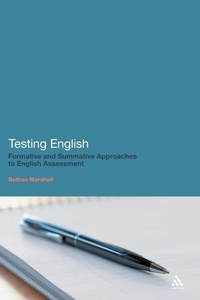
Testing English
Formative and Summative Approaches to English Assessment
Published on 17. March 2011
Book
Hardback
168 pages
978-1-4411-8293-7 (ISBN)
Description
This title considers why summative assessment in English is difficult and explores viewing it as an arts subject rather than one which is quantifiable and assessable objectively. "Testing English" considers why English is such a difficult subject to assess summatively and takes the view that English is an arts subject rather than one which is quantifiable and assessable objectively. Bethan Marshall examines the nature of the subject, the battlegrounds of examinations over the last 100 years and considers some of the solutions that have been put in place to overcome the problem both in the UK and abroad. "Testing English" looks at the way English lends itself to formative assessment in that it actively encourages dialogue with the pupils in the absence of 'right answers'. It explores the complex relationship between formative and summative assessment and considers the relationship in the light of the introduction of Assessing Pupil's Progress (APP). It is an essential reading for postgraduate students and researchers looking at the complexities involved in assessing English.
Reviews / Votes
'If English teachers read only one educational text this year, this should be it. Bethan Marshall not only gives a fascinating analysis of the almost incomprehensible world of policy development in English but provides a powerful evidence base to inform future policy and practice. This is a book entirely in the 'spirit of AfL', relective, analytical and immensely practical.' Louise Hayward, Professor of Educational Studies, University of Glasgow, UK 'Testing thinking, testing practice and always challenging...Bethan Marshall constantly provokes her readers to question inert ideas, while offering hope to teachers that they can reclaim the intellectual and moral high ground.' John MacBeath, Professor Emeritus, Faculty of Education, University of Cambridge, UK 'Marshall is extremely well qualified to take this subject on - she is arguably the UK's foremost expert in English and Assessment... It' a well-written and compelling book that draws on a great range of academic literature and a career rich in assessment research...this text is a must-read.' -- NATE - English Drama Media Marshall's text provides an excellent resource for teachers at all stages of their career... [her] style is engaging and her English teacher habit of proffering close textual analysis of educational terminology will resonate with many readers. -- The Use of English, Volume 63, Number 1 The prospects this author paints for future developments in assessing English, lie not so much in the details of individual projects but in the swift watercolour brushstrokes of deeply held beliefs of those involved. In 140 pages of text its depth and range is an inspiration to all who want to integrate English assessment into their practice in deeply purposeful ways. An inspirational read for us all. -- Philip Norman, University of Plymouth, UK * British Educational Research Journal *More details
Language
English
Place of publication
New York
United States
Target group
Professional and scholarly
Dimensions
Height: 260 mm
Width: 183 mm
Thickness: 14 mm
Weight
523 gr
ISBN-13
978-1-4411-8293-7 (9781441182937)
Copyright in bibliographic data and cover images is held by Nielsen Book Services Limited or by the publishers or by their respective licensors: all rights reserved.
Schweitzer Classification
Other editions
Additional editions
E-Book
01/2011
1st Edition
Continuum Publishing Corporation
€200.99
Available for download
Person
Bethan Marshall is Senior Lecturer at King's College London, UK, where she is Director of MA English and Education and MA Creative Arts in the Classroom.
Content
Introduction; 1. The Arts Based Nature of English; 2. English and Examination Boards in the England, Scotland and Wales; 3. International Experiences of Assessment; 4. Formative Assessment in the Classroom; 6. Assessment for Learning; 7. Conclusions; References; Index.