

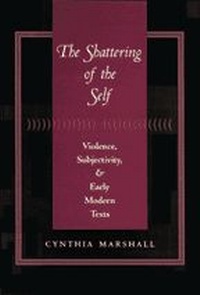
The Shattering of the Self
Violence, Subjectivity, and Early Modern Texts
Published on 20. August 2002
Book
Hardback
232 pages
978-0-8018-6778-1 (ISBN)
Description
In The Shattering of the Self: Violence, Subjectivity, and Early Modern Texts, Cynthia Marshall reconceptualizes the place and function of violence in Renaissance literature. During the Renaissance an emerging concept of the autonomous self within art, politics, religion, commerce, and other areas existed in tandem with an established, popular sense of the self as fluid, unstable, and volatile. Marshall examines an early modern fascination with erotically charged violence to show how texts of various kinds allowed temporary release from an individualism that was constraining. Scenes such as Gloucester's blinding and Cordelia's death in King Lear or the dismemberment and sexual violence depicted in Titus Andronicus allowed audience members not only a release but a "shattering"-as opposed to an affirmation-of the self. Marshall draws upon close readings of Shakespearean plays, Petrarchan sonnets, John Foxe's Acts and Monuments of the Christian Martyrs, and John Ford's The Broken Heart to successfully address questions of subjectivity, psychoanalytic theory, and identity via a cultural response to art.
Timely in its offering of an account that is both historically and psychoanalytically informed, The Shattering of the Self argues for a renewed attention to the place of fantasy in this literature and will be of interest to scholars working in Renaissance and early modern studies, literary theory, gender studies, and film theory.
Timely in its offering of an account that is both historically and psychoanalytically informed, The Shattering of the Self argues for a renewed attention to the place of fantasy in this literature and will be of interest to scholars working in Renaissance and early modern studies, literary theory, gender studies, and film theory.
Reviews / Votes
Marshall effectively brings to our attention the variety of ways in which late-sixteenth- and early-seventeenth-century texts successfully exploited means to debunk the emergent concept of selfhood... An original and stimulating contribution to the field of Renaissance studies, offering insights that go far beyond the boundaries of a specific discipline. -- Antonella Dalla Torre Renaissance Quarterly 2004 In this interesting study of violence in early modern English drama, Marshall sets out to demonstrate how these texts offer their audiences an experience of psychic fracture that results from conflicting yet coexistent perceptions of subjectivity. Choice 2003 Marshall leaves her own readers with a rich sense of what it may have meant, and may still mean, to lose oneself in the violent pleasures of Renaissance textuality. -- Patricia A. Cahill Modern Philology 2005 Elegant book... the book's reach goes beyond studies of the early modern period. -- Tzachi Zamir Partial Answers 2007More details
Language
English
Place of publication
Baltimore, MD
United States
Target group
Professional and scholarly
Illustrations
5 s/w Zeichnungen, 5 s/w Abbildungen
5 Illustrations, black and white; 5 Line drawings, black and white
Dimensions
Height: 229 mm
Width: 152 mm
Thickness: 22 mm
Weight
499 gr
ISBN-13
978-0-8018-6778-1 (9780801867781)
DOI
10.1353/book.20632
Copyright in bibliographic data and cover images is held by Nielsen Book Services Limited or by the publishers or by their respective licensors: all rights reserved.
Schweitzer Classification
Other editions
Additional editions
E-Book
07/2003
Johns Hopkins University Press
€37.99
Available for download
Person
Cynthia Marshall is a professor of English at Rhodes College in Memphis, Tennessee.
Content
Contents: List of Illustrations Acknowledgments Introduction 1 Violence, Subjectivity, and Paradoxes of Pleasure 2 "To Speak of Love" in the Language of Petrarchanism 3 Foxe and the Touissance of Martyrology 4 The Pornographic Economy of Titus Andronicus 5 Form, Characters, Viewers, and Ford's The Broken Heart Conclusion Notes Bibliography Index