

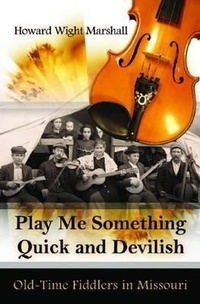
Play Me Something Quick and Devilish
Old-Time Fiddlers in Missouri
Published on 14. January 2013
Book
Hardback
386 pages
978-0-8262-1994-7 (ISBN)
Description
'Play Me Something Quick and Devilish' explores the heritage of traditional fiddle music in Missouri. Howard Wight Marshall considers the place of homemade music in people's lives across social and ethnic communities from the late 1700s to the World War I years and into the early 1920s. This exceptionally important and complex period provided the foundations in history and settlement for the evolution of today's old-time fiddling.
Beginning with the French villages on the Mississippi River, Marshall leads us chronologically through the settlement of the state and how these communities established our cultural heritage. Other core populations include the 'Old Stock Americans' (primarily Scotch-Irish from Kentucky, Tennessee, North Carolina, and Virginia), African Americans, German-speaking immigrants, people with American Indian ancestry (focusing on Cherokee families dating from the Trail of Tears in the 1830s), and Irish railroad workers in the post-Civil War period. These are the primary communities whose fiddle and dance traditions came together on the Missouri frontier to cultivate the bounty of old-time fiddling enjoyed today.
Marshall also investigates themes in the continuing evolution of fiddle traditions. These themes include the use of the violin in Westward migration, in the Civil War years, and in the railroad boom that changed history. Of course, musical tastes shift over time, and the rise of music literacy in the late Victorian period, as evidenced by the brass band movement and immigrant music teachers in small towns, affected fiddling. The contributions of music publishing as well as the surprising importance of ragtime and early jazz also had profound effects. Much of the old-time fiddlers' repertory arises not from the inherited reels, jigs, and hornpipes from the British Isles, nor from the waltzes, schottisches, and polkas from the Continent, but from the prolific pens of Tin Pan Alley.
Marshall also examines regional styles in Missouri fiddling and comments on the future of this time-honored, and changing, tradition. Documentary in nature, this social history draws on various academic disciplines and oral histories recorded in Marshall's forty-some years of research and field experience. Historians, music aficionados, and lay people interested in Missouri folk heritage - as well as fiddlers, of course - will find 'Play Me Something Quick and Devilish' an entertaining and enlightening read.
With 39 tunes, the enclosed Voyager Records companion CD includes a historic sampler of Missouri fiddlers and styles from 1955 to 2012.
Beginning with the French villages on the Mississippi River, Marshall leads us chronologically through the settlement of the state and how these communities established our cultural heritage. Other core populations include the 'Old Stock Americans' (primarily Scotch-Irish from Kentucky, Tennessee, North Carolina, and Virginia), African Americans, German-speaking immigrants, people with American Indian ancestry (focusing on Cherokee families dating from the Trail of Tears in the 1830s), and Irish railroad workers in the post-Civil War period. These are the primary communities whose fiddle and dance traditions came together on the Missouri frontier to cultivate the bounty of old-time fiddling enjoyed today.
Marshall also investigates themes in the continuing evolution of fiddle traditions. These themes include the use of the violin in Westward migration, in the Civil War years, and in the railroad boom that changed history. Of course, musical tastes shift over time, and the rise of music literacy in the late Victorian period, as evidenced by the brass band movement and immigrant music teachers in small towns, affected fiddling. The contributions of music publishing as well as the surprising importance of ragtime and early jazz also had profound effects. Much of the old-time fiddlers' repertory arises not from the inherited reels, jigs, and hornpipes from the British Isles, nor from the waltzes, schottisches, and polkas from the Continent, but from the prolific pens of Tin Pan Alley.
Marshall also examines regional styles in Missouri fiddling and comments on the future of this time-honored, and changing, tradition. Documentary in nature, this social history draws on various academic disciplines and oral histories recorded in Marshall's forty-some years of research and field experience. Historians, music aficionados, and lay people interested in Missouri folk heritage - as well as fiddlers, of course - will find 'Play Me Something Quick and Devilish' an entertaining and enlightening read.
With 39 tunes, the enclosed Voyager Records companion CD includes a historic sampler of Missouri fiddlers and styles from 1955 to 2012.
Reviews / Votes
"This is a fascinating addition to the literature of traditional music, and anyone with an interest in the origins of tunes and their regional variants will get a lot out of it." - Old Time NewsMore details
Language
English
Place of publication
Missouri
United States
Dimensions
Height: 241 mm
Width: 166 mm
Thickness: 43 mm
Weight
842 gr
ISBN-13
978-0-8262-1994-7 (9780826219947)
Copyright in bibliographic data and cover images is held by Nielsen Book Services Limited or by the publishers or by their respective licensors: all rights reserved.
Schweitzer Classification
Person
Howard Wight Marshall is Professor Emeritus in the Department of Art History and Archaeology at the University of Missouri, Columbia and former director of the Missouri Cultural Heritage Center. He is the author or editor of ten books, including Barns of Missouri: Storehouses of History. He lives near Fulton, Missouri.