

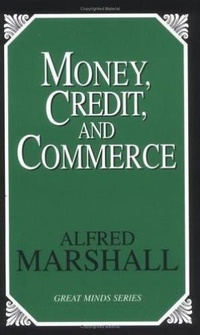
Money, Credit, and Commerce
Published on 1. January 2003
Book
Paperback/Softback
506 pages
978-1-59102-036-3 (ISBN)
Description
Alfred Marshall (1842-1924), distinguished British economist and one of the founders of the neoclassical school of economics, established his reputation with the magisterial Principles of Economics (1890). That magnum opus quickly became a standard reference work, went through eight editions in Marshall's lifetime, and to this day is considered one of the classic economic treatises. Among his areas of expertise was monetary analysis, but he did not have the opportunity to publish a systematic presentation of his views until his later years. Money, Credit, and Commerce, devoted to this subject, was his last major work.
Among the proposals made in this work for which he is most remembered is the adoption of "symmetalism," a plan for the combined use of gold and silver as the monetary base. Marshall also expressed his views on the relation of business fluctuations and the credit market to general unemployment. He saw reckless inflation of credit as the main cause of economic troubles.
As the foremost British economist of his time, he influenced a later generation of economists. One of his most gifted students was John Maynard Keynes, who disagreed with some of Marshall's ideas, yet continued to refer to Marshall's contributions as essential groundwork. For students of economics and monetary policy Money, Credit, and Commerce remains a valuable book.
Among the proposals made in this work for which he is most remembered is the adoption of "symmetalism," a plan for the combined use of gold and silver as the monetary base. Marshall also expressed his views on the relation of business fluctuations and the credit market to general unemployment. He saw reckless inflation of credit as the main cause of economic troubles.
As the foremost British economist of his time, he influenced a later generation of economists. One of his most gifted students was John Maynard Keynes, who disagreed with some of Marshall's ideas, yet continued to refer to Marshall's contributions as essential groundwork. For students of economics and monetary policy Money, Credit, and Commerce remains a valuable book.
More details
Series
Language
English
Place of publication
Amherst
United States
Product notice
Paperback (trade)
Dimensions
Height: 213 mm
Width: 135 mm
Thickness: 27 mm
Weight
599 gr
ISBN-13
978-1-59102-036-3 (9781591020363)
Copyright in bibliographic data and cover images is held by Nielsen Book Services Limited or by the publishers or by their respective licensors: all rights reserved.
Schweitzer Classification
Person
By Alfred Marshall