

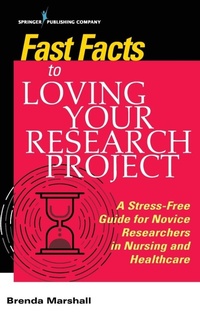
Fast Facts to Loving Your Research Project
A Stress-free Guide for Novice Researchers in Nursing and Healthcare
Will be published approx. on 10. October 2019
Book
Paperback/Softback
258 pages
978-0-8261-4636-6 (ISBN)
Description
While often greeted with trepidation, the importance of a research project-how it is conducted and its significance to practice-is an essential aspect of nursing and other healthcare arenas. This innovative resource is a user-friendly introduction to evidence-based practice and other types of research-based initiatives that improve patient outcomes. Using a method formed through years of teaching experience, Brenda Marshall translates the difficult and sometimes confusing language of research into everyday vocabulary, linking complicated concepts with easily understood scenarios.
Written in quick-access Fast Facts style, this book presents knowledge in a consistent, step-by-step format characterized by bite-sized information. Each chapter opens with learning objectives that unfold into new concepts, followed by everyday life examples. Fast Facts boxes, systematized tables, and new vocabulary reinforce learning and highlight key concepts. This application-based approach helps students question their preconceived notions about research and then engage in it with newfound confidence.
Key Features:Translates complex research concepts into straightforward language
Demonstrates clear, step-by-step methods that facilitate successful attainment of research goals
Helps students to construct an argument, build a theory, and critically explore a belief
Promotes self-sufficiency in lifelong learning and achievement
Written by an instructor whose classes have propelled many successful research careers
Written in quick-access Fast Facts style, this book presents knowledge in a consistent, step-by-step format characterized by bite-sized information. Each chapter opens with learning objectives that unfold into new concepts, followed by everyday life examples. Fast Facts boxes, systematized tables, and new vocabulary reinforce learning and highlight key concepts. This application-based approach helps students question their preconceived notions about research and then engage in it with newfound confidence.
Key Features:Translates complex research concepts into straightforward language
Demonstrates clear, step-by-step methods that facilitate successful attainment of research goals
Helps students to construct an argument, build a theory, and critically explore a belief
Promotes self-sufficiency in lifelong learning and achievement
Written by an instructor whose classes have propelled many successful research careers
More details
Series
Language
English
Place of publication
New York
United States
Target group
Professional and scholarly
Dimensions
Height: 203 mm
Width: 127 mm
Thickness: 14 mm
Weight
283 gr
ISBN-13
978-0-8261-4636-6 (9780826146366)
Copyright in bibliographic data and cover images is held by Nielsen Book Services Limited or by the publishers or by their respective licensors: all rights reserved.
Schweitzer Classification
Person
Brenda Marshall, EdD, PMHNP-BC, APN, ANEF, FAANP, is a full professor in the School of Nursing at Montclair State University. She is a Fulbright Scholar Specialist in mental health with a hospital affi liation at Holy Name Medical Center in Teaneck, New Jersey, and a private practice (Learn 2 Choose Inc.) in Wayne, New Jersey. She has been recognized by multiple organizations for innovative teaching methods in research and was awarded the National Excellence in Research Award (2018) by the American Psychiatric Nurses Association.
Content
Contributors
Preface
Part I DEFINE, CLARIFY, SEARCH, PREPARE
1. Introduction to Research
2. Finding the BIG PROBLEM
3. From Hypothesis to Aim/Purpose
4. Why We Review the Literature
5. The Theoretical Framework
6. Research Design
Tom Heinzen
Part II STARTING THE ACTUAL PROJECT
7. Qualitative, Quantitative, and Mixed Methods Research Designs
8. Methods of Data Collection
9. Reliability and Validity
Katherine Roberts
10. From Population to Sample
11. Impact of the Outside World: Legal and Ethical Considerations in Research
Part III TEST, ANALYZE, DISCUSS
12. Conducting the Research
13. Data Analysis
Katherine Roberts
14. Results: What Did the Project Discover? Why Is It Important?
15. The Conclusion of the Thesis, Project, or Dissertation: Writing the Discussion, Conclusion, and Abstract
16. The Beginning: Sharing What Was Learned With the Greater Community
Index
Preface
Part I DEFINE, CLARIFY, SEARCH, PREPARE
1. Introduction to Research
2. Finding the BIG PROBLEM
3. From Hypothesis to Aim/Purpose
4. Why We Review the Literature
5. The Theoretical Framework
6. Research Design
Tom Heinzen
Part II STARTING THE ACTUAL PROJECT
7. Qualitative, Quantitative, and Mixed Methods Research Designs
8. Methods of Data Collection
9. Reliability and Validity
Katherine Roberts
10. From Population to Sample
11. Impact of the Outside World: Legal and Ethical Considerations in Research
Part III TEST, ANALYZE, DISCUSS
12. Conducting the Research
13. Data Analysis
Katherine Roberts
14. Results: What Did the Project Discover? Why Is It Important?
15. The Conclusion of the Thesis, Project, or Dissertation: Writing the Discussion, Conclusion, and Abstract
16. The Beginning: Sharing What Was Learned With the Greater Community
Index